A Serene Vision of Faith: Piero della Francesca’s “Nativity”
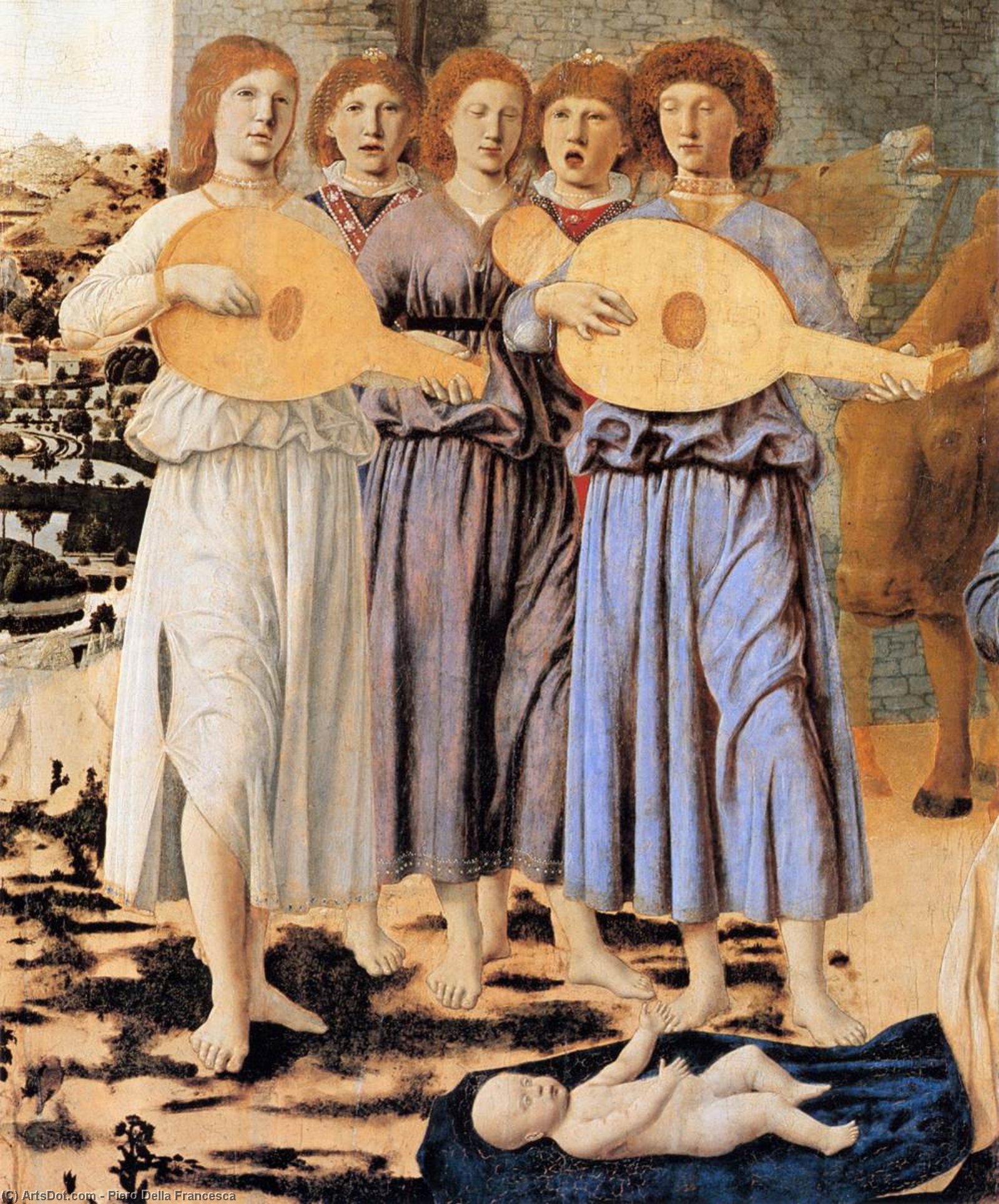
Piero della Francesca's "Nativity" (detail), painted in 1470, is more than just a depiction of the biblical birth of Christ; it’s a profound meditation on humanism, geometry, and the quiet dignity of faith. Housed within the National Gallery in London, this oil-on-panel masterpiece transcends its subject matter to become a testament to the artist's revolutionary approach to Renaissance art. The painting immediately draws the viewer into a remarkably tranquil scene – a deliberate departure from the often dramatic and emotionally charged depictions prevalent at the time. Instead of bustling activity or overt displays of piety, Piero presents a carefully constructed tableau of serene contemplation, inviting us to pause and consider the profound significance of this pivotal moment in Christian history. The composition itself is a marvel of geometric precision; the figures are arranged according to strict mathematical ratios, creating a sense of stability and order that mirrors the artist’s deep interest in mathematics and perspective – hallmarks of his distinctive style.
The Composition: Harmony and Humanism
At the heart of the scene lies Mary, cradling the infant Jesus with an expression of profound tenderness and quiet devotion. Her posture is remarkably simple, yet imbued with a subtle grace that speaks volumes about her role as the mother of God. Surrounding her are four women, not depicted in traditional roles of serving or assisting, but rather engaged in musical performance – two playing guitars and two with lutes. This inclusion subtly shifts the focus from solely religious narrative to a celebration of human creativity and harmony. The presence of these musicians adds an unexpected layer of warmth and earthly beauty to the sacred scene, suggesting that faith and life are not mutually exclusive but can coexist in perfect balance. Adding further depth is the carefully placed horse on the right and the cow further back on the left – elements that ground the scene in a recognizable, albeit idealized, landscape, anchoring the divine narrative within a tangible reality. The use of perspective, particularly evident in the receding lines of the buildings in the background, creates an illusion of vast space and draws the viewer’s eye into the heart of the composition.
Piero della Francesca: A Renaissance Innovator
Piero della Francesca stands as a singular figure within the Early Renaissance, renowned for his pioneering use of perspective and geometric forms. Born in San Sepolcro around 1415, he initially received training locally before moving to Florence, where he was profoundly influenced by artists like Domenico Veneziano and Masaccio – figures who were already experimenting with new approaches to representation. His time in Florence exposed him to the burgeoning interest in classical antiquity and the development of mathematical perspective, concepts that would become central to his artistic practice. Returning to his native region, Piero established himself as a leading artist, developing a distinctive style characterized by its clarity, stillness, and intellectual rigor. Unlike many of his contemporaries who embraced emotional intensity and dramatic gestures, Piero favored a more restrained and contemplative approach, seeking to capture the essence of his subjects through precise observation and geometric construction. His work reflects a deep understanding of human anatomy, light, and shadow, combined with an unwavering commitment to mathematical accuracy.
Symbolism and Emotional Resonance
Beyond its technical brilliance, “Nativity” is rich in symbolic meaning. The muted color palette – dominated by earthy tones and subtle blues – contributes to the painting’s overall sense of serenity and timelessness. The figures themselves are depicted with an almost sculptural quality, their faces remarkably calm and devoid of overt emotion. This deliberate restraint invites viewers to contemplate the scene on a deeper level, prompting reflection on themes of faith, humility, and the miracle of birth. The positioning of Mary and Jesus – bathed in soft light – evokes a sense of divine grace and protection. The inclusion of musical instruments suggests that joy and celebration are integral components of the Christian narrative. Ultimately, “Nativity” is not merely a representation of a biblical event; it’s an invitation to experience a moment of profound peace and spiritual contemplation—a testament to Piero della Francesca's ability to elevate the ordinary into the extraordinary.
For art enthusiasts interested in owning a reproduction of this captivating masterpiece, ArtsDot.com offers meticulously crafted oil painting reproductions that faithfully capture the beauty and serenity of Piero della Francesca’s “Nativity.”
Explore other related works by Piero della Francesca and explore the broader context of Italian Renaissance painting at Italian Renaissance Painting and Themes in Italian Renaissance Painting.