The Polyptych of St. Anthony: A Renaissance Masterpiece of Light and Faith
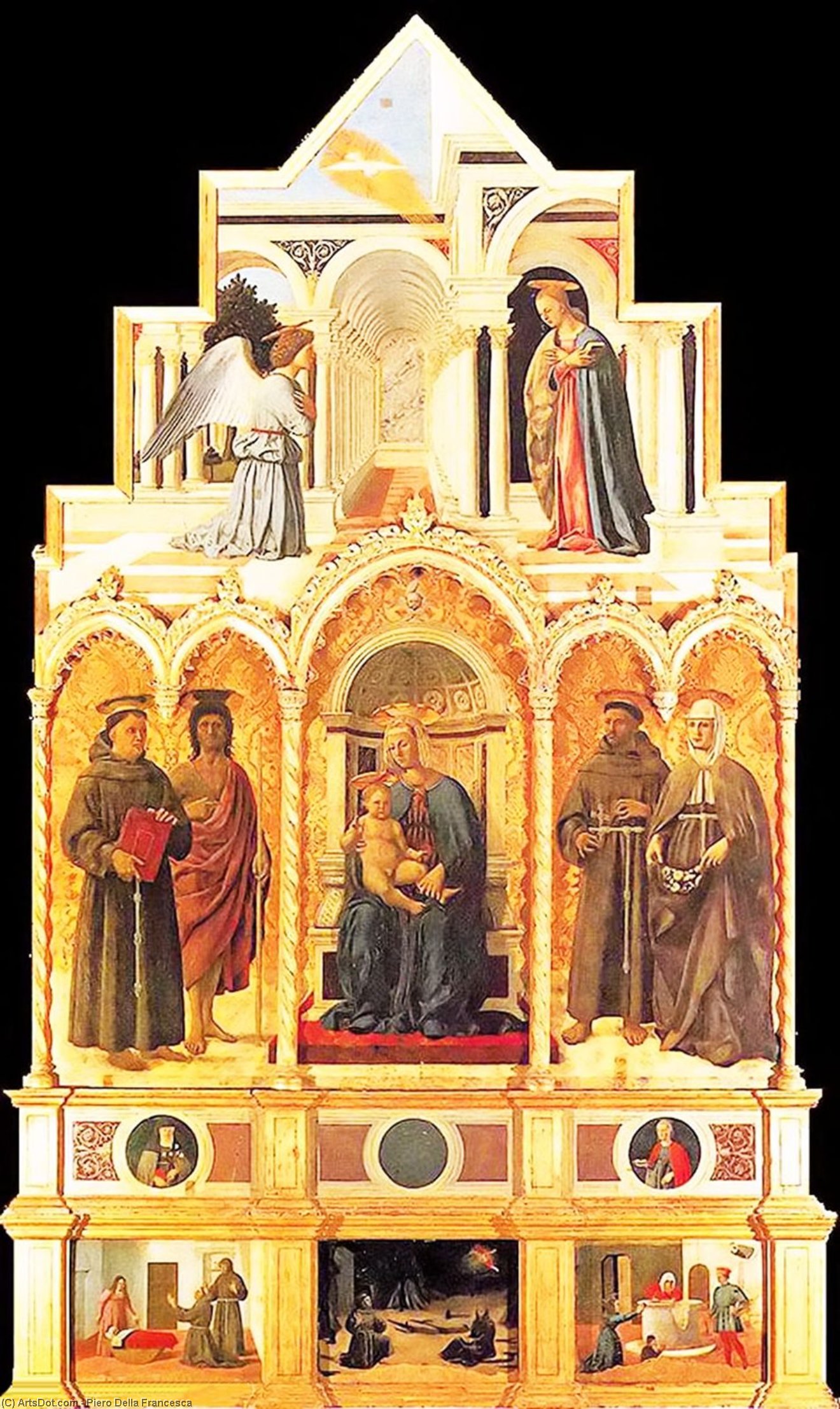
Piero della Francesca’s Polyptych of St. Anthony, completed around 1470 for the Franciscan convent in Perugia, is more than just a religious painting; it's a profound meditation on perspective, faith, and the human condition. This complex altarpiece, now housed within the Galleria Nazionale dell’Umbria, offers a captivating journey through Renaissance artistry, inviting viewers to contemplate its intricate symbolism and masterful execution.
The polyptych itself is a testament to the era's evolving artistic sensibilities. It’s not merely a single image but a series of interconnected panels arranged in a tiered structure – a deliberate choice that mimics the grandeur of a Renaissance church. The central panel depicts the Virgin Mary enthroned with the Christ Child, flanked by the venerated saints Anthony of Padua and John the Baptist on the left, and Francis and Elizabeth of Hungary on the right. Above this core scene unfolds an exquisite Annunciation, rendered with breathtaking precision using linear perspective – a technique pioneered by Piero himself and exemplified in his treatise *De prospectiva pingendi*. The vanishing point, strategically placed within the colonnade, creates an illusion of depth that draws the eye into the composition, mirroring the spiritual journey towards divine grace.
A Symphony of Color and Technique
Piero della Francesca’s genius lies not only in his mastery of perspective but also in his innovative use of color and technique. He moved away from the traditional tempera-on-panel approach prevalent at the time, embracing oil paints – a relatively new medium that allowed for greater luminosity, richer hues, and subtle gradations of tone. This shift is particularly evident in the Annunciation, where the light seems to emanate from within the painted space, creating an ethereal atmosphere. The palette itself is restrained yet powerful: deep browns, reds, creams, and golds dominate, evoking a sense of solemnity and reverence. The figures are rendered with remarkable anatomical accuracy and psychological depth – they aren’t idealized representations but rather believable human beings experiencing profound emotion.
The predella panels below the central scene offer further insights into the lives of the Franciscan saints. These smaller, more intimate scenes depict miraculous events attributed to Anthony, Francis, and Elizabeth, illustrating their dedication to charity and faith. The panel depicting Anthony raising a child from the dead is particularly striking, conveying both compassion and divine intervention. The meticulous detail in each brushstroke speaks volumes about Piero’s commitment to his craft – every fold of drapery, every expression on a face, is rendered with painstaking care.
Symbolism and Historical Context
Beyond its aesthetic beauty, the Polyptych of St. Anthony is rich in symbolism. The choice of saints reflects the Franciscan order’s core values – devotion to Mary, service to the poor, and a commitment to preaching the Gospel. The inclusion of elements like the Holy Sepulchre, subtly referenced within the composition, underscores the importance of pilgrimage and spiritual journeys. Furthermore, the painting's creation coincided with a period of significant intellectual ferment in Italy, marked by renewed interest in classical antiquity and advancements in mathematics and geometry – fields that profoundly influenced Piero’s artistic vision.
Interestingly, the polyptych’s history is intertwined with Perugia’s political landscape. Commissioned for the Franciscan convent, it was later moved to the town hall during a period of instability, highlighting the painting's role as both a religious icon and a symbol of civic pride. The story of Anthony Clarke, the British artillery officer who saved the fresco from destruction during World War II, adds another layer of intrigue to this remarkable artwork – a testament to the enduring power of art and its ability to transcend time and conflict.
A Timeless Legacy
The Polyptych of St. Anthony remains one of Piero della Francesca’s most celebrated works, admired for its technical brilliance, profound symbolism, and emotional resonance. It stands as a powerful example of Early Renaissance artistry – a testament to the enduring legacy of a master painter who dared to challenge convention and explore the boundaries of artistic expression. Reproductions of this masterpiece offer an opportunity to bring its beauty and depth into any setting, serving as a constant reminder of the power of faith, art, and human ingenuity.