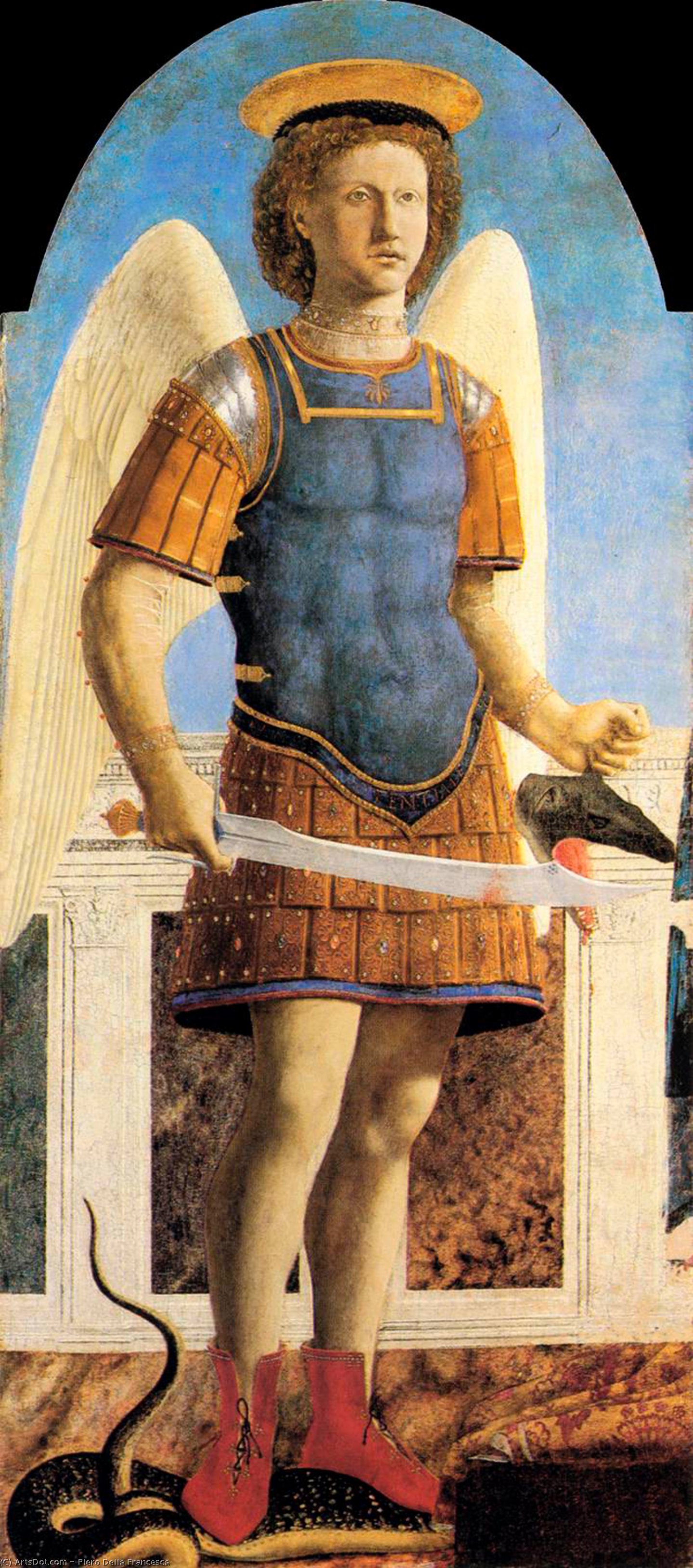
Polyptych of St Augustine: St Michael
The
Polyptych of St Augustine: St Michael stands as a testament to Piero Della Francesca’s mastery—a monumental achievement that transcends mere visual representation and delves into profound theological contemplation. Completed in 1470, this painting resides within the National Gallery in London, offering visitors an unparalleled glimpse into the artistic fervor of the Early Renaissance. Measuring 133 x 60 cm, it is executed in tempera on panel—a technique known for its luminosity and durability—resulting in a remarkably preserved image that continues to inspire awe centuries later.
Artistic Significance: Geometric Precision and Spiritual Depth
Piero Della Francesca’s approach to art was fundamentally shaped by the burgeoning humanist ideals of his time, yet he steadfastly adhered to the principles of geometric perspective and mathematical proportion—a hallmark of Florentine artistic innovation. Unlike many contemporaries who prioritized emotional expression, Piero sought to convey spiritual truth through meticulous observation and rational calculation. The
Polyptych of St Augustine: St Michael exemplifies this dedication to intellectual rigor—a deliberate rejection of Gothic stylistic conventions that favored decorative grandeur over anatomical accuracy. The composition itself is strikingly balanced, mirroring the serene stability associated with Christian faith.
Historical Context: Renaissance Florence and Religious Patronage
Piero Della Francesca’s artistic trajectory unfolded against the backdrop of Florence during its golden age—a period characterized by unprecedented intellectual curiosity and artistic dynamism. Influenced by Masaccio and Domenico Veneziano, he absorbed the Florentine preoccupation with classical ideals and embraced the revolutionary concept of linear perspective—transforming painting forever. The commission for this polyptych underscores the importance of religious patronage in shaping artistic production during the Renaissance. Sant’Agostino Monastery, located in Sansepolcro, Tuscany, entrusted Piero with creating a devotional masterpiece intended to glorify St Michael—a figure revered throughout Christendom as protector against evil and herald of divine justice.
Symbolism: The Serpent and the Pillar – Representations of Temptation and Divine Protection
The
Polyptych of St Augustine: St Michael is replete with symbolic imagery—a deliberate strategy employed by Piero to communicate complex theological concepts. The serpent coiled around a pillar represents the temptation offered to Adam and Eve in Genesis—a visual depiction of evil’s insidious influence over human consciousness. Conversely, St Michael stands triumphant above the pillar, wielding his sword and wings—symbols of divine power and righteousness—affirming humanity's ultimate victory over darkness. These carefully crafted motifs underscore the painting’s overarching theme: the triumph of faith over adversity.
Current Location & Relevance to ArtsDot.com
Currently housed in the National Gallery, London, this
Polyptych of St Augustine: St Michael continues to captivate audiences worldwide—a testament to Piero Della Francesca’s enduring artistic legacy. ArtsDot.com offers meticulously crafted oil painting reproductions that allow enthusiasts to experience the grandeur and spiritual depth of this masterpiece firsthand. For those seeking to adorn their homes with art inspired by Renaissance ideals, ArtsDot.com presents an exceptional opportunity to acquire a stunning replica—preserving the beauty and intellectual rigor of Piero Della Francesca’s vision for generations to come.
For more information on Piero Della Francesca and his works, visit ArtsDot.com.