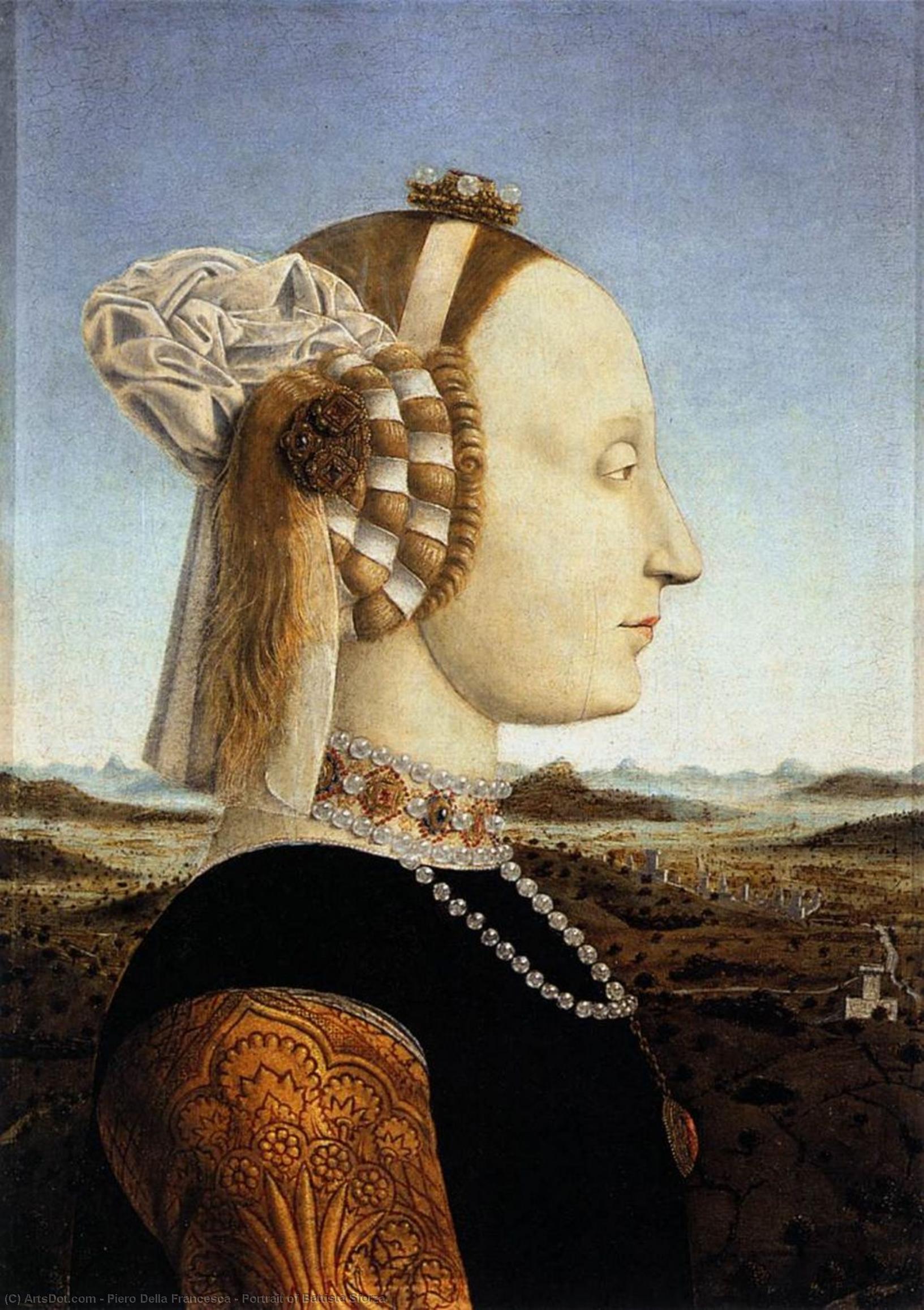
Portrait of Battista Sforza: A Renaissance Jewel
Piero della Francesca’s “Portrait of Battista Sforza,” painted in 1465 and currently residing within the hallowed halls of the Galleria degli Uffizi in Florence, is more than just a depiction of a noblewoman; it's a meticulously crafted window into the heart of Renaissance Italy. This captivating work transcends mere portraiture, offering a profound meditation on beauty, power, and the burgeoning humanist ideals that defined the era. Measuring a modest 47 x 33 cm, the painting’s scale belies its monumental impact – a testament to Piero's mastery of composition and his ability to imbue a single image with layers of meaning.
At first glance, Battista Sforza appears serene and poised, her gaze direct and unwavering. She is adorned in a sumptuous black dress, accented by a magnificent headpiece—a symbol of her status as the wife of Federico da Montefeltro, Duke of Urbino. A long necklace further emphasizes her wealth and position. However, it’s within the details that Piero's genius truly shines through. The subtle play of light across her skin, the delicate rendering of her jewelry, and the precise geometry of her features all speak to his unwavering commitment to realism and anatomical accuracy – a departure from the more stylized portraits of previous generations.
The Maestro: Piero della Francesca - Geometry and Humanism
Piero della Francesca was an extraordinary figure, a man whose talents extended far beyond the realm of painting. He was also a keen mathematician and geometer, disciplines that profoundly influenced his artistic practice. This intellectual rigor is immediately apparent in “Portrait of Battista Sforza.” Piero’s use of perspective—particularly the subtle recession into the background—is revolutionary for its time. It creates an illusion of depth and space, drawing the viewer into the painting's world and lending it a remarkable sense of realism. His style is characterized by serene humanism, geometric forms, and the meticulous application of mathematical principles to achieve visual harmony.
Considered one of the most important figures in the early Renaissance, Piero’s work often draws inspiration from classical antiquity, particularly the works of ancient Greece and Rome. He sought to emulate their ideals of beauty, proportion, and order, but he adapted them to his own unique vision. His paintings are not merely representations of reality; they are carefully constructed illusions designed to evoke a sense of wonder and contemplation.
A Window into Renaissance Culture
“Portrait of Battista Sforza” is deeply embedded within the cultural context of 15th-century Italy. The Renaissance was a period of unprecedented intellectual and artistic ferment, marked by a renewed interest in classical learning, humanism, and scientific inquiry. The portrait reflects this spirit of innovation and experimentation, showcasing Piero’s willingness to challenge traditional conventions and push the boundaries of artistic expression.
Furthermore, the painting offers insights into the social and political landscape of the time. Battista Sforza was a powerful figure in her own right, as the wife of one of Italy's most influential dukes. The portrait celebrates her beauty and status, but it also subtly acknowledges her role within the complex dynamics of Renaissance power structures. The backdrop, with its carefully rendered landscape, suggests her dominion over the territories of the Marches – a visual representation of her influence and authority.
Technique and Legacy
Piero della Francesca’s masterful use of tempera on canvas is crucial to understanding the painting's enduring appeal. Tempera, a slow-drying paint mixed with egg yolk, allowed him to achieve incredible detail and luminosity—particularly in the rendering of fabrics and skin tones. The subtle gradations of color create a sense of depth and volume that is both captivating and remarkably realistic.
“Portrait of Battista Sforza” remains one of Piero della Francesca’s most celebrated works, admired for its technical brilliance, its profound psychological insight, and its enduring beauty. Its presence in the Galleria degli Uffizi ensures that this remarkable painting will continue to inspire and captivate audiences for generations to come. ArtsDot offers meticulously crafted hand-painted reproductions of this masterpiece, allowing you to bring a piece of Renaissance history into your own home.