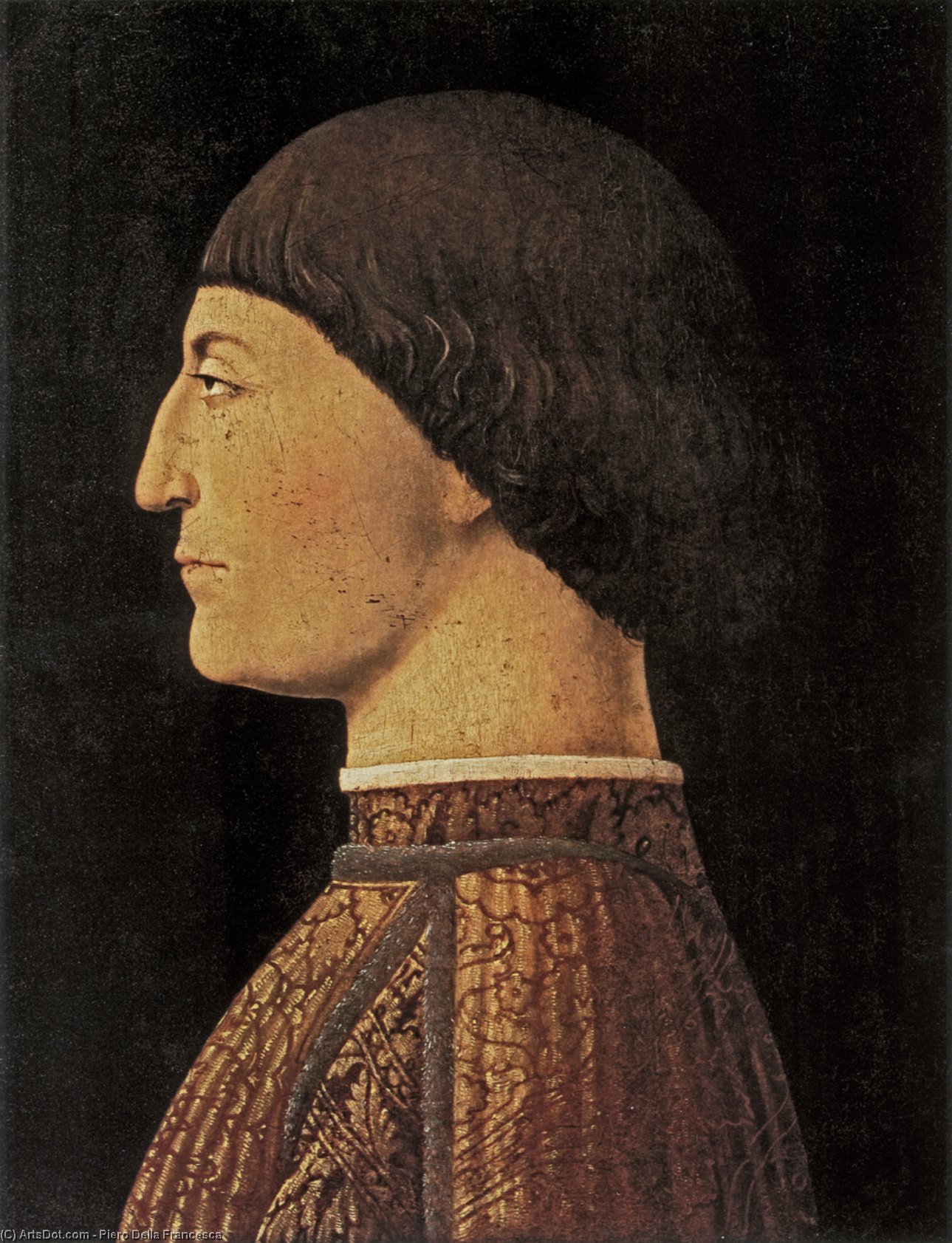
Sigismondo Malatesta: A Tuscan Renaissance Portrait of Dignity
Piero della Francesca’s “Portrait of Sigismondo Pandolfo Malatesta,” completed in 1451, stands as a cornerstone of Early Renaissance art—a testament to the movement's fascination with humanist ideals and its mastery of visual representation. Executed on panel oil paint, this artwork transcends mere likeness; it embodies a profound exploration of human psychology and spiritual contemplation.
- Subject Matter: The portrait depicts Sigismondo Malatesta, Lord of Rimini, a prominent condottiero (military leader) who commanded considerable influence during his time. He is portrayed in profile, conveying an aura of solemn repose and intellectual seriousness – characteristics deeply rooted in the humanist ethos prevalent throughout Italy.
- Style & Technique: Piero della Francesca’s approach distinguishes itself through meticulous attention to detail and a masterful application of perspective. The artist skillfully employs linear perspective to create depth and spatial realism, drawing the viewer into the scene with an understated elegance that anticipates the innovations of later Renaissance painters like Masaccio.
- Historical Context: Created during the Quattrocento—the “century of Florentines”—the painting reflects the broader cultural landscape of Italy in the mid-15th century. The revival of classical learning and artistic traditions fueled a renewed interest in human anatomy, proportion, and idealized beauty. Malatesta’s patronage exemplifies this humanist spirit.
- Composition: The balanced composition—with Sigismondo positioned centrally against a muted background—emphasizes his dignified presence. Piero's deliberate use of geometric forms contributes to the overall harmony and stability of the artwork, mirroring the Renaissance fascination with mathematical precision.
Beyond its technical brilliance, “Portrait of Sigismondo Malatesta” resonates with deeper symbolic meanings. The contemplative gaze of the subject speaks to the humanist preoccupation with inner life and moral virtue—a reflection of the era’s philosophical currents. It's a portrait not merely of a man but of an ideal – one embodying dignity, wisdom, and unwavering faith.
ArtsDot offers exceptional reproductions of Piero della Francesca’s masterpiece, allowing you to experience its beauty and intellectual depth firsthand. Explore the artwork’s history and artistic significance at https://www.wga.hu/tours/chapels/rimini/piero.html.
Piero Della Francesca: The Quintessence of Renaissance Humanism
Piero della Francesca (1415-1492), born in San Sepolcro, Tuscany, stands as one of the most influential figures in Early Renaissance painting. His unwavering commitment to geometric precision and perspective—evident throughout his oeuvre—established him as a pioneer of artistic innovation.
- Early Life & Training: Piero’s formative years were marked by exposure to Tuscan artistic traditions, nurtured under the guidance of masters like Sassetta and Maestro Benedetto. This grounding in local craftsmanship instilled within him a profound understanding of visual representation—a skill that would define his artistic legacy.
- Federico III da Montefeltro & Urbino: Piero’s association with Federico III da Montefeltro, Duke of Urbino, proved pivotal to his career. Montefeltro's court fostered an environment conducive to intellectual discourse and artistic experimentation—drawing artists like Uccello and Alberti into Urbino’s orbit.
- Notable Works: Piero della Francesca produced a remarkable body of work encompassing frescoes, altarpieces, and portraits—each demonstrating his unparalleled mastery of technique and compositional vision. Among his most celebrated achievements are “The Baptism of Christ,” “St Sigismund and Sigismondo Pandolfo Malatesta” and “Madonna del Parto.”
His unwavering dedication to mathematical principles—particularly the golden ratio—influenced his artistic choices, resulting in compositions characterized by harmonious proportions and visual balance. Piero della Francesca’s legacy continues to inspire artists today—a testament to his enduring contribution to the history of art.
The Tempio Malatestiano: A Monument to Renaissance Patronage
Piero della Francesca's involvement with Rimini’s Tempio Malatestiano – commissioned by Sigismondo Pandolfo Malatesta – represents a landmark achievement in architectural and artistic collaboration. Leon Battista Alberti, renowned architect and humanist scholar, spearheaded the temple’s reconstruction, incorporating Piero’s frescoes into its design.
- Architectural Context: The Tempio Malatestiano embodies Alberti's innovative approach to Renaissance architecture—characterized by classical influences and a deliberate pursuit of geometric perfection. Its façade is adorned with sculptures inspired by Roman models, reflecting the broader humanist revival of antiquity.
- Frescoes & Symbolism: Piero della Francesca’s frescoes depict biblical narratives—primarily “The Legend of the True Cross”—employing linear perspective to create an immersive visual experience. The artwork's symbolism underscores themes of faith, redemption, and divine grace – mirroring the spiritual aspirations of Renaissance Italy.
- Collaboration & Artistic Vision: Piero della Francesca’s partnership with Alberti exemplifies the collaborative spirit that prevailed during the Quattrocento—driving artistic innovation and elevating architectural grandeur to unprecedented heights.
The Tempio Malatestiano stands as a tangible embodiment of Renaissance ideals—a testament to the transformative power of art and architecture in shaping cultural identity.