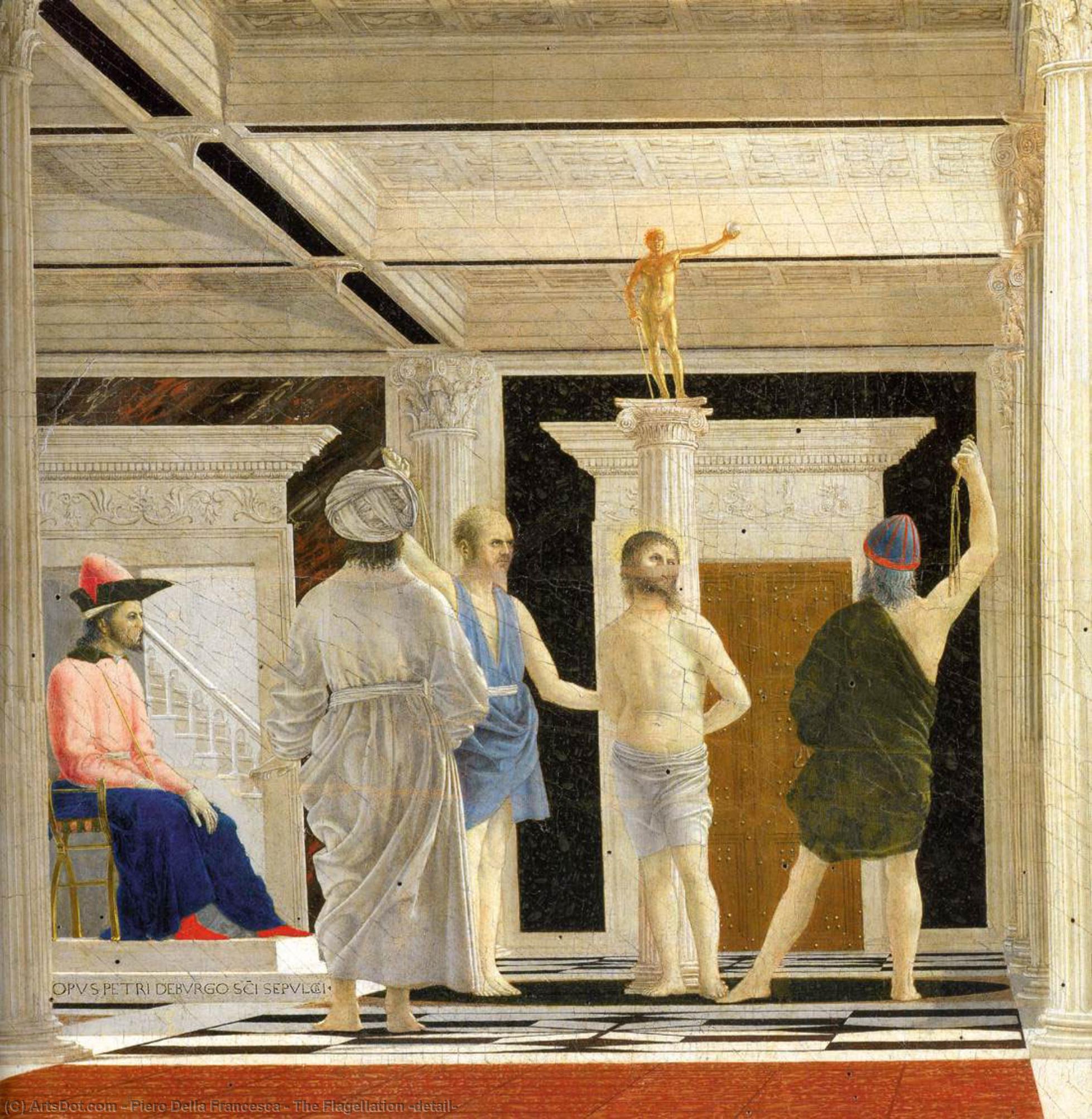
The Flagellation (detail) by Piero della Francesca: A Masterpiece of Renaissance Perspective
“The Flagellation,” painted around 1455 by the Italian master Piero della Francesca, is a captivating work that exemplifies his unique blend of artistic skill and mathematical precision. Housed in the Galleria Nazionale delle Marche in Urbino, Italy, this oil on panel painting offers a profound exploration of perspective, composition, and the complexities of human emotion within a historical context.
Subject Matter and Composition
The artwork depicts a scene from Christ’s Passion: his flagellation. However, Piero della Francesca deviates from typical depictions by placing the central event – the whipping itself – in the background. The foreground is dominated by three figures who appear detached from the suffering unfolding behind them. A man is being whipped by another figure, while others observe. Architectural elements like columns and arches frame the scene, creating a sense of depth and order. Piero’s meticulous attention to detail—the textures of clothing, the play of light on surfaces—adds to the painting's realism.
Artistic Technique and Historical Context
Piero della Francesca was a leading figure in the Early Renaissance, known for his serene humanism and groundbreaking use of perspective. He wasn’t just an artist; he was also a mathematician and geometer, deeply interested in the principles that governed visual space. “The Flagellation” is a testament to this intellectual curiosity. The painting showcases Piero's mastery of linear perspective—a technique that creates the illusion of three-dimensional space on a two-dimensional surface. This work reflects the Renaissance’s renewed interest in classical antiquity and its emphasis on reason, order, and human observation. The use of oil paint allowed for greater detail and subtle gradations of tone compared to earlier tempera techniques.
Symbolism and Interpretation
The painting's symbolism has been a subject of much debate among art historians. The detached figures in the foreground have been interpreted as representing various concepts, including the passage of time, human indifference to suffering, or even portraits of contemporary individuals with symbolic significance. Some scholars suggest they represent rulers witnessing events beyond their control. The architectural setting itself—a blend of classical and Renaissance elements—may symbolize a transition between eras or a commentary on the relationship between earthly power and divine judgment. The precise arrangement of figures and objects is not arbitrary; it’s carefully calculated to create a harmonious composition that invites contemplation.
Emotional Impact and Enduring Legacy
Despite its intellectual rigor, “The Flagellation” evokes a profound sense of stillness and melancholy. The detached observation of the suffering Christ creates an unsettling tension—a feeling of witnessing something both tragic and strangely distant. Piero della Francesca’s ability to convey complex emotions through subtle gestures and carefully controlled composition is what makes this painting so compelling. Today, "The Flagellation" remains a significant piece of Renaissance art, admired for its technical brilliance and enduring mystery. ArtsDot.com offers high-quality, handmade oil painting reproductions that allow art lovers to appreciate the beauty and detail of Piero della Francesca's work from the comfort of their own homes.