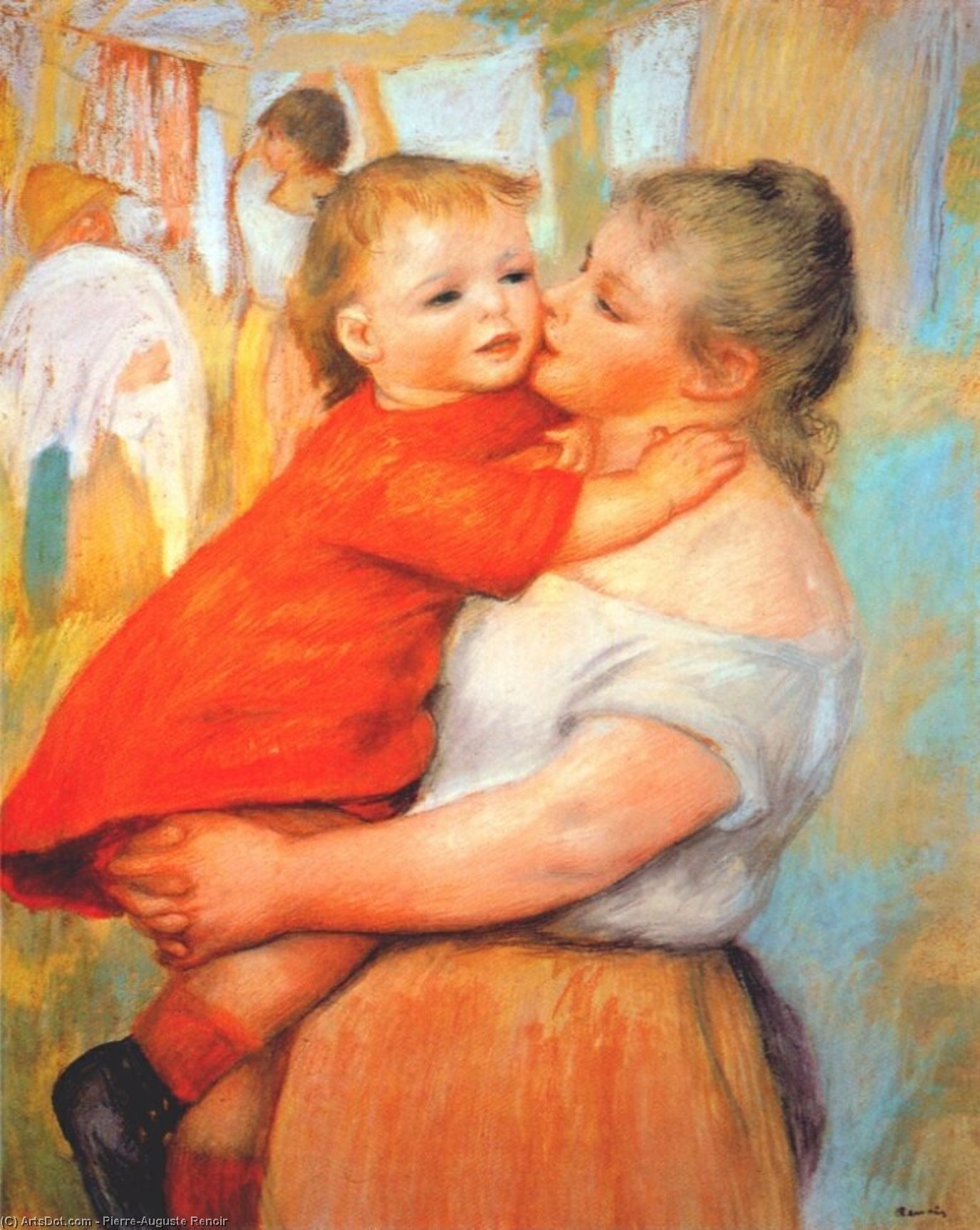
Aline and Pierre: A Pastel Reverie of Domestic Tranquility
Pierre-Auguste Renoir’s
Aline and Pierre is more than just a painting; it's a snapshot of a cherished moment—a tender kiss exchanged between Aline Charigot and their son, Pierre—captured with the luminous grace characteristic of Impressionism. Created in 1887 during Renoir’s prolific period exploring domestic life and familial affection, this pastel on paper on wood transcends mere representation, inviting viewers into an intimate tableau of everyday beauty.
Composition and Subject Matter: The Essence of Domestic Harmony
Renoir skillfully arranges the figures within a simple yet profound composition. Aline, bathed in soft light emanating from the window behind her, leans towards Pierre, who rests his head against her shoulder. Two chairs—one positioned centrally and another slightly to the right—establish a comfortable setting, reinforcing the sense of domestic tranquility. The inclusion of a handbag on the ground adds subtle detail, grounding the scene in the realities of daily life while simultaneously elevating it to an idealized portrayal of motherhood. Renoir’s meticulous attention to detail underscores his desire to convey not just what he saw but also how he felt—a deep appreciation for the quiet joys of family connection.
Artistic Technique: Pastel's Delicate Brilliance
Renoir’s masterful use of pastel on paper on wood is pivotal to the painting’s emotive power. Unlike oil paints, pastels offer unparalleled luminosity and vibrancy thanks to their powdered pigment combined with a binder of wax and oil—a technique that Renoir embraced wholeheartedly during his artistic evolution. The resulting velvety texture captures the softness of Aline's skin and Pierre's youthful innocence, mirroring the gentle hues of the surrounding environment. This medium allows for nuanced blending and layering, enabling Renoir to achieve an ethereal quality that perfectly embodies the Impressionist ethos of capturing fleeting impressions of light and color.
Historical Context: Impressionism’s Celebration of Everyday Life
Aline and Pierre resides firmly within the broader context of Impressionism—an artistic movement that rejected academic conventions in favor of capturing subjective experience and prioritizing optical perception. Artists like Monet and Sisley similarly sought to depict scenes from ordinary life with immediacy and sensitivity, rejecting idealized representations for a more honest portrayal of the human condition. Renoir’s work reflects this spirit of experimentation and innovation, cementing his place as one of the movement's foremost champions.
Relevance to Art Lovers: An Icon of Maternal Love
For art enthusiasts,
Aline and Pierre stands as a testament to Renoir’s ability to distill complex emotions into visual form—specifically, the profound tenderness of maternal affection. The painting's serene atmosphere invites contemplation on themes of family unity and the beauty found in simple gestures. Its enduring appeal lies in its timeless depiction of love and innocence, reminding viewers of the importance of cherishing those precious moments that define our lives.
Photo Description: The painting is a beautiful depiction of a woman holding her baby in her arms. The woman appears to be kissing the child on the cheek as they stand together. In addition to the main subjects, there are several other people present in the scene, some standing and others sitting. There are two chairs visible in the painting, one located near the center of the image and another towards the right side. A handbag can also be seen placed on the ground, close to the left edge of the painting. The overall atmosphere of the painting is warm and inviting, capturing a tender moment between the mother and her child.
Size: Unknown
Date: 1887