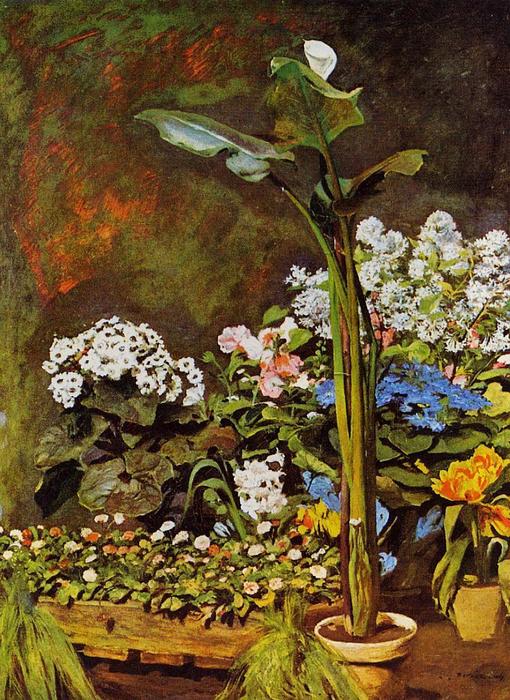
Pierre-Auguste Renoir's 'Arum and Conservatory Plants,' painted in 1864, exemplifies Impressionism's focus on fleeting light and color. This oil on canvas showcases a captivating collection of arum lilies and conservatory foliage rendered with loose brushwork and vibrant hues—a testament to Renoir’s mastery and enduring legacy. Explore a high-quality reproduction at ArtsDot.
A Symphony of Verdant Light
In the quiet, sun-drenched corners of a mid-nineteenth-century conservatory, Pierre-Auguste Renoir captured a moment of botanical splendor that transcends mere still life. Arum and Conservatory Plants, completed in 1864, serves as a breathtaking prelude to the Impressionist revolution. At first glance, the viewer is enveloped by a lush, emerald sanctuary where the boundaries between light and leaf seem to dissolve. The composition centers on the dramatic elegance of arum lilies, their pristine white spathes standing in stark, luminous contrast against a dense tapestry of ferns and tropical foliage. Renoir does not merely depict plants in pots; he orchestrates a sensory experience, inviting us to feel the humid warmth of the glasshouse and the dappled sunlight dancing across waxy surfaces.
The painting is a masterclass in the early development of Renoir’s signature technique. While his later works are famed for their soft, ethereal glow, this piece reveals a fascinating bridge between academic precision and Impressionist innovation. One can observe the influence of his training as a porcelain painter in the careful attention to texture and the delicate interplay of light on ceramic vessels. Yet, even in 1864, Renoir was beginning to move away from rigid outlines. He employs a more fluid, rhythmic brushstroke that imbues the greenery with a sense of breathing vitality. The way the light filters through the unseen glass ceiling creates a shimmering effect, where shadows are not merely dark patches but are infused with deep blues and rich greens, suggesting a world in constant, subtle motion.
Symbolism and the Spirit of Nature
Beyond its botanical accuracy, the artwork carries a profound emotional resonance that speaks to the eternal human desire for tranquility and connection with the natural world. The arum lily, often associated with purity and rebirth, acts as a focal point of spiritual clarity amidst the wild, untamed complexity of the surrounding ferns. There is a deliberate tension between the controlled environment of the conservatory—a man-made sanctuary—and the exuberant, almost overwhelming growth of the plants themselves. This reflects a romantic fascination with the power of nature to flourish even within the confines of civilization.
For the discerning collector or interior designer, this piece offers more than just aesthetic beauty; it provides an atmosphere of timeless serenity. The deep, restorative greens and the bright, punctuating whites make it a versatile centerpiece for any sophisticated space. Whether placed in a sunlit morning room to enhance a sense of freshness or in a more formal study to provide a touch of classical elegance, Arum and Conservatory Plants acts as a window into a more peaceful era. It is an invitation to pause, to breathe, and to find inspiration in the quiet, magnificent details of the natural world that Renoir so lovingly preserved on canvas.