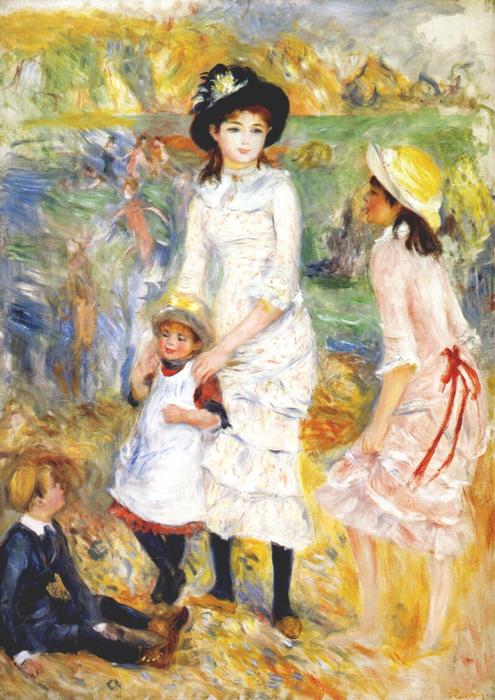
Experience the luminous joy of childhood through Pierre-Auguste Renoir's Impressionist masterpiece Children on the Seashore, a sun-drenched seaside scene that invites you to bring this timeless moment of tranquility home.
Explore Pierre-Auguste Renoir's (1841-1919) luminous Impressionist paintings! Discover portraits, Parisian life & feminine beauty in his iconic artworks.
Children on the Seashore – A Moment of Tranquility Captured by Renoir
Pierre-Auguste Renoir’s “Children on the Seashore” (1883) isn't merely a depiction of a seaside scene; it’s an embodiment of Impressionism’s core philosophy—the fleeting beauty of everyday life rendered with luminous color and loose brushstrokes. Painted during Renoir’s prolific period in Guernsey, Channel Islands, this artwork captures the idyllic joy of childhood summers against the backdrop of the English coast. The painting showcases three young children engaged in playful activity near the shoreline, bathed in dappled sunlight—a masterful achievement of capturing a transient moment.
Style and Technique: Impressionistic Brilliance
Renoir’s signature Impressionist style is immediately apparent. He abandons traditional academic realism, prioritizing optical perception over meticulous detail. Instead of striving for photographic accuracy, Renoir employs broken color – applying small strokes of pure pigment side by side—to create an illusion of shimmering light and atmosphere. Observe how the artist skillfully blends shades of ochre, lemon yellow, and turquoise to recreate the warmth of the sun reflecting off the sand and sea. The brushstrokes themselves are visible, contributing to the painting’s textural richness and conveying a sense of spontaneity and immediacy. This technique wasn't just aesthetically pleasing; it was revolutionary for its time, representing a radical departure from artistic conventions.
Historical Context: Gauguin’s Influence and Parisian Society
“Children on the Seashore” emerged during a period of significant artistic experimentation in Paris. Renoir’s fellow Impressionists—Monet, Sisley, Degas—were actively challenging the dominance of academic painting, advocating for a new visual language that prioritized subjective experience. The painting reflects the broader societal fascination with leisure and family life during Belle Époque France – a time marked by optimism and prosperity. Interestingly, Renoir’s friendship with Vincent van Gogh influenced his artistic sensibilities, fostering a shared interest in capturing emotion and conveying atmosphere—a connection evident in both artists' expressive use of color and brushwork.
Symbolism: Innocence and Joyful Connection
Beyond its technical brilliance, “Children on the Seashore” resonates with symbolic significance. The children represent innocence, spontaneity, and uninhibited joy – qualities that Impressionists sought to celebrate. Their carefree play embodies a yearning for simplicity and connection with nature—themes prevalent in Romantic art preceding Renoir’s era. The positioning of the figures, bathed in sunlight, symbolizes vitality and optimism. Furthermore, the hat worn by one child adds a subtle detail that contributes to the painting's narrative quality, hinting at a story unfolding within this tranquil scene.
Emotional Impact: A Window into Happiness
Ultimately, “Children on the Seashore” succeeds in transporting the viewer back to a moment of pure happiness. Renoir’s masterful use of color and brushwork evokes feelings of warmth, serenity, and nostalgia—capturing the essence of childhood summers with remarkable sensitivity. It's a painting that invites contemplation and appreciation for the beauty found in ordinary moments, cementing Renoir’s place as one of Impressionism’s foremost luminaries and ensuring its enduring appeal to audiences worldwide.