Pierre-Auguste Renoir (1841–1919) revolutionized Impressionism with his masterful use of color and light, portraying scenes of Parisian life and feminine portraits with unparalleled sensitivity. His early training in porcelain painting instilled a meticulous attention to detail that informed his artistic vision.
Explore Pierre-Auguste Renoir's (1841-1919) luminous Impressionist paintings! Discover portraits, Parisian life & feminine beauty in his iconic artworks.
Discover the Musée d'Orsay in Paris! Housed in a stunning former railway station, explore an unparalleled collection of Impressionist & Post-Impressionist masterpieces by Monet, Van Gogh & more.
A Moment Frozen in Parisian Light: Renoir’s City Dance
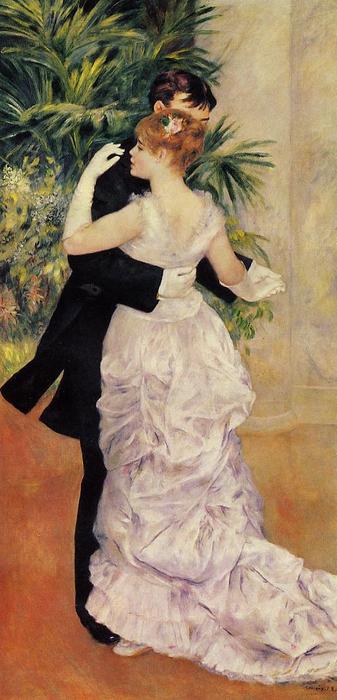
Pierre-Auguste Renoir's "City Dance" isn’t merely a depiction of a couple enjoying an evening stroll; it’s a masterful encapsulation of Impressionism’s core ethos – capturing fleeting moments of beauty and emotion with luminous color and loose brushstrokes. Painted around 1876, this canvas resides in the Musée d’Orsay, offering visitors a privileged glimpse into Renoir's artistic vision during his formative years as an Impressionist innovator. The painting transports us to a Parisian salon, bathed in soft, diffused light—a hallmark of Renoir’s obsession with capturing atmospheric conditions and conveying sensations rather than precise representations.
The Dance Beneath the Surface: Composition and Technique
At first glance, the scene appears simple: a man and woman dancing gracefully together on an immaculate parquet floor. However, Renoir's genius lies in his subtle compositional choices. The couple occupies the center of the canvas, dominating the visual space but not overwhelming it. Their movements are suggested rather than explicitly rendered, achieved through delicate brushwork that blends seamlessly into the background. Notice how Renoir utilizes a technique known as *alla prima*, applying paint directly onto the canvas without preliminary sketches or underlayers—a bold departure from academic conventions and a cornerstone of Impressionist practice. The artist’s masterful blending of colors creates an ethereal glow, emphasizing the warmth of the ballroom setting and conveying the palpable joy of the dance.
Symbolism Within Everyday Life: Flowers and Tranquility
Beyond the central figures, Renoir introduces elements that enrich the painting's symbolic significance. Two potted plants—one positioned prominently on the upper left corner and another nestled in the middle-left area—serve as visual anchors and contribute to the overall sense of serenity. Plants were frequently used by Impressionists to represent vitality, growth, and connection with nature – a deliberate counterpoint to the urban environment depicted. The inclusion of these botanical details underscores Renoir’s desire to elevate ordinary life into something sublime, capturing not just what is seen but also what is felt. Furthermore, the man's attire features a tie—a small yet significant detail that adds to the painting’s charm and reinforces its depiction of refined Parisian society.
Historical Context: Impressionism's Embrace of Modernity
“City Dance” emerged during a pivotal moment in art history – the rise of Impressionism as a reaction against Romantic idealism. Artists like Renoir sought to depict the realities of modern life, prioritizing sensory experience over idealized narratives. The painting reflects the broader cultural preoccupation with capturing fleeting impressions and conveying emotions—a departure from the grand historical canvases favored by previous generations. It exemplifies Impressionism’s commitment to portraying everyday scenes with honesty and sensitivity, cementing Renoir's legacy as one of the movement’s most celebrated figures.
Emotional Resonance: Capturing Joyful Connection
Ultimately, “City Dance” succeeds in conveying a profound emotional resonance. The painting captures the essence of human connection—the intimacy and pleasure derived from shared experience. Renoir’s luminous palette and expressive brushwork evoke feelings of warmth, optimism, and delight. It's a testament to his ability to transform ordinary moments into enduring symbols of beauty and emotion – an achievement that continues to inspire artists and collectors alike. A high-quality reproduction allows viewers to appreciate the subtle nuances of Renoir’s technique and immerse themselves in the captivating atmosphere of Parisian life at the turn of the century.