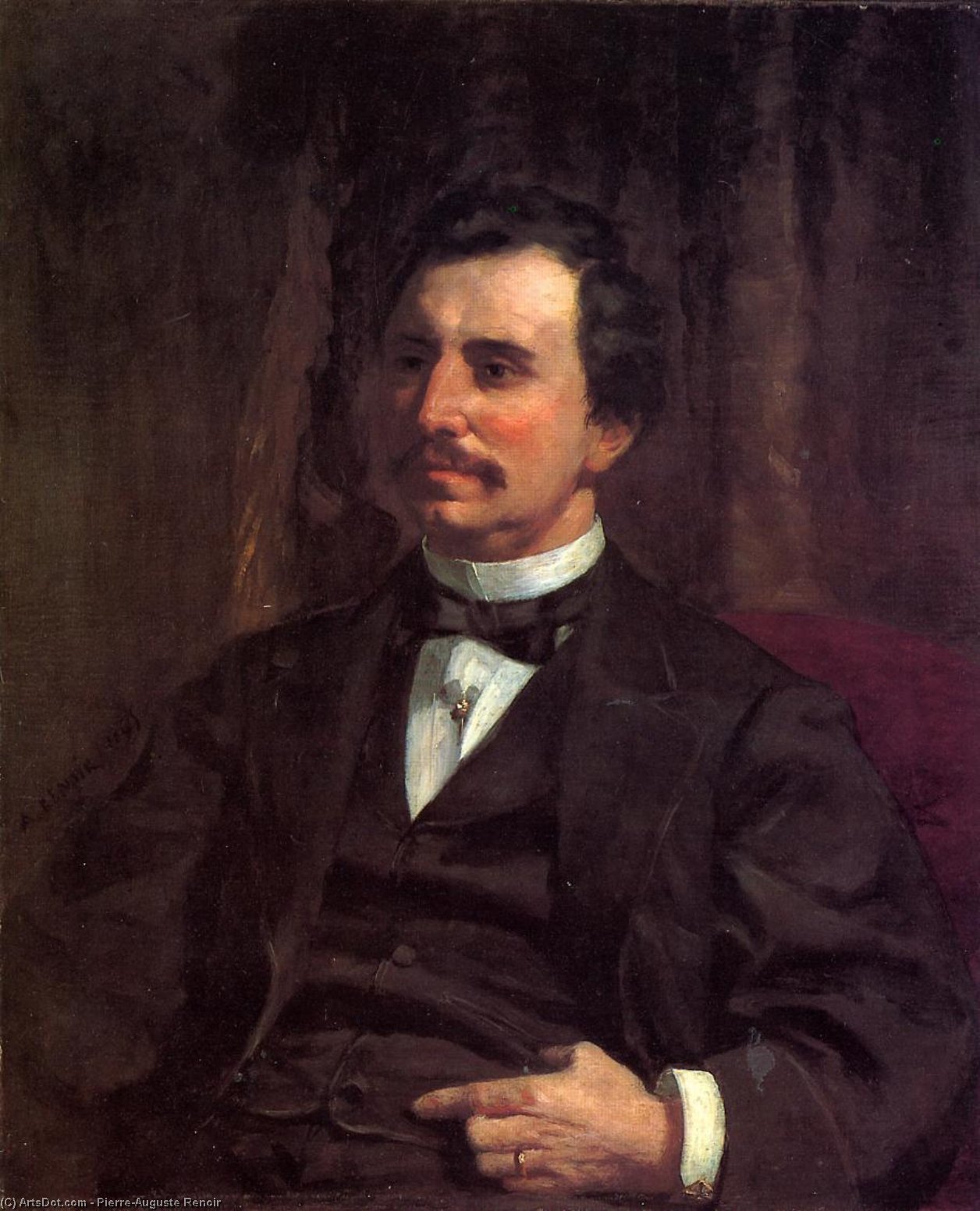
Colonel Barton Howard Jenks: A Snapshot of Victorian Society Through Renoir’s Impressionistic Lens
Pierre-Auguste Renoir's “Colonel Barton Howard Jenks,” painted in 1865, isn’t merely a portrait; it’s a carefully constructed tableau vivant—a fleeting moment captured on canvas that speaks volumes about the social dynamics and aesthetic sensibilities of mid-Victorian England. This work, now residing within The University of Maine Museum of Art, offers a fascinating glimpse into Renoir's early development as an artist and his burgeoning mastery of Impressionism, showcasing a deliberate blending of meticulous observation with a loose, atmospheric approach to color and form.
The subject himself, Colonel Barton Howard Jenks, is presented with a dignified formality befitting his rank. Dressed in the rich fabrics and intricate details characteristic of the era – a dark suit, a crisp white shirt, and a meticulously tied cravat – he embodies the established social order. However, Renoir’s technique subtly undermines this rigid structure. The background figures, indistinct and rendered with blurred brushstrokes, are not integrated into the composition; they exist as peripheral elements, almost dreamlike, suggesting a world beyond the Colonel's immediate presence. This deliberate separation highlights Jenks’ centrality while simultaneously hinting at the complexities of Victorian society – the formality versus the everyday realities experienced by those outside the upper echelons.
Artistic Style and Technique: A Dance of Light and Color
Renoir’s approach to this portrait is deeply rooted in Impressionism, a movement he was actively participating in during this period. He employs a technique characterized by broken brushstrokes—small, distinct dabs of color applied directly to the canvas—to capture the fleeting effects of light and atmosphere. The use of color is particularly noteworthy; vibrant hues are juxtaposed with muted tones, creating a sense of depth and luminosity. Notice how Renoir masterfully uses color to define Jenks’ attire – the deep blues and browns of his coat contrasted against the lighter shades of his shirt—drawing the viewer's eye to the central figure.
Furthermore, Renoir demonstrates an impressive command of chiaroscuro, the interplay of light and shadow. The subtle gradations in tone create a sense of dimensionality, giving Jenks’ form a tangible presence within the painting. His hands, crossed with quiet elegance, are rendered with remarkable detail, while the background fades into a hazy abstraction. This skillful manipulation of light not only enhances the portrait's visual appeal but also contributes to its overall mood—a blend of formality and introspection.
Subject and Composition: More Than Just a Portrait
At first glance, “Colonel Barton Howard Jenks” appears to be a straightforward depiction of a gentleman in his prime. However, closer examination reveals layers of meaning embedded within the composition. The Colonel’s direct gaze engages the viewer, creating an immediate connection—a sense of being observed and judged. His posture exudes confidence and authority, reflecting his social standing.
The presence of two indistinct figures in the background adds another layer to the narrative. These individuals, seemingly absorbed in their own activities, represent the broader context of Victorian society – a world teeming with social interactions and unspoken dynamics. They are not participants in Jenks’ world but rather witnesses to it, subtly reminding us that even within the confines of formal portraiture, life continues beyond the subject's immediate presence.
Historical Context: A Pivotal Moment in Impressionist Development
“Colonel Barton Howard Jenks” was created during a pivotal period in Renoir’s artistic career. It represents an early example of his experimentation with Impressionistic techniques and his growing interest in capturing the essence of modern life. The painting reflects the broader social and cultural shifts occurring in France during the mid-19th century—a time of rapid industrialization, urbanization, and evolving social norms. Renoir’s work stands as a testament to this era, offering a nuanced portrayal of Victorian society through the lens of an emerging artistic voice.
The painting's significance extends beyond its aesthetic qualities; it is also a valuable historical document, providing insights into the lives and customs of the upper class during the Victorian period. Its current location within The University of Maine Museum of Art underscores its enduring value as a significant work of art history.
For those interested in exploring more works by Pierre-Auguste Renoir, visit Colonel Barton Howard Jenks and The Boating Party Lunch on ArtsDot.com. Learn more about the Impressionist movement and its key figures, such as Edouard Manet and his work Au Prado, at Au Prado. Discover the works of other notable artists, including Rovi Jesher Salegumba, on ArtsDot.com.