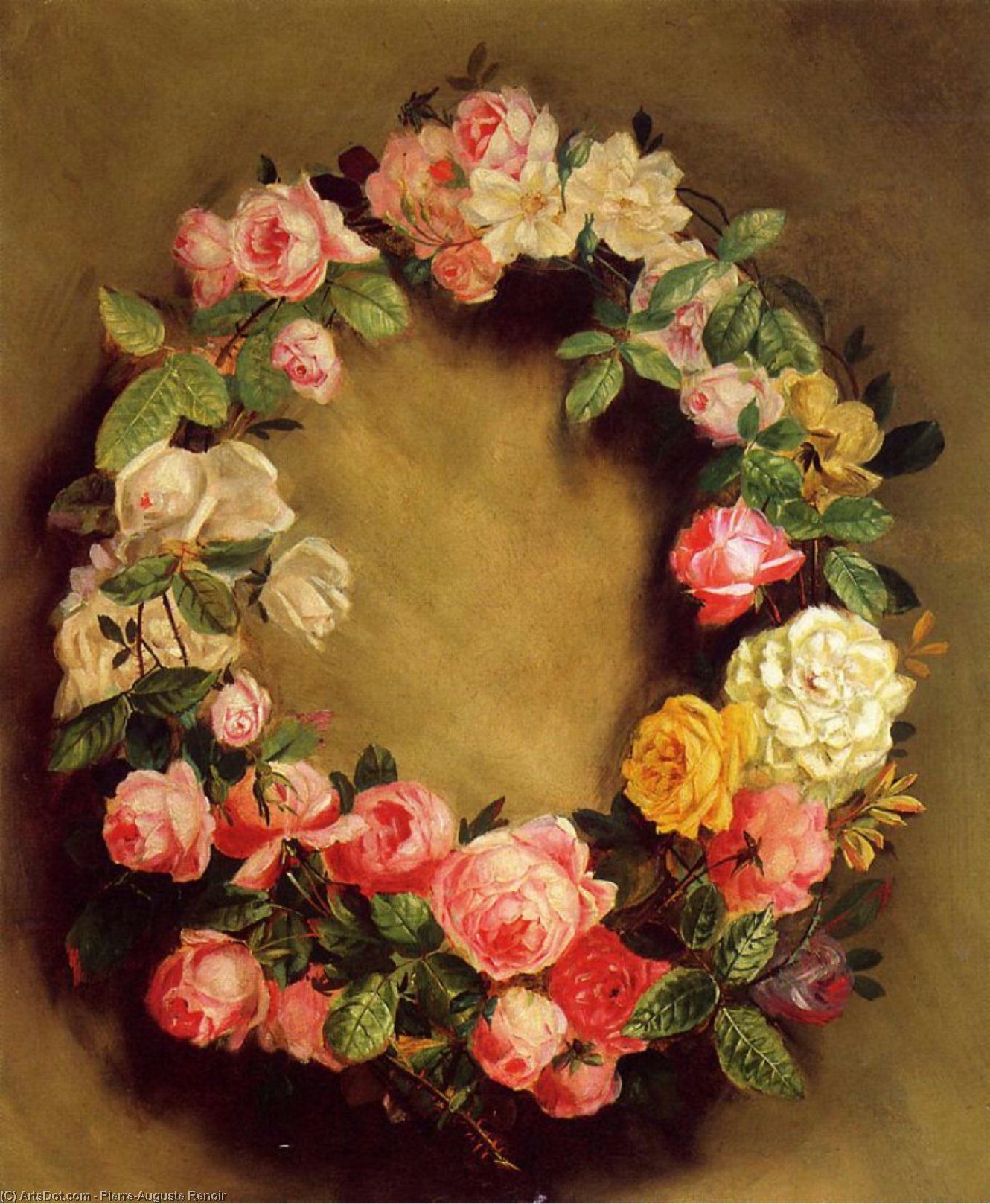
A Moment Frozen in Time: Pierre-Auguste Renoir’s “Crown of Roses”
Pierre-Auguste Renoir's "Crown of Roses," painted in 1858, isn’t merely a still life; it’s a delicate distillation of beauty and an intimate glimpse into the artist’s evolving artistic sensibilities. This captivating canvas, now meticulously reproduced for ArtsDot.com, offers a serene invitation to contemplate the ephemeral nature of floral arrangements and the quiet joy found in observing the natural world. Initially created during a transitional period in Renoir's career – bridging his early Realist explorations with the blossoming Impressionism that would define him – “Crown of Roses” reveals a remarkable sensitivity to light, texture, and color, foreshadowing the luminous quality that would become his signature.
The painting centers around an exquisite wreath composed of a vibrant assortment of flowers: blushing pink roses, cheerful yellow daisies, and delicate leaves. Renoir’s masterful technique immediately draws the eye. He employs a loose, broken brushstroke – characteristic of his early style – to capture the velvety texture of the petals and the subtle variations in color. Notice how he doesn't strive for photographic realism; instead, he uses dabs and dashes of pigment to suggest form and volume, creating an impression of depth and movement within the frame. The arrangement is carefully positioned within a shallow space, almost as if viewed through a windowpane, inviting the viewer into this intimate tableau. The composition itself feels deliberately balanced, with the central wreath anchoring the eye while the surrounding foliage provides a gentle, organic border.
Early Realism and the Pursuit of Beauty
“Crown of Roses” represents an important step in Renoir’s artistic development. Emerging from his apprenticeship at the porcelain factory, he was initially influenced by artists like Rubens and Watteau, whose works celebrated beauty and sensuality. However, he also absorbed elements of Realism, particularly through his exposure to Gustave Courbet's work – a movement that sought to depict everyday subjects with unflinching honesty. Courbet’s “Flower Still-Life,” a contemporary piece, shares a similar focus on the beauty of flowers but employs a more rigid and structured composition. Renoir, however, retains a lightness and an almost playful quality in his rendering, hinting at the shift towards Impressionism that would soon liberate him from the constraints of academic painting.
The choice of subject matter itself is significant. Flowers were not simply decorative objects; they held symbolic weight within 19th-century culture. Roses, in particular, represented love, beauty, and passion – themes frequently explored by artists and writers of the era. Renoir’s careful selection and arrangement of these blooms suggests a deliberate intention to evoke feelings of tranquility and appreciation for nature's bounty. The inclusion of daisies adds a touch of youthful exuberance, further enriching the painting’s emotional resonance.
A Window into Renoir’s World
Beyond its aesthetic appeal, “Crown of Roses” offers a valuable insight into Pierre-Auguste Renoir’s life and artistic vision. Born in Limoges in 1841, his early years were marked by financial hardship and a struggle to find recognition within the established art world. This painting reflects a period of experimentation and self-discovery – a time when he was honing his skills and developing his unique style. The intimate scale of the work—a relatively small canvas—suggests that it was created for personal enjoyment, perhaps as a study or a cherished keepsake. It’s a testament to Renoir's ability to find beauty in the simplest of subjects, transforming ordinary flowers into objects of profound artistic contemplation.
Own a Piece of Art History
ArtsDot is proud to offer meticulously crafted, hand-painted reproductions of “Crown of Roses,” allowing you to bring this timeless masterpiece into your home or office. Our skilled artisans replicate Renoir’s delicate brushstrokes and vibrant color palette with exceptional precision, ensuring that your reproduction captures the essence of the original painting. Whether you're an art enthusiast, a collector, or simply seeking to add a touch of elegance to your space, our “Crown of Roses” reproduction is a beautiful and meaningful addition to any collection. Discover more artworks and handmade oil painting reproductions at ArtsDot.com.