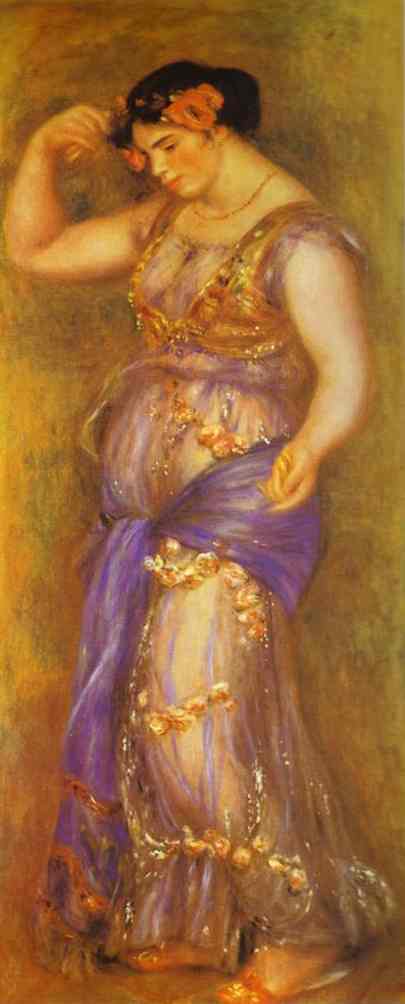
Experience the vibrant beauty of Renoir's 'Dancer with Castanets'! This Impressionist masterpiece captures Gabrielle Renard’s grace and movement, showcasing a dancer's captivating performance. Order a hand-painted reproduction today!
Explore Pierre-Auguste Renoir's (1841-1919) luminous Impressionist paintings! Discover portraits, Parisian life & feminine beauty in his iconic artworks.
A Dance of Light and Emotion: Renoir’s “Dancer with Castanets”
Pierre-Auguste Renoir's "Dancer with Castanets," painted in 1897, isn’t merely a portrait; it’s an exquisite distillation of Impressionist joy. This captivating work, featuring Gabrielle Renard as the central figure, transcends simple representation to become a vibrant embodiment of movement, music, and the fleeting beauty of a Parisian moment. The painting immediately draws the eye with its luminous palette—a symphony of pinks, oranges, and golds that seem to shimmer and ripple across the canvas, mirroring the dancer’s flowing costume and the imagined rhythm of her performance. Renoir masterfully employs broken brushstrokes, characteristic of his style, creating an almost palpable sense of energy and spontaneity. These aren't rigid lines defining form; instead, they are delicate whispers suggesting movement, capturing not just a static image but the very essence of a dance in progress. The loose application of paint allows light to play across the surface, contributing significantly to the work’s ethereal quality – a hallmark of Impressionism’s pursuit of capturing the transient effects of light and atmosphere.
Gabrielle Renard: Muse and Model
The subject of “Dancer with Castanets,” Gabrielle Renard, held a particularly special place in Renoir's life. She was not only a frequent model but also a close friend and housekeeper for the artist’s family. This personal connection imbues the painting with an intimacy rarely found in portraits of the era. Renoir clearly sought to capture more than just her physical likeness; he aimed to convey her spirit, her grace, and perhaps even a hint of playful mischief. Notice how Renoir has subtly shifted her pose – she’s not rigidly posed for a formal portrait but appears caught mid-step, her hands poised above the castanets, inviting the viewer to imagine the music and movement accompanying her dance. The inclusion of the flower in her hair—a delicate sprig of white—adds a touch of romanticism and further emphasizes the painting’s celebration of beauty.
The Language of Color and Movement
Renoir's masterful use of color is central to the painting’s impact. The warm, saturated hues – particularly the oranges and pinks – evoke a sense of warmth and vitality, reminiscent of a flamenco performance or a sunset over the Mediterranean. These colors aren’t blended smoothly; instead, they are applied in distinct strokes, creating a vibrant mosaic that seems to pulsate with energy. The background is deliberately blurred, suggesting depth and distance while simultaneously focusing attention on the dancer herself. The castanets, rendered in shades of brown and gold, provide a focal point, hinting at the rhythmic accompaniment to her dance. Renoir’s technique brilliantly captures not just the visual appearance of the scene but also its auditory dimension – inviting us to hear the clatter of the castanets and feel the pulse of the music.
A Window into Parisian Life and Impressionist Ideals
“Dancer with Castanets” is deeply rooted in the social and artistic context of late 19th-century Paris. The painting reflects the city’s vibrant cultural scene, particularly its thriving dance halls and theaters. It also embodies the core tenets of Impressionism—a movement that sought to capture fleeting moments of beauty and experience through a subjective lens. Like other works by Renoir, such as his depictions of Parisian cafes and outdoor gatherings, this painting offers a glimpse into the everyday life of the city’s inhabitants. Furthermore, it aligns with the broader Impressionist interest in exploring light, color, and movement—themes that would become central to the development of modern art. The work's enduring appeal lies not only in its aesthetic beauty but also in its ability to transport us back to a time when Paris was a hub of artistic innovation and cultural excitement. A hand-painted reproduction allows you to bring this vibrant scene into your own home, experiencing the joy and energy of Renoir’s masterpiece firsthand.