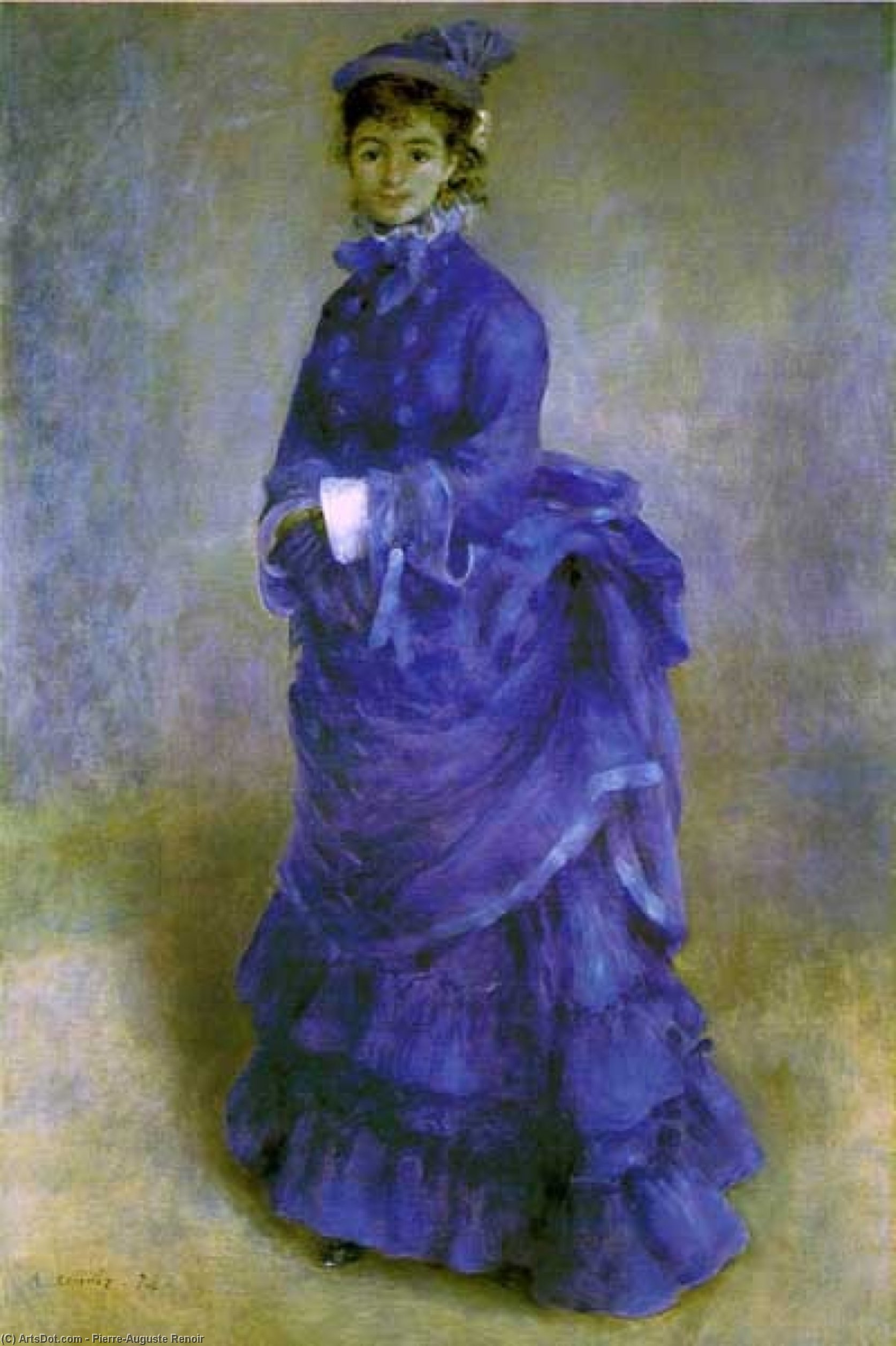
La Parisienne: A Glimpse of Impressionist Grace
Pierre-Auguste Renoir’s “La Parisienne,” painted in 1874, isn't merely a portrait; it’s a shimmering distillation of the Impressionist movement’s core tenets – light, color, and the fleeting beauty of everyday life. This captivating oil on canvas, measuring 160 x 106 cm, transports us to a Parisian afternoon, capturing a moment of quiet elegance within a bustling urban landscape. The painting immediately draws the eye to its subject: a young woman, poised with an almost ethereal grace, standing before what appears to be a stage backdrop – a subtle detail that hints at the theatricality and performance inherent in Impressionist art.
Renoir’s masterful use of light is paramount. He doesn't strive for photographic realism but instead employs broken brushstrokes and vibrant hues to capture the way sunlight filters through the air, illuminating the woman’s blue dress and casting delicate shadows across her face. The color palette itself is remarkably restrained yet intensely evocative – a deep, rich blue dominates, contrasted by softer shades of mauve and grey in the background. This careful orchestration of color creates an atmosphere of warmth and intimacy, inviting the viewer into the scene.
The Woman and Her World
The woman herself embodies the spirit of the era. Dressed in a fashionable blue gown with a ruffled skirt, reminiscent of 19th-century Parisian style, she possesses a captivating blend of innocence and sophistication. Her slightly tilted hat, her gentle smile, and the delicate gesture of placing her gloves suggest a poised confidence, yet there’s also an underlying vulnerability. It's believed that the model for this painting was Henriette Henriot, a rising starlet at the time, adding another layer of intrigue to the artwork.
The stage backdrop, though seemingly simple, is crucial to understanding the work’s context. It subtly references the burgeoning world of theater and entertainment in Paris during the Second Empire – an environment that profoundly influenced Impressionist artists. Renoir frequently depicted scenes from Parisian life, often incorporating elements of performance and social interaction, reflecting a fascination with the dynamism of urban existence.
Impressionism’s Delicate Dance
“La Parisienne” exemplifies the core principles of Impressionism. Renoir, alongside Monet and others, rejected the academic traditions of the Salon system, opting instead to paint *en plein air* – outdoors – directly from observation. This approach allowed them to capture the ephemeral qualities of light and atmosphere with unprecedented accuracy. The loose brushstrokes, the emphasis on color over form, and the sense of movement all contribute to this impressionistic effect.
Interestingly, Renoir’s artistic lineage can be traced back to the Baroque masters Rubens and Watteau, artists known for their opulent depictions of beauty and sensuality. However, Renoir infused these influences with a distinctly modern sensibility, capturing the fleeting moments of everyday life with remarkable sensitivity and grace. His work stands as a bridge between tradition and innovation, solidifying his place as one of the most important figures in the development of Impressionism.
A Legacy of Beauty
Beyond its artistic merits, “La Parisienne” holds a personal significance for Renoir – he was a devoted father. His sons, Pierre, Jean, and Claude, all followed in his footsteps, with Jean becoming a renowned filmmaker and Claude a celebrated ceramic artist. This familial connection adds another layer of richness to the painting’s narrative, highlighting the enduring legacy of artistic talent within the Renoir family.
Today, reproductions of “La Parisienne” are available through ArtsDot.com, offering art enthusiasts the opportunity to bring this exquisite masterpiece into their homes. These handmade oil paintings capture the essence of Renoir’s original work with remarkable fidelity, allowing you to experience the beauty and charm of “La Parisienne” in a tangible way. Consider commissioning a custom reproduction – perhaps incorporating your own personal style or color palette – to create a truly unique piece of art that reflects your individual taste.