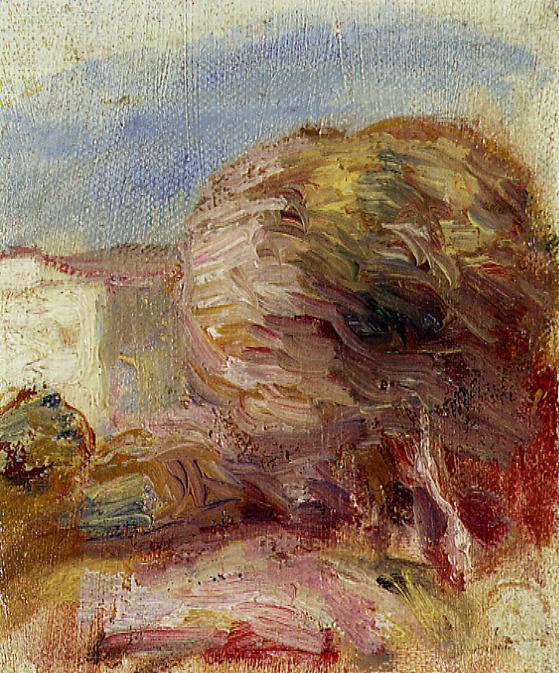
A Glimpse into Provençal Life: Pierre-Auguste Renoir’s *La Poste at Cagnes*
Pierre-Auguste Renoir's *La Poste at Cagnes*, painted in 1905, is more than just a depiction of a rural scene; it’s an evocative distillation of the French Impressionist aesthetic and a testament to Renoir’s enduring fascination with light, color, and the beauty of everyday life. Created during a period when Renoir was seeking respite from rheumatism in the warmer climate of Cagnes-sur-Mer, this painting captures not only a physical location but also a sense of tranquility and contentment.
Impressionism at its Zenith
*La Poste at Cagnes* exemplifies the core tenets of
Impressionism. Renoir abandons meticulous detail in favor of capturing the *impression* of a moment – the way light filters through foliage, the warmth of the sun on stone, and the overall atmosphere of a quiet afternoon. The loose brushwork is immediately apparent, creating a vibrant texture that seems to shimmer before the viewer’s eyes. This technique wasn't about replicating reality perfectly; it was about conveying the subjective experience of seeing. Renoir masterfully employs broken color – applying small strokes of pure pigment side-by-side – allowing the viewer’s eye to blend them optically, resulting in a luminous and vibrant effect.
Composition & Subject Matter: A Scene of Rural Charm
The painting centers around a modest building—the local post office ( *La Poste* )—nestled amongst lush greenery. A prominent rock formation anchors the foreground, providing a strong visual base for the composition. The buildings are partially obscured by trees and foliage, suggesting a harmonious integration of architecture with nature. Renoir doesn’t focus on grand narratives or dramatic events; instead, he finds beauty in the ordinary. This deliberate choice reflects the Impressionist desire to depict modern life as it was lived, rather than through historical or mythological lenses. The scene is bathed in warm, golden light, creating a sense of peace and serenity.
Historical Context & Renoir’s Late Style
Painted towards the end of his career, *La Poste at Cagnes* reveals a shift in Renoir's style. While still rooted in Impressionism, it hints at the Post-Impressionist explorations to come. The simplification of forms and the emphasis on color as an expressive element foreshadow the work of artists like Matisse and Derain. This period also saw Renoir increasingly interested in exploring more sculptural forms within his paintings, a tendency visible in the solidity of the rock and buildings. His friendship with Louis Valtat, who frequently visited him at Cagnes, likely influenced this stylistic evolution – Valtat being considered a “proto-Fauve” for his bold use of color.
Symbolism & Emotional Resonance
While not overtly symbolic, *La Poste at Cagnes* evokes feelings of nostalgia and peacefulness. The post office itself can be interpreted as a symbol of connection – linking the rural community to the wider world. The secluded setting suggests a retreat from the bustle of modern life, offering a moment of quiet contemplation.
The painting’s enduring appeal lies in its ability to transport viewers to this idyllic scene and evoke a sense of calm and well-being. The warmth of the colors and the gentle brushstrokes create an inviting atmosphere, making it a captivating piece for any space.
Collecting & Interior Design
*La Poste at Cagnes*, or a high-quality reproduction thereof, is a versatile addition to any art collection or interior design scheme. Its warm color palette complements a variety of décor styles, from traditional to contemporary.
- In a living room setting, it can create a focal point and add a touch of Provençal charm.
- Its serene atmosphere makes it ideal for bedrooms or studies, promoting relaxation and focus.
- The painting’s relatively small scale allows for flexible placement in various spaces.
Ultimately, *La Poste at Cagnes* is a celebration of beauty in simplicity—a timeless masterpiece that continues to inspire and delight art lovers worldwide.