A Moment Frozen in Twilight: Pierre-Auguste Renoir’s Landscape with Trees
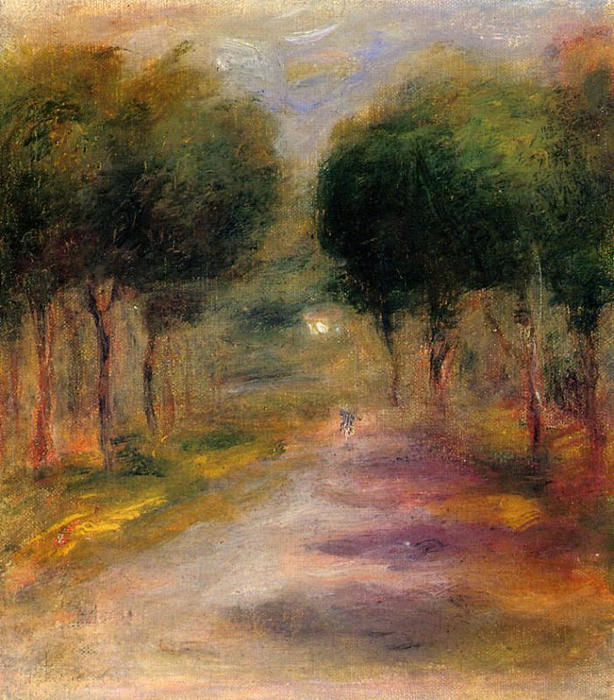
Pierre-Auguste Renoir's “Landscape with Trees,” painted in 1886, stands as a quintessential embodiment of Impressionist aesthetics—a captivating glimpse into the ephemeral beauty of nature bathed in the soft hues of dusk. Currently residing at the Allen Memorial Art Museum in Oberlin, Ohio, this canvas transcends mere depiction; it’s an invitation to experience the tranquil serenity and subtle luminescence characteristic of Renoir's artistic vision.
Composition and Observation
Renoir meticulously captured a scene brimming with observation—a solitary figure traversing a path bordered by trees. The artist skillfully arranges these trees, positioning some closer to the viewer while others recede into the distance, creating depth and enhancing the sense of space. Notably, a cluster of trees dominates the right side of the composition, anchoring the eye and emphasizing the grandeur of the natural environment. This deliberate compositional strategy reflects Renoir’s commitment to portraying reality as perceived by the senses—a core principle of Impressionism.
The Language of Light: Impressionist Technique
What truly distinguishes “Landscape with Trees” is Renoir's masterful application of Impressionist technique. Abandoning traditional academic conventions, he embraced short, broken brushstrokes—a revolutionary departure from the smooth, blended surfaces favored by earlier artists. These strokes aren’t merely marks on canvas; they are fragments of light and color, painstakingly layered to recreate the fleeting effects of twilight. The artist's palette explodes with vibrant shades of ochre, emerald green, and lavender, mirroring the atmospheric conditions of the evening.
Influences and Artistic Dialogue
Renoir’s artistic sensibilities were profoundly shaped by his contemporaries, particularly Claude Monet—the pioneer of Impressionism who championed the concept of series paintings devoted to a single theme. Monet's groundbreaking approach to capturing light and color served as an inspiration for Renoir, fostering a collaborative spirit within the movement. Furthermore, artists like Alfred Sisley and Jean Frédéric Bazille contributed to the burgeoning Impressionist landscape genre, exploring similar themes of rural life and atmospheric observation.
Emotional Resonance: A Tranquil Reflection
"Landscape with Trees" isn't simply a visual record; it’s imbued with an emotional resonance that speaks to the human desire for solace and contemplation. The painting evokes feelings of peace and tranquility, inviting viewers to immerse themselves in the stillness of the evening forest—a testament to Renoir’s ability to translate sensory experience into artistic expression.