A Moment of Quietude: Exploring Renoir’s *Leontine Reading*
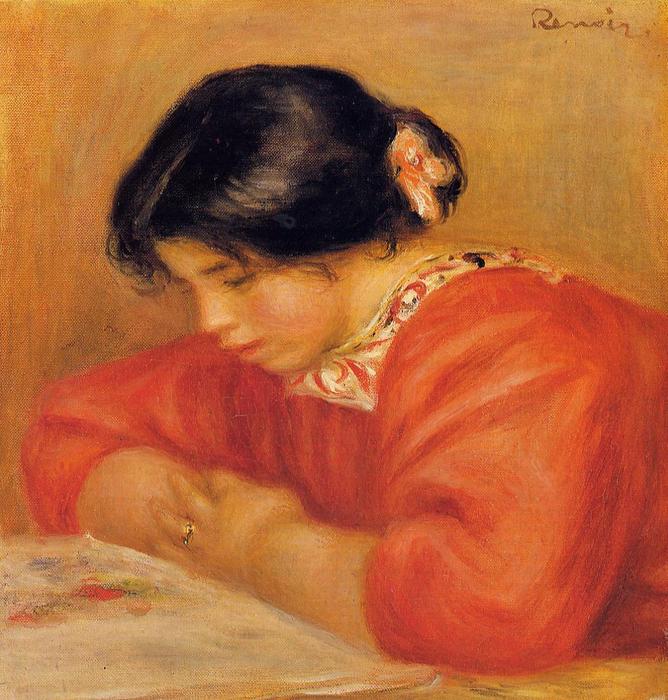
Pierre-Auguste Renoir's *Leontine Reading*, painted in 1909, is more than just a portrait; it’s an intimate glimpse into a private world. This captivating work exemplifies Renoir’s evolving style as he moved beyond the purely Impressionistic landscapes of his earlier career and delved deeper into capturing the psychological depth of his subjects. The painting invites us to share in a moment of peaceful contemplation with Leontine, offering a respite from the bustling modern life of the early 20th century.
Subject & Composition
The artwork centers on Leontine, a young woman wholly absorbed in her reading. She is elegantly dressed in a striking red dress – a bold choice that immediately draws the eye and suggests a vibrant inner life. The composition is carefully balanced; she’s positioned against an interior backdrop featuring a chair and a clock, subtly hinting at the passage of time and the domestic sphere. Two books are present: one held near her face, actively engaged with, and another slightly removed, perhaps representing past readings or future explorations. This arrangement isn't accidental; it creates visual harmony and directs our focus to Leontine’s expression – thoughtful, serene, and lost in thought.
Impressionistic Technique & Artistic Style
While Renoir is celebrated as a founder of Impressionism, *Leontine Reading* demonstrates his masterful adaptation of the style. Though set indoors, the painting retains key Impressionistic characteristics: loose brushstrokes, a focus on capturing light and atmosphere, and an emphasis on color to convey mood. However, here, the technique serves not to depict fleeting outdoor impressions but to create a sense of *intimacy*. The soft, diffused lighting gently illuminates Leontine’s face and clothing, lending her form a delicate luminosity. Renoir's brushwork isn't about precise detail; it's about capturing the *feeling* of being in her presence.
Historical & Cultural Context
Painted during a period of significant social change, *Leontine Reading* reflects a growing interest in portraying women’s inner lives and intellectual pursuits. This theme resonated with other artists of the time, notably
Mary Cassatt, who similarly focused on depicting the domestic world and the experiences of women. The painting subtly challenges traditional representations of women as merely decorative or objects of desire, instead presenting Leontine as an individual engaged in self-improvement and intellectual stimulation. It’s a quiet statement about female agency and the importance of education.
Symbolism & Emotional Impact
The symbolism within *Leontine Reading* is subtle yet powerful. The red dress, beyond its visual impact, can be interpreted as representing passion, vitality, or even intellectual fervor. The act of reading itself symbolizes knowledge, imagination, and escape – a doorway to other worlds. More broadly, the painting evokes feelings of tranquility, introspection, and the simple beauty of everyday life. It’s a reminder to slow down, disconnect from the external world, and find solace in quiet contemplation.
Artwork Details
- Artist: Pierre-Auguste Renoir
- Title: Leontine Reading
- Medium: Oil on Canvas
- Style: Impressionism
- Date: 1909
*Leontine Reading* is a timeless piece that continues to resonate with viewers today. Whether you are an art collector, an interior designer seeking a touch of elegance and sophistication, or simply someone who appreciates beauty, this painting offers a captivating window into the world of Renoir and the enduring power of quiet contemplation.