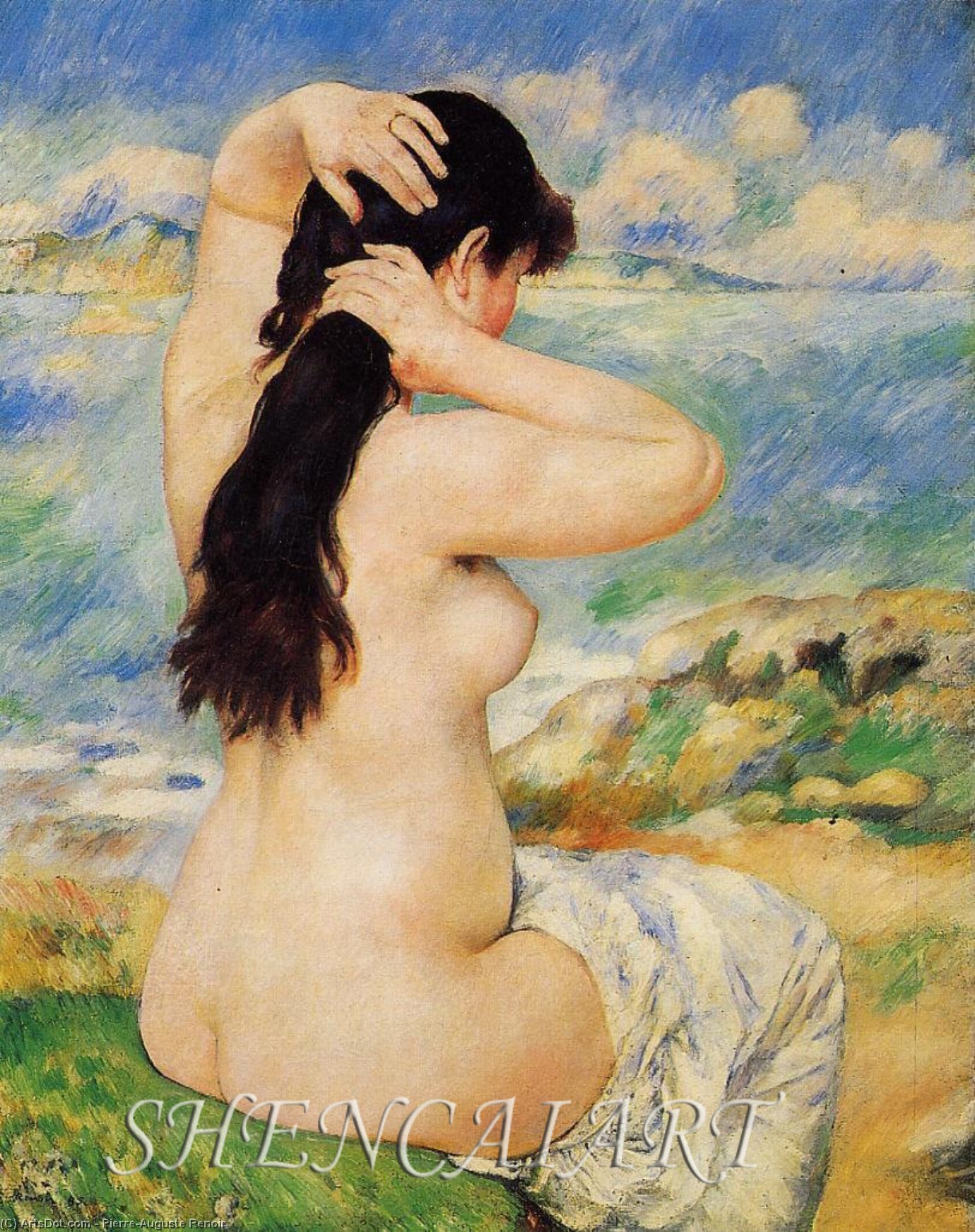
Nude Fixing Her Hair: A Study in Impressionist Light and Feminine Grace
Pierre-Auguste Renoir’s
Nude Fixing Her Hair (1885) stands as a quintessential emblem of Impressionist art—a testament to Renoir’s masterful ability to capture fleeting moments of beauty and emotion. Housed at the Sterling and Francine Clark Art Institute in Williamstown, Massachusetts, this oil on canvas painting transcends mere depiction; it invites contemplation on light, texture, and the quiet intimacy of domestic life.
The Evolution of Renoir's Style
Renoir’s artistic journey began in the 1870s with experiments in Impressionist techniques—a deliberate fracturing of form into shimmering planes of color designed to convey atmospheric effects. Unlike his predecessors who sought to meticulously render reality, Renoir embraced a looser brushstroke style, prioritizing sensation over precise representation. By the mid-1880s, however, Renoir’s approach solidified toward more substantial figures and forms, as vividly demonstrated in
Nude Fixing Her Hair. The smooth luminescence of the woman’s skin—rendered in warm hues—contrasts sharply with the sketchy, dappled brushstrokes that define the background, signaling a decisive shift toward Renoir's signature style.
Artistic Composition and Technique
The painting depicts a nude woman seated on the ground, absorbed in the delicate task of arranging her hair. Her pose exudes effortless repose, conveying a profound sense of serenity—a deliberate choice by Renoir to portray vulnerability alongside beauty. The artist’s meticulous attention to detail is evident in the subtle gradations of color and texture; he skillfully blends shades of ochre, umber, and ivory to create an illusion of depth and luminosity. Notably, Renoir utilizes a technique known as *plein air*, painting outdoors directly onto canvas—a cornerstone of Impressionism that allowed him to capture the immediacy of natural light and its transformative influence on color perception.
Impressionist Movement: Capturing Fleeting Beauty
Nude Fixing Her Hair is a pivotal work within the Impressionist movement—characterized by its unwavering devotion to capturing transient visual impressions. Artists like Monet and Sisley championed this approach, rejecting academic conventions in favor of subjective experience. Renoir’s masterpiece exemplifies this ethos, inviting viewers to immerse themselves in the sensory richness of a sunlit afternoon—a moment frozen in time yet brimming with palpable emotion.
Relevance in Art History
Nude Fixing Her Hair occupies a prominent position within Renoir’s oeuvre—alongside works such as
Woman Combing Her Hair (1887) and
Nude in a Straw Hat (1892)—these paintings demonstrate Renoir’s unwavering fascination with the human form and his contribution to establishing Impressionism as one of the most influential artistic movements of the late nineteenth century.
### Conclusion: A Legacy of Light and Emotion
Handmade oil painting reproductions of
Nude Fixing Her Hair offer a remarkable opportunity to experience the enduring beauty and emotional resonance of Renoir’s masterpiece—a timeless symbol of Impressionist artistry that continues to captivate audiences worldwide. Explore more stunning Impressionist artworks at ArtsDot.com.