Explore Pierre-Auguste Renoir's (1841-1919) luminous Impressionist paintings! Discover portraits, Parisian life & feminine beauty in his iconic artworks.
Discover the Musée d'Orsay in Paris! Housed in a stunning former railway station, explore an unparalleled collection of Impressionist & Post-Impressionist masterpieces by Monet, Van Gogh & more.
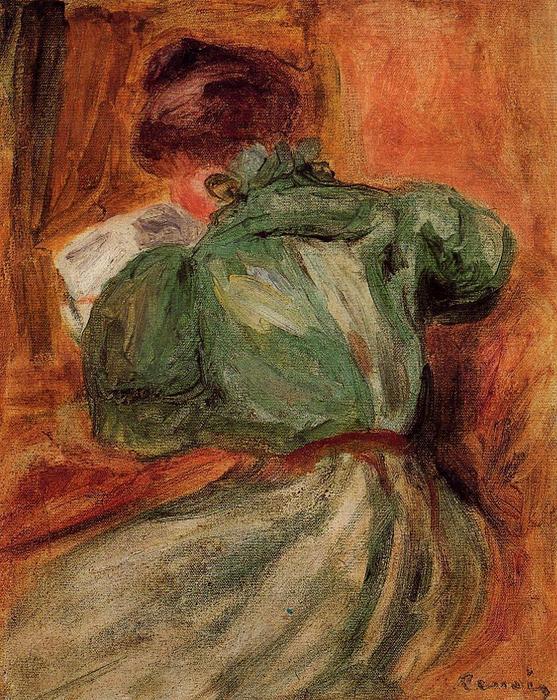
Reader in Green by Pierre-Auguste Renoir
Pierre-Auguste Renoir’s “Reader in Green,” completed in 1894, stands as an exquisite exemplar of Impressionism—a movement that sought to capture fleeting moments of light and color with unprecedented spontaneity. Housed within the Musée d'Orsay in Paris, this canvas transcends mere depiction; it embodies a profound exploration of domestic tranquility and feminine contemplation.
Composition and Subject Matter
The painting centers around a woman seated comfortably in a chair, her gaze directed towards a book held open before her. Renoir skillfully employs asymmetrical composition—the woman’s head tilts slightly to the left—creating visual dynamism that draws the viewer's eye across the canvas. Two figures inhabit the background: one stands behind the woman, providing support and grounding the scene, while another is positioned further away, subtly enhancing the sense of depth. The chair itself serves as a pivotal element, anchoring the composition and symbolizing stability amidst the ephemeral beauty of the moment.
Impressionist Techniques – A Dance of Light
Renoir’s mastery lies in his masterful application of Impressionist techniques. Loose, feathery brushstrokes dominate the surface, eschewing meticulous detail in favor of capturing the subtle nuances of light filtering through the window onto the woman's dress and surrounding environment. The green hue of her gown isn’t rendered with solid pigment but rather built up from a series of broken strokes—a technique characteristic of Impressionism—giving it an iridescent shimmer that vibrates with life. Renoir meticulously observed how sunlight transformed colors, prioritizing atmosphere over precise representation.
Influences Beyond Impressionism
Renoir's artistic vision was undeniably shaped by the broader currents of his time. He absorbed influences from Paul Cézanne, whose geometric simplification of forms paved the way for subsequent avant-garde movements like Cubism. Cézanne’s emphasis on underlying structure resonated with Renoir’s desire to move beyond mere optical illusion and delve into a deeper understanding of visual perception. Furthermore, the painting reflects the spirit of the Belle Époque—a period marked by optimism, artistic innovation, and burgeoning cultural sophistication—capturing the essence of a society embracing new ideas and aesthetic sensibilities.
Symbolism and Emotional Resonance
“Reader in Green” is more than just a portrait; it’s imbued with symbolic significance. The woman reading represents intellectual curiosity, introspection, and the pursuit of knowledge—values highly esteemed during the Belle Époque. The green dress symbolizes freshness, vitality, and perhaps even fertility, reflecting the prevailing Romantic ideals of beauty and femininity. Renoir's ability to convey emotion through subtle gestures and tonal variations elevates the painting beyond a simple visual record, inviting viewers to contemplate themes of contemplation, serenity, and the quiet pleasures of domestic life. It remains an enduring testament to Renoir’s artistic genius and his contribution to the legacy of Impressionism.