Explore Renoir's "The Fisherman," "Woman in a Straw Hat 2," and "Conversation with the Gardener." Discover more Impressionist masterpieces at ArtsDot.com.
Explore Pierre-Auguste Renoir's (1841-1919) luminous Impressionist paintings! Discover portraits, Parisian life & feminine beauty in his iconic artworks.
A Portrait Steeped in Tranquility: Exploring Renoir’s “Seated Woman”
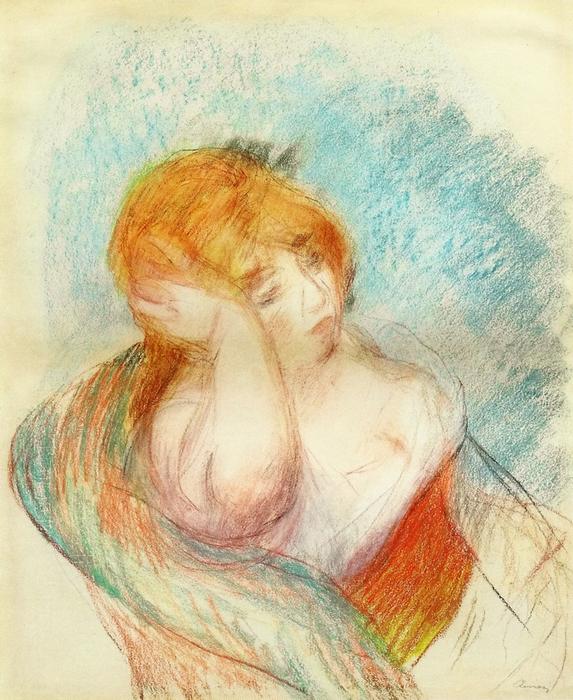
The painting "Seated Woman," attributed to Pierre-Auguste Renoir, stands as an exemplar of Impressionist aesthetics—a movement that sought to capture fleeting moments of sensory experience rather than meticulously rendering reality. Completed around 1883-84 during Renoir's prolific Parisian period, it depicts a woman seated gracefully on what appears to be a stone bench, her head resting delicately upon her hand. This posture immediately conveys an aura of serenity and contemplation, inviting the viewer into a space of quiet introspection.
Style and Technique: Impressionistic Brushstrokes
Renoir’s masterful technique embodies the core principles of Impressionism. Rather than striving for photographic accuracy, he employed loose, visible brushstrokes—a hallmark of his style—to convey the luminosity and vibrancy of light upon the woman's skin and drapery. The artist skillfully blended colors directly on the canvas, layering hues to achieve a shimmering effect that mimics the way sunlight dances across surfaces. Notice particularly the dappled patches of color beneath the shade of what is presumed to be foliage – this deliberate fragmentation of form contributes significantly to the painting’s overall impressionistic character.
Historical Context: The Belle Époque and Artistic Innovation
“Seated Woman” emerged during the Belle Époque—the “Beautiful Era”—a period marked by optimism, artistic experimentation, and social progress in France following the Franco-Prussian War. Impressionism was challenging established academic conventions, rejecting idealized representations of beauty in favor of capturing everyday life with immediacy and spontaneity. Renoir’s work aligns perfectly with this spirit of innovation, reflecting a broader cultural shift toward valuing sensory experience and emotional resonance over formal correctness. He was part of a group of artists who frequented Montmartre, the bohemian heart of Paris, fostering an environment conducive to artistic creativity and collaboration.
Symbolism: Gesture and Emotion
The woman’s gesture—resting her head on her hand—is laden with symbolic significance. Traditionally, this posture represents repose, vulnerability, and inner reflection. It speaks to a deeper emotional state – perhaps longing, melancholy, or simply a desire for stillness amidst the bustle of urban life. The subtle shading around her face enhances this sense of emotion, inviting viewers to engage in an empathetic response. Furthermore, the woman’s attire—a simple red dress—adds to the painting's visual harmony and contributes to its understated elegance.
Emotional Impact: Capturing a Moment of Grace
Ultimately, “Seated Woman” succeeds in conveying a profound emotional impact. It transcends mere depiction; it captures a fleeting moment of grace—a glimpse into the inner life of an individual experiencing quiet contemplation. The painting’s luminous palette and expressive brushstrokes evoke feelings of tranquility, beauty, and wistful nostalgia. It serves as a reminder that art can illuminate not only what we see but also what we feel, fostering connections between artist and viewer across time and space. This piece continues to resonate with audiences today, demonstrating the enduring power of Impressionist artistry.