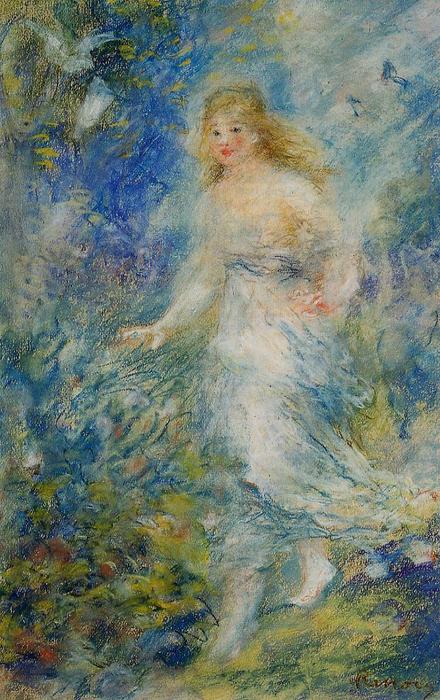
A Moment Frozen in Light: Exploring Renoir’s “Spring”
Pierre-Auguste Renoir's "Spring," painted in 1879, stands as a quintessential embodiment of Impressionism—a movement that sought to capture fleeting moments of sensory experience rather than meticulously documenting reality. More than just a depiction of a picturesque woodland scene, the painting delves into themes of renewal, beauty, and the harmonious relationship between humanity and nature, offering viewers an invitation to contemplate the ephemeral joys of springtime.
- Subject Matter: The artwork centers around a woman strolling through a sunlit grove, her presence radiating serenity amidst blossoming trees and azure skies. This deliberate choice of subject matter aligns perfectly with Impressionist ideals—focusing on capturing the atmosphere and mood of a particular place and time rather than adhering to strict compositional rules.
- Style: Renoir’s signature Impressionistic style is immediately recognizable through his loose brushstrokes, which create an illusion of shimmering light and movement. Unlike academic painting traditions that prioritized precise detail, Impressionists aimed for spontaneity and immediacy, prioritizing the artist's subjective perception of the visual world.
- Technique: Renoir skillfully employs broken color—applying pigment in small, separate strokes rather than blending them seamlessly—to achieve a luminous effect. This technique allows him to capture the subtle variations in light and color that characterize springtime landscapes, creating an impressionistic tapestry of hues and tones.
Historical Context: Impressionism’s Dawn
“Spring” emerged during a pivotal moment in artistic history—the burgeoning Impressionist movement challenged the conventions of Salon art exhibitions and established a new aesthetic vocabulary. Artists like Renoir rejected the rigid formalism of academic painting, advocating for plein air painting—working outdoors directly from nature—and prioritizing tonal harmony over meticulous realism. The painting reflects the broader cultural fascination with capturing transient beauty and celebrating the revitalizing power of springtime following the winter months.
- Salon Exhibitions: Prior to Impressionism’s ascendancy, Salon exhibitions dictated artistic trends, favoring idealized depictions of mythological subjects or historical narratives. Renoir's decision to portray a simple woodland scene represented a radical departure from these established norms.
- Scientific Influence: The burgeoning field of optics and color theory played an important role in shaping Impressionist technique. Artists like Renoir meticulously studied the effects of light on color, striving to reproduce accurately what their eyes perceived—a scientific approach that underpinned their artistic endeavors.
Symbolism and Emotional Resonance
Beyond its aesthetic qualities, “Spring” carries symbolic weight, representing rebirth, fertility, and optimism. The woman’s graceful posture conveys a sense of tranquility and contentment as she embraces the beauty of her surroundings—a visual metaphor for embracing life's joys and accepting change with grace. Renoir’s masterful use of color—particularly the dominant blues and greens—evokes feelings of freshness and vitality, inviting viewers to immerse themselves in the sensory experience of springtime.
Consider: The woman’s dress is adorned with a pattern that adds visual interest to the painting, mirroring the intricate beauty found within nature itself. This subtle detail underscores Renoir's belief that art should inspire contemplation and evoke emotional responses—a core principle of Impressionist philosophy.
Ultimately, “Spring” transcends mere representation; it’s a celebration of sensory experience and an affirmation of life’s inherent beauty. Its enduring appeal lies in its ability to transport viewers back to a moment frozen in light—a testament to Renoir's genius as an Impressionist painter and his profound understanding of the human spirit.