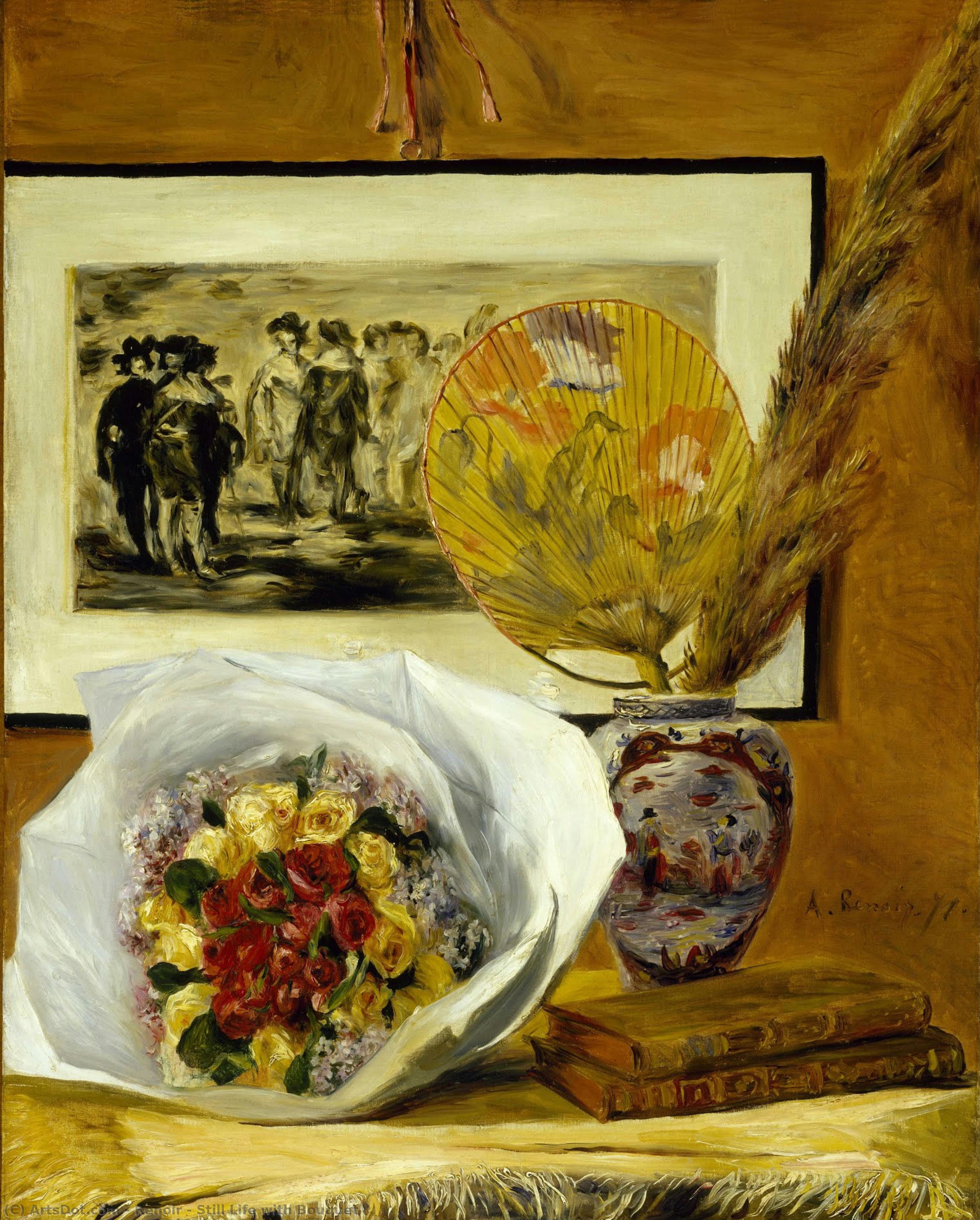
A Moment Preserved: Still Life with Bouquet by Pierre-Auguste Renoir
Pierre-Auguste Renoir’s “Still Life with Bouquet,” painted in 1871, isn't merely a depiction of objects arranged on a table; it’s an invitation into a world of quiet beauty and fleeting impressions – a quintessential example of the burgeoning Impressionist movement. This intimate scene, housed within the Museum of Fine Arts Houston, captures a specific moment, imbued with a sense of domestic tranquility and a subtle yearning for remembrance. The painting immediately draws the eye to the vibrant bouquet at its heart, a riot of color—deep reds, sunny yellows, delicate pinks, and hints of lavender—arranged loosely within a fold of white paper, suggesting both fragility and abundance.
Renoir’s masterful technique is evident in his loose, expressive brushstrokes. He abandons the meticulous detail favored by earlier academic painters, instead prioritizing the *impression* of light and texture. Notice how he doesn't attempt to precisely render each petal or leaf; rather, he uses short, broken strokes to capture their essence—the way sunlight catches on velvet folds, the subtle variations in color that define their form. The background elements – a framed picture, a decorative vase, and several books – are rendered with a similar sensitivity, contributing to the overall sense of atmosphere and depth. The inclusion of the framed artwork adds an intriguing layer of narrative, hinting at memories or perhaps a cherished scene from the past—a deliberate choice that elevates the still life beyond a simple arrangement of objects.
Impressionism’s Embrace of Light and Atmosphere
“Still Life with Bouquet” firmly establishes Renoir within the context of Impressionism. This movement, which gained momentum in France during the latter half of the 19th century, rejected the rigid conventions of academic art and sought to capture the ephemeral qualities of light and atmosphere. Artists like Monet, Sisley, and Pissarro were fascinated by how light transforms a scene throughout the day, and they experimented with techniques such as *plein air* painting—working outdoors directly from nature—to achieve this effect. Renoir’s use of vibrant color, loose brushstrokes, and emphasis on capturing fleeting moments perfectly embodies these principles. The soft, diffused lighting contributes significantly to the painting's serene mood, casting gentle shadows that enhance the sense of intimacy and warmth.
Symbolism Within a Domestic Setting
Beyond its aesthetic qualities, “Still Life with Bouquet” is rich in symbolic meaning. The bouquet itself can be interpreted as representing beauty, fleeting moments of joy, or even romantic love—a common motif in Impressionist art. The books suggest contemplation and knowledge, hinting at the intellectual pursuits of the owner of this space. The framed picture adds a layer of narrative complexity, possibly alluding to personal memories or cherished experiences. Renoir’s choice of objects – commonplace yet carefully arranged – speaks to the beauty he found in everyday life, transforming ordinary items into subjects worthy of artistic contemplation.
A Legacy of Light and Color
Pierre-Auguste Renoir's “Still Life with Bouquet” stands as a testament to the Impressionist movement’s revolutionary approach to painting. It is more than just a still life; it’s a window into a specific moment in time, imbued with emotion, atmosphere, and a profound appreciation for beauty. Reproductions of this captivating artwork offer an opportunity to bring this evocative scene into your home, allowing you to experience the magic of Renoir's brushstrokes and immerse yourself in its tranquil charm. Consider how the warm colors and loose technique would complement your interior design—creating a space that is both visually stunning and emotionally resonant.