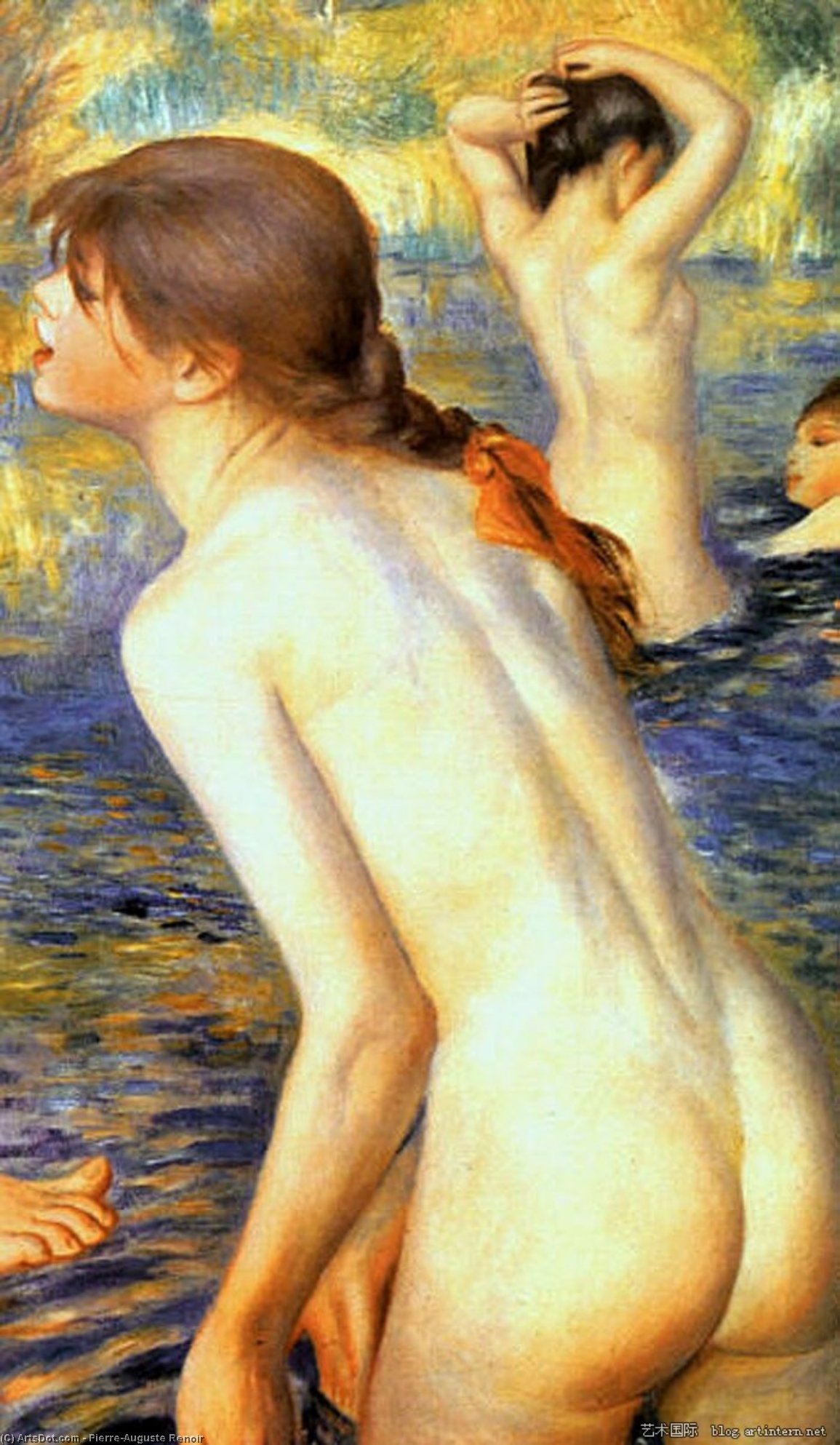
A Moment Frozen in Light: Exploring Renoir’s ‘The Great Bathers’
Pierre-Auguste Renoir's “The Great Bathers,” completed in 1887, stands as a quintessential embodiment of Impressionism—a movement that revolutionized painting by prioritizing fleeting impressions of light and color over meticulous detail. More than just a depiction of women enjoying the pleasures of summer, this monumental canvas delves into themes of beauty, sensuality, and the harmonious relationship between humanity and nature, cementing Renoir’s place as one of the most beloved artists of his era.
The painting captures three nude female figures reclining on towels in shallow water, bathed in dappled sunlight filtering through foliage. One woman gazes intently at her reflection in the tranquil surface—a gesture laden with contemplation and perhaps a subtle acknowledgment of femininity itself. Her posture exudes grace and serenity, mirroring the stillness of the surrounding environment. Alongside her are two other women partially clothed, adding to the dynamic interplay of light and shadow that characterizes Renoir’s masterful technique. A gentleman stands nearby, observing the scene with quiet admiration—a figure representing both social convention and a fascination with idealized beauty.
Renoir's approach to painting was fundamentally influenced by his early apprenticeship in porcelain decoration, where he honed skills in layering translucent glazes to achieve luminous effects. This meticulous attention to surface texture is evident in “The Great Bathers,” where Renoir employs loose brushstrokes—characteristic of Impressionism—to capture the shimmering quality of water and the velvety softness of skin. The palette is dominated by warm hues – ochre, peach, and rose – skillfully blended to create an atmosphere of warmth and vibrancy. Unlike academic painters who sought to represent reality with precise accuracy, Renoir prioritized capturing the subjective experience of seeing—the way light transforms color and shapes our perception of the world.
The historical context surrounding “The Great Bathers” is crucial to understanding its significance. Painted during the Belle Époque – a period of unprecedented optimism and artistic innovation in Paris – the artwork reflects the broader cultural fascination with leisure, hedonism, and idealized femininity. Renoir’s depiction aligns perfectly with the prevailing aesthetic sensibilities of his time, celebrating the sensual pleasures of summer days and embodying the Impressionists' belief that art should capture the ephemeral beauty of everyday life.
Beyond its visual splendor, “The Great Bathers” resonates deeply with viewers due to its exploration of profound themes. The nude figures represent not merely physical beauty but also vulnerability and freedom—a deliberate rejection of Victorian moral constraints. Furthermore, the painting’s serene composition conveys a sense of harmony between human beings and their environment, mirroring the Impressionists' reverence for nature as a source of inspiration and spiritual renewal. It remains an enduring testament to Renoir’s artistic genius and his ability to transform ordinary moments into extraordinary expressions of beauty and emotion.
- Artist: Pierre-Auguste Renoir
- Year Painted: 1887
- Style: Impressionism
- Medium: Oil on Canvas