Pierre-Auguste Renoir’s “The Hat Pinned”: A Moment of Intimacy and Romantic Grace
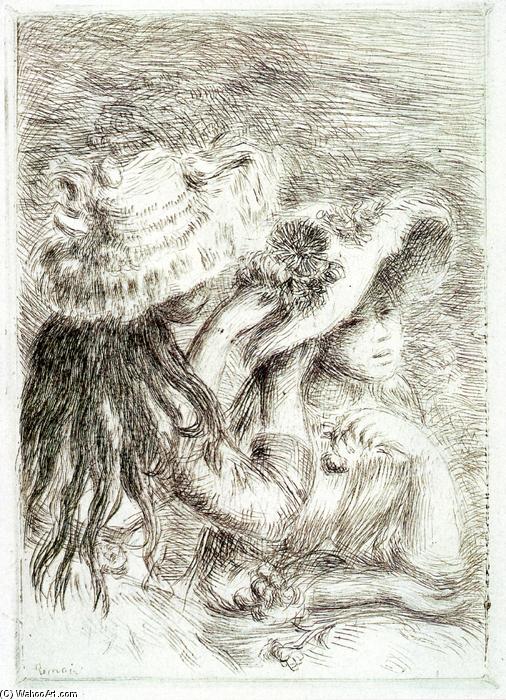
Pierre-Auguste Renoir's "The Hat Pinned" (1894) is more than just a lithograph; it’s a delicately rendered tableau of feminine connection, imbued with the quiet elegance characteristic of the Impressionist movement. This evocative work captures a fleeting moment between three figures – a young girl, her mother, and an unseen observer – within a domestic setting that feels both familiar and subtly melancholic. The piece, executed in meticulous hatching and cross-hatching, speaks volumes about Renoir’s mastery of tonal value and his ability to convey emotion through the subtle manipulation of line and shadow.
The scene unfolds with remarkable intimacy. A young girl, her face partially obscured, is carefully adjusting a hat – likely pinned by her mother – while an implied presence watches from the background. The composition is vertically oriented, drawing the eye upwards towards the central figures and creating a sense of height and contained space. Renoir’s use of muted tones—primarily browns, grays, and creams—evokes a soft, diffused light, reminiscent of a late afternoon indoors. This atmospheric quality contributes significantly to the painting's overall mood of gentle contemplation.
A Study in Romantic Realism
Renoir’s style here beautifully blends elements of Romanticism with the emerging tenets of Impressionism. The emphasis on emotional expression and the portrayal of human relationships are hallmarks of the Romantic tradition, while the loose brushwork, focus on capturing fleeting moments, and exploration of light and color align perfectly with the Impressionist movement. Unlike the rigid formality often found in academic art, Renoir’s figures possess a naturalness and spontaneity that feels remarkably contemporary for its time.
The technique employed is particularly noteworthy. Renoir masterfully utilizes hatching – layering parallel lines to create tonal variations – to build up form and texture. This method allows him to suggest the softness of fabric, the contours of faces, and the subtle play of light on surfaces with remarkable precision. The careful attention to detail in rendering the hat itself—its folds, its sheen, and the way it catches the light—demonstrates Renoir’s keen observational skills and his ability to translate visual impressions onto paper.
Symbolism and Emotional Resonance
Beyond its technical brilliance, “The Hat Pinned” is rich in symbolic meaning. The act of pinning a hat can be interpreted as a gesture of care, protection, or even control – suggesting the mother’s role in guiding and nurturing her daughter. The unseen observer adds an element of mystery and perhaps a hint of longing, inviting the viewer to contemplate the dynamics between these three figures. The overall mood is one of quiet intimacy, tenderness, and a subtle undercurrent of melancholy—a poignant reminder of fleeting moments and the complexities of human relationships.
Historical Context and Legacy
Created in 1894, “The Hat Pinned” reflects a period of significant artistic experimentation and social change. Impressionism was gaining momentum as a challenge to traditional academic art, and Renoir was at the forefront of this movement. The work’s focus on everyday life—a simple domestic scene—contrasts sharply with the grand historical or mythological subjects favored by many artists of the time. It's interesting to note that Pierre-Auguste Renoir himself was a father, and his art often explored themes of family and intimacy. This piece, like much of his work, offers a glimpse into the private world of Parisian life during the late 19th century.
Reproductions of “The Hat Pinned” continue to resonate with viewers today, offering a timeless depiction of human connection and emotional depth. Its delicate beauty and evocative atmosphere make it a captivating addition to any collection or interior space—a testament to Renoir’s enduring legacy as one of the greatest artists of the Impressionist era.