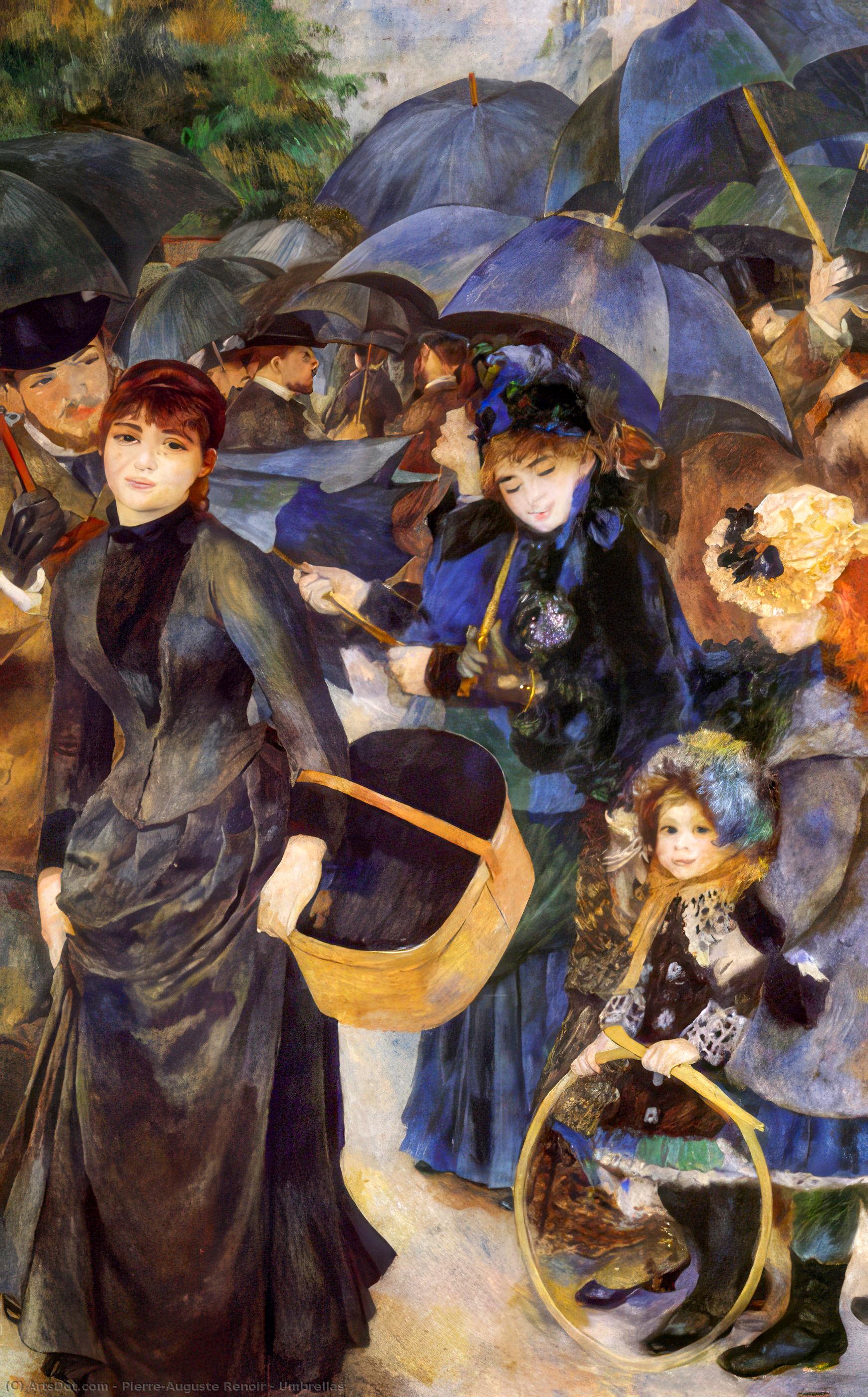
A Parisian Moment Captured in Time: Exploring Renoir's "Umbrellas"
Pierre-Auguste Renoir’s “Umbrellas,” painted in 1886, isn't merely a depiction of a rainy day; it is an intimate glimpse into the vibrant social fabric of 19th-century Paris. This masterpiece of Impressionism invites us to step onto a bustling Parisian street, sharing a fleeting moment with its elegantly dressed inhabitants. The painting’s enduring appeal lies not just in its technical brilliance but also in its ability to evoke a sense of atmosphere and human connection that resonates deeply even today.
The Essence of Impressionism: Light, Color, and Fleeting Moments
“Umbrellas” stands as a quintessential example of Renoir’s signature Impressionist style. Eschewing the rigid formality of earlier artistic movements, Renoir embraced spontaneity and sought to capture the ephemeral qualities of light and color. Observe how he employs loose, expressive brushstrokes – not meticulously blending colors but allowing them to sit side-by-side, creating a shimmering effect that mimics the play of light on wet surfaces. The palette is dominated by muted tones—blues, blacks, and browns—which establish a somber yet sophisticated ambiance. Yet, within this restrained color scheme, Renoir masterfully uses pops of brighter hues to draw the eye and highlight key figures. The umbrellas themselves, predominantly in shades of blue, act as unifying elements, guiding our gaze through the lively scene and subtly reinforcing the sense of shared experience.
A Narrative Unfolding: Composition and Symbolism
The composition is a carefully orchestrated dance of figures, creating a dynamic interplay between individuals within an urban setting. At the heart of the painting are two women engaged in animated conversation, sheltered beneath a single umbrella—a gesture that speaks volumes about intimacy and connection. To their right, a child’s playful interaction with a hoop injects a sense of youthful energy and movement into the scene. The background teems with other individuals, each holding an umbrella, contributing to the painting's depth and density. Beyond its visual appeal, “Umbrellas” is rich in symbolism. The umbrellas themselves represent protection and unity—a shared shield against the elements that brings people together. The contrast between the adults’ more subdued expressions and the child’s carefree play adds layers of emotional complexity, prompting reflection on the different ways we experience life's moments.
Historical Context and Renoir's Artistic Evolution
Created during a period when Renoir was at the height of his artistic powers, “Umbrellas” reflects both his mature style and his ongoing exploration of light and color. The 1880s marked a significant phase in Renoir’s career, characterized by a focus on capturing the beauty and sensuality of everyday life—the simple pleasures of Parisian existence. While initially embracing the more radical tenets of Impressionism, Renoir began to incorporate elements of classical art into his work during this time, as evidenced by the subtle linearity and refined forms present in “Umbrellas.” This evolution is particularly noticeable in the treatment of the central female figure, whose features exhibit a greater degree of definition than those found in some of his earlier works. The painting stands as a testament to Renoir’s ability to synthesize diverse influences into a uniquely personal artistic vision.