Explore Pierre-Auguste Renoir's (1841-1919) luminous Impressionist paintings! Discover portraits, Parisian life & feminine beauty in his iconic artworks.
Discover Detroit's iconic art scene at the DIA! Explore world-class collections, including Rivera murals & American masterpieces, reflecting the city’s rich history and vibrant culture.
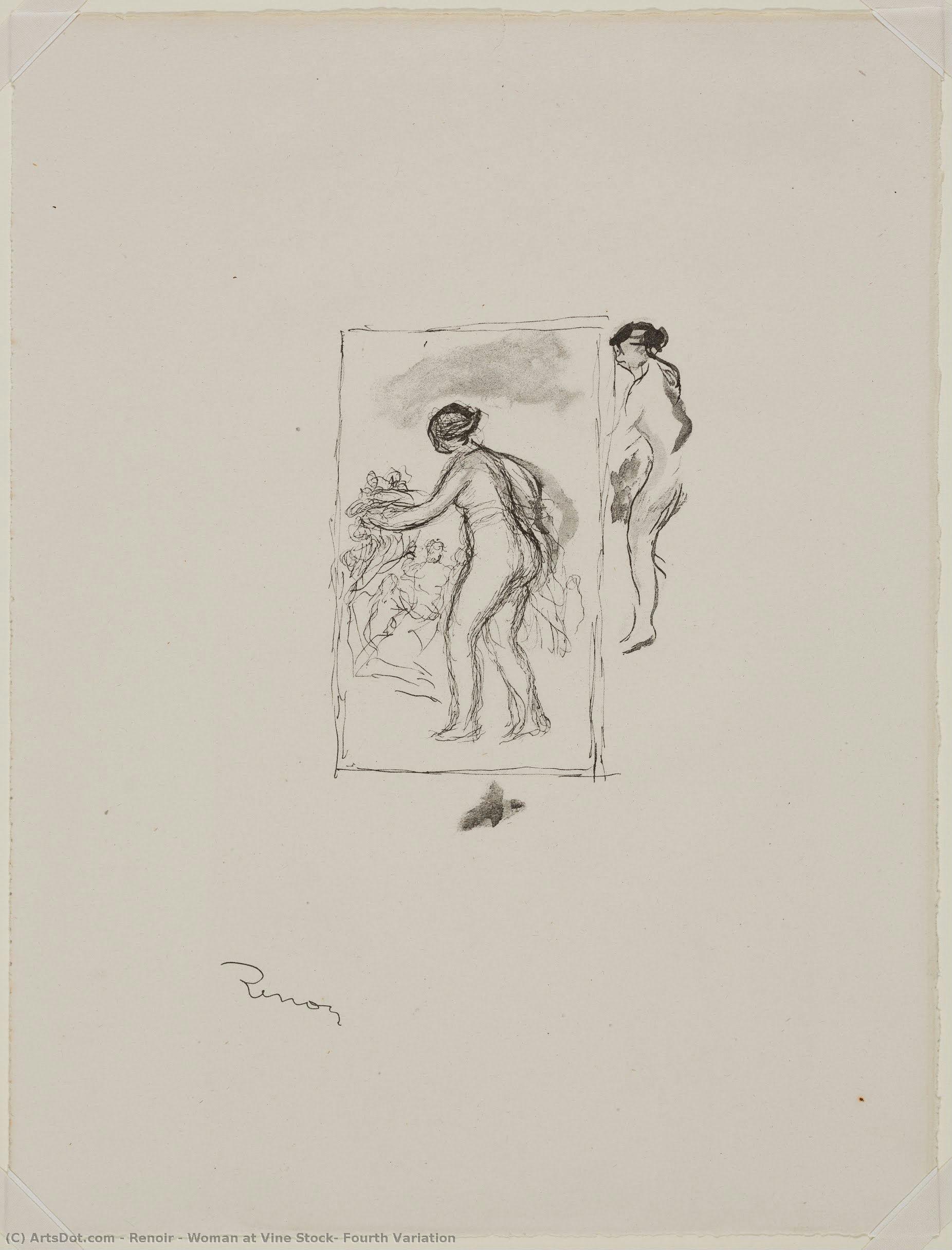
Woman at Vine Stock, Fourth Variation – A Study in Impressionistic Tranquility
Pierre-Auguste Renoir’s “Woman at Vine Stock, Fourth Variation” is a deceptively simple sketch that encapsulates the very essence of Impressionism—a fleeting glimpse into a moment of serene beauty captured with rapid brushstrokes and subtle tonal shifts. Executed around 1904 and published in 1919 as part of his celebrated lithograph suite “Twelve Original Lithographs,” this artwork offers more than just a visual representation; it invites contemplation on the relationship between humanity and nature, rendered with remarkable sensitivity to light and texture.
Composition and Technique: Embracing Impressionistic Fluidity
The composition prioritizes organic forms—a woman standing near a vine stock—within a loosely defined rectangular frame. Renoir’s technique is characterized by loose, gestural lines that prioritize capturing the immediacy of perception over meticulous detail. Charcoal or pencil on paper dominates, resulting in a surface texture that subtly suggests variations in pressure and tonal gradation. The artist eschews sharp angles or geometric precision, aligning perfectly with Impressionist principles aimed at conveying sensory experience rather than photographic realism. Notice how the lines weave together, creating movement and hinting at depth despite the flattened perspective—a deliberate choice to emphasize spontaneity and intimacy.
Historical Context: Renoir’s Pursuit of Light and Atmosphere
Renoir's artistic journey began amidst the vibrant intellectual currents of Paris at the turn of the century. Influenced profoundly by artists like Monet and Sisley, he relentlessly pursued the elusive qualities of light and atmosphere—themes central to Impressionist aesthetics. Like many Impressionists, Renoir sought inspiration outdoors, meticulously observing natural landscapes and capturing their ephemeral beauty on canvas. The sketch’s monochromatic palette – shades of grey and white against an off-white background – reinforces this focus on tonal nuance and contributes to the artwork's contemplative mood. Considering the broader context of Impressionism, "Woman at Vine Stock" exemplifies Renoir’s commitment to portraying scenes from everyday life infused with poetic emotion.
Symbolic Resonance: Connection and Observation
Beyond its formal qualities, “Woman at Vine Stock” speaks to deeper symbolic concerns. The woman's posture suggests attentive observation and care—a gesture of connection with the natural world. The vine stock itself symbolizes fecundity and renewal, mirroring Renoir’s fascination with capturing transient moments of beauty. While not overtly laden with iconography, the artwork evokes a feeling of tranquility and invites viewers to appreciate the subtle harmonies found within simple landscapes. It's a testament to Renoir’s ability to distill complex emotions into understated visual language.
Emotional Impact: A Moment Frozen in Time
Ultimately, “Woman at Vine Stock” succeeds in conveying an emotional resonance that transcends its technical execution. The sketch’s loose style and tonal subtlety imbue it with a palpable sense of immediacy—as if capturing a fleeting instant of serenity. It's a piece that encourages reflection on the beauty of observation and the restorative power of nature, qualities deeply valued by Renoir himself and enduringly appreciated by audiences today. Reproductions offer an exceptional opportunity to experience this captivating Impressionistic vision firsthand.