Explore Pierre-Auguste Renoir's (1841-1919) luminous Impressionist paintings! Discover portraits, Parisian life & feminine beauty in his iconic artworks.
Renoir's Reverie: Exploring the Elegance of Woman’s Nude Torso
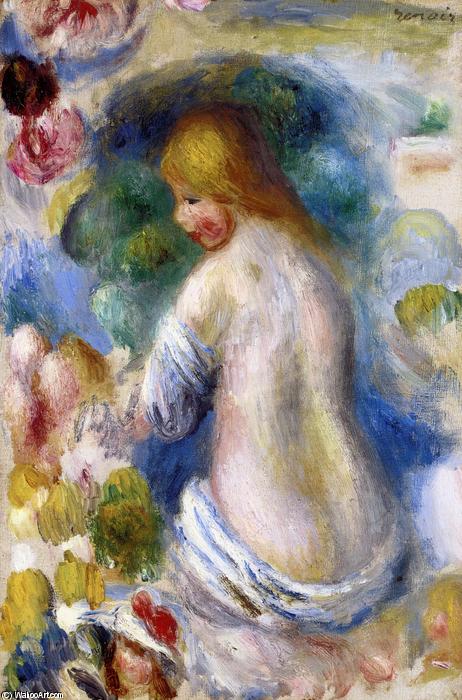
Pierre-Auguste Renoir’s *Woman’s Nude Torso*, completed around 1876, stands as a quintessential embodiment of Impressionist aesthetics—a celebration of light, color, and sensual beauty captured with breathtaking immediacy. Measuring just 34 x 23 cm, this painting transcends its diminutive size to deliver an experience of profound artistic contemplation. It resides within the Musée d’Ixelles in Brussels, Belgium, where visitors can immerse themselves in the luminous atmosphere created by Renoir's masterful brushstrokes and his unwavering devotion to capturing fleeting moments of visual sensation.
Compositional Harmony: A Dance of Light and Form
The painting’s genius lies in its deceptively simple yet exquisitely balanced composition. Renoir presents us with a woman’s torso turned away from the viewer, creating an intimate tableau that invites introspection. Her posture exudes grace and repose, mirroring the serene stillness of the surrounding environment. The lower half of the canvas showcases her dress—a creamy white fabric rendered in delicate brushstrokes—illuminated by diffused sunlight, establishing a harmonious interplay between light and shadow. Two potted plants flank the woman, adding subtle textural elements that enrich the visual landscape without distracting from the central figure. A vase positioned near the left edge contributes to the overall sense of tranquility, while a bowl nestled at the bottom right corner anchors the composition.
The Alchemy of Light: Impressionistic Principles in Action
Renoir’s technique exemplifies the core tenets of Impressionism—specifically, his meticulous observation and depiction of light's transformative effects on color and form. As art historians have meticulously documented, Impressionists like Monet prioritized capturing the ephemeral qualities of daylight, rejecting traditional academic conventions that demanded precise tonal rendering. Renoir achieves this goal through a technique known as *plein air* painting, working outdoors directly before his easel to capture the nuances of natural illumination. The dappled sunlight filtering through foliage casts soft shadows across the woman’s torso and dress, creating a velvety texture that enhances the painting's sensual appeal. This careful manipulation of light imbues the artwork with an ethereal glow—a testament to Renoir’s ability to translate visual experience into artistic expression.
Echoes of Classicism and Modern Sensuality
Despite its Impressionistic style, *Woman’s Nude Torso* subtly references classical ideals of beauty—particularly those championed by artists like Rubens and Watteau. The woman's pose recalls sculptures depicting idealized female figures, conveying a sense of timeless elegance. However, Renoir deftly blends these influences with the burgeoning fascination for naturalism that characterized the late 19th century. Unlike earlier depictions of nude figures, which often prioritized anatomical accuracy over emotional resonance, Renoir prioritizes capturing the woman’s inner serenity—her gaze averted from the viewer—creating a portrait that speaks to the soul rather than merely presenting a visual representation.
A Legacy Illuminated: Comparisons with Fellow Impressionists
The painting's spirit resonates powerfully with the broader artistic movement of Impressionism, alongside works by Claude Monet and Paul Gauguin. Monet’s landscapes—particularly his series depicting Rouen Cathedral—share Renoir’s preoccupation with capturing light’s fleeting transformations, while Gauguin’s Tahitian canvases explore similar themes of primitivism and sensual experience. Examining these comparative artworks underscores the shared commitment to portraying beauty in its most immediate form—a legacy that continues to inspire artists and captivate audiences today. The Musée d’Ixelles serves as a beacon for art enthusiasts eager to appreciate Renoir's enduring contribution to Impressionist art history.