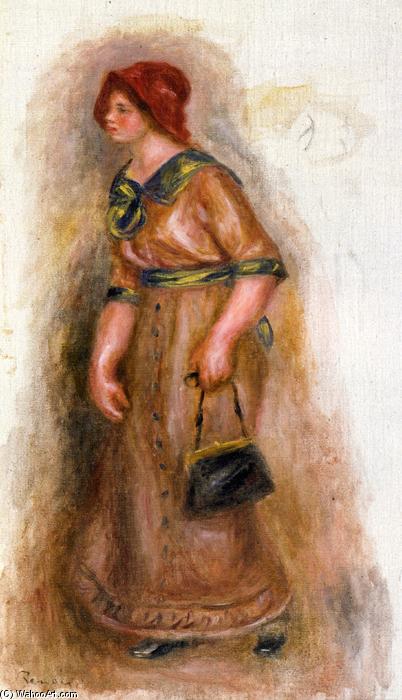
Woman with Bag by Pierre-Auguste Renoir
Pierre-Auguste Renoir’s “Woman with Bag,” completed in 1906, stands as an emblem of Impressionism—a movement that irrevocably altered the course of art history. More than just a depiction of a woman strolling down Parisian streets, it embodies Renoir's profound understanding of capturing fleeting moments and conveying emotion through luminous color and delicate brushstrokes. Measuring 55 x 35 cm and executed in oil on canvas, this artwork resides within El Museo Parrish Art Museum (Estados Unidos), attracting admirers who appreciate its masterful blend of observation and artistic expression.
Impressionism: A Revolution in Perception
The Impressionist movement arose in France during the late nineteenth century as a defiant reaction against academic conventions. Artists like Claude Monet, Paul Cézanne, and Georges Braque sought to liberate painting from rigid rules concerning perspective and form—prioritizing instead the subjective experience of seeing. Renoir’s approach mirrored this ethos; he wasn't interested in meticulously recreating reality but rather in conveying its essence – the way light dances across surfaces and imbues objects with vibrancy. “Woman with Bag” exemplifies this principle, demonstrating Renoir’s ability to transform an ordinary scene into a captivating visual poem.
Composition and Technique: Light as Subject Matter
Renoir's compositional choices contribute significantly to the painting's impact. The woman is positioned centrally, bathed in dappled sunlight—a hallmark of Impressionist technique. Her flowing dress and scarlet hair draw attention, yet Renoir skillfully softens these details with subtle blending, creating an atmosphere of warmth and tranquility. Notice how he employs loose brushstrokes to render textures – the fabric of her dress, the folds of her scarf—giving the painting a palpable sense of movement and immediacy. The artist’s masterful manipulation of color is equally noteworthy; shades of brown and ochre dominate the background, providing a harmonious counterpoint to the woman's fiery hues.
Symbolism and Emotional Resonance
Beyond its aesthetic qualities, “Woman with Bag” resonates with deeper symbolic meanings. The handbag itself represents practicality and everyday life—a deliberate departure from the idealized subjects favored by earlier artistic traditions. Renoir’s portrayal of femininity isn’t merely decorative; it conveys a sense of grace and confidence—reflecting the changing social landscape of early twentieth-century France. The painting invites contemplation on themes of beauty, solitude, and the ephemeral nature of experience—capturing not just what is seen but also how it feels to observe the world around us.
Legacy and Relevance Today
“Woman with Bag” continues to inspire artists and collectors alike. Its enduring appeal stems from Renoir’s unwavering commitment to capturing the beauty inherent in ordinary moments—a philosophy that aligns perfectly with contemporary sensibilities. For those seeking a piece of Impressionist art history, a high-quality reproduction of this masterpiece is available at ArtsDot.com. Explore more captivating artworks by Pierre Auguste Renoir and delve into the artistic spirit of the Belle Époque at
Pierre-Auguste Renoir: Woman with Bag. Also, consider examining Paul Cézanne’s “Woman Diving into Water” and Pierre Auguste Vafflard's "Young Holding his Dead Daughter" for comparative insights into artistic expression during the same period.