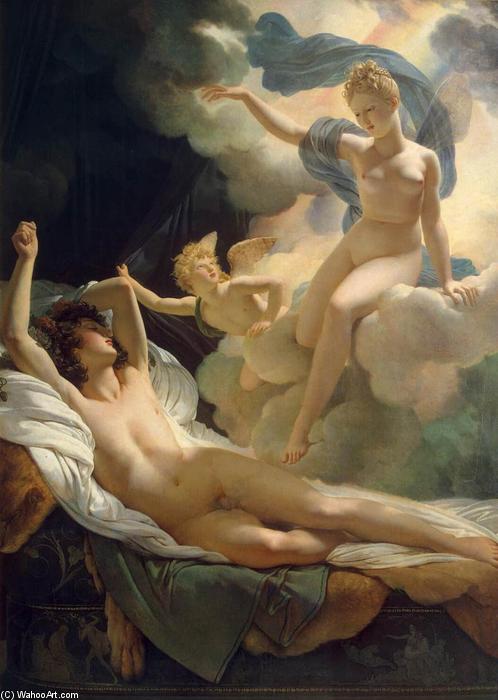
Delacroix and Géricault's influence shaped Guérin’s style! Admire Pierre Narcisse Guérin’s neoclassical masterpiece, ‘Morpheus and Iris,’ depicting gods of dreams & rainbow – housed in St Petersburg’s Hermitage.
Morpheus and Iris: A Dreamscape of Classical Myth
Pierre Narcisse Guérin’s *Morpheus and Iris* stands as a testament to the enduring fascination with classical mythology within the Romantic era. Painted in 1811, this monumental oil on canvas—measuring 251 x 178 cm—currently resides in The Hermitage museum in St. Petersburg, Russia, offering visitors a glimpse into the artistic sensibilities of its time. Guérin’s masterful execution captures not merely an image but an atmosphere, transporting viewers to a realm where divine figures intertwine with ethereal beauty.
Composition and Style: Balancing Light and Shadow
The painting depicts Morpheus, the god of dreams, reclining serenely on a bed, accompanied by Iris, goddess of the rainbow and messenger of Olympus, who extends her hand towards him. This carefully orchestrated scene unfolds against a backdrop of softly diffused clouds—a deliberate choice that underscores the dreamlike quality inherent in Guérin’s vision. The artist employs classical principles of composition, prioritizing balance and harmony—a hallmark of Neoclassicism—yet imbues it with an emotional depth characteristic of Romanticism. Light and shadow play a crucial role, sculpting form and creating a palpable sense of dimensionality that draws the eye into the depicted space.
Technical Brilliance: Mastering Oil Paint
Guérin’s technique demonstrates exceptional skill in manipulating oil paint. He achieves remarkable tonal gradations through meticulous blending—evident in the subtle nuances of color within the clouds and Morpheus' drapery—resulting in a luminous surface that captures the ethereal glow of twilight. The artist’s brushstrokes are confident yet controlled, conveying both precision and expressive dynamism. Detailed observation informs every aspect of the painting, from the rendering of Morpheus’ facial features to the delicate folds of Iris’ garment, reflecting Guérin's commitment to realism within a stylized framework.
Mythological Narrative: Echoes of Ovid’s Metamorphoses
The subject matter derives directly from Ovid’s *Metamorphoses*, where Iris accompanies Morpheus on his journey back to Rome—a poignant allegory mirroring the protagonist’s grief over lost love and the desolate landscape of his return. Guérin skillfully translates this mythological narrative into visual form, conveying profound emotion through gesture and posture. Morpheus' gaze is contemplative, hinting at the subconscious realm of dreams, while Iris’ outstretched hand symbolizes hope and divine intervention—a powerful juxtaposition that encapsulates the painting’s thematic core.
Historical Context: Bridging Neoclassicism and Romanticism
Guérin’s work exemplifies the transitional period between Neoclassicism and Romanticism in France. While adhering to classical ideals of order and restraint, he nevertheless incorporates elements of Romantic emotion—particularly luminosity and dramatic expression—demonstrating the evolving artistic landscape of the early 19th century. The painting reflects a broader cultural preoccupation with themes of mortality, memory, and spiritual contemplation—concerns that resonated deeply within the Romantic movement’s intellectual currents.
- Artist: Pierre Narcisse Guérin
- Year: 1811
- Dimensions: 251 x 178 cm
- Location: The Hermitage Museum, St. Petersburg