A Celestial Ascent: Exploring Prud'hon’s "Psyche Transported to Heaven"
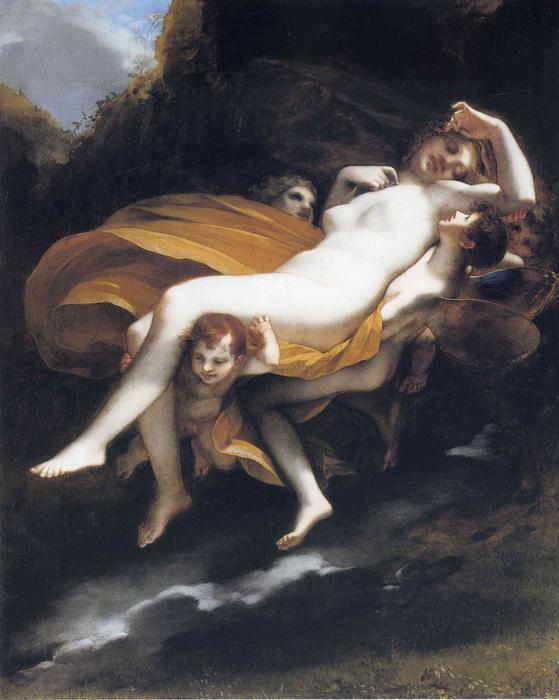
Pierre-Paul Prud'hon's "Psyche transported to Heaven," painted around the early 19th century, is a captivating work that embodies the transition from Neoclassicism to Romanticism in French art. Measuring an impressive 197 x 195 cm, this oil on canvas masterpiece depicts a pivotal moment from Greek mythology – Psyche’s ascension to Olympus after enduring trials of love and proving her worthiness to be with Eros (Cupid). The painting isn't just a visual narrative; it's a profound exploration of themes like devotion, redemption, and the ultimate triumph of virtue.
Romanticism & Neoclassical Echoes
Prud’hon masterfully blends elements of both artistic movements. While retaining the clarity of line and idealized forms characteristic of Neoclassicism, he infuses the scene with a palpable emotional intensity that defines Romanticism. The soft, diffused lighting, the flowing drapery, and Psyche’s serene yet yearning gaze all contribute to this emotive atmosphere. The composition itself moves away from the rigid symmetry often found in Neoclassical works, embracing a more dynamic and fluid arrangement.
Symbolism & Narrative
The painting is rich with symbolic meaning. Psyche, representing the human soul, is being lifted towards heaven by cherubs – traditional symbols of love, joy, and divine assistance. Their gentle support signifies the grace bestowed upon those who demonstrate unwavering devotion. The upward gaze of Psyche embodies aspiration and spiritual longing. Her garments, rendered in delicate folds, suggest both vulnerability and ethereal beauty. The soft blue sky filled with clouds evokes a sense of peace and transcendence, hinting at the eternal reward awaiting her. It's important to note that this scene draws from Ovid’s *Metamorphoses*, where Psyche’s journey is a testament to overcoming adversity through love and faith.
Prud'hon: A Master of Chiaroscuro & Portraiture
Pierre-Paul Prud'hon (1758-1823) was renowned for his exceptional skill in chiaroscuro – the dramatic use of light and shadow. In "Psyche transported to Heaven," this technique is evident in how Psyche and the cherubs are illuminated against a darker background, drawing the viewer's eye directly to the central narrative. Beyond this allegorical work, Prud’hon gained considerable fame for his portraits, notably those of Napoleon Bonaparte’s wives, Josephine and Marie-Louise. His ability to capture both physical likeness and psychological depth made him a sought-after artist in his time. He was admired by leading figures like Stendhal, Delacroix, Millet, and Baudelaire, further solidifying his place in art history.
Emotional Resonance & Artistic Legacy
"Psyche transported to Heaven" is more than just a depiction of a mythological scene; it's an exploration of universal human emotions – hope, longing, and the pursuit of something greater. The painting’s gentle beauty and uplifting narrative continue to resonate with audiences today, making it a timeless masterpiece that speaks to the enduring power of love and redemption. Its influence can be seen in later Romantic artists who sought to convey emotional depth through their works.