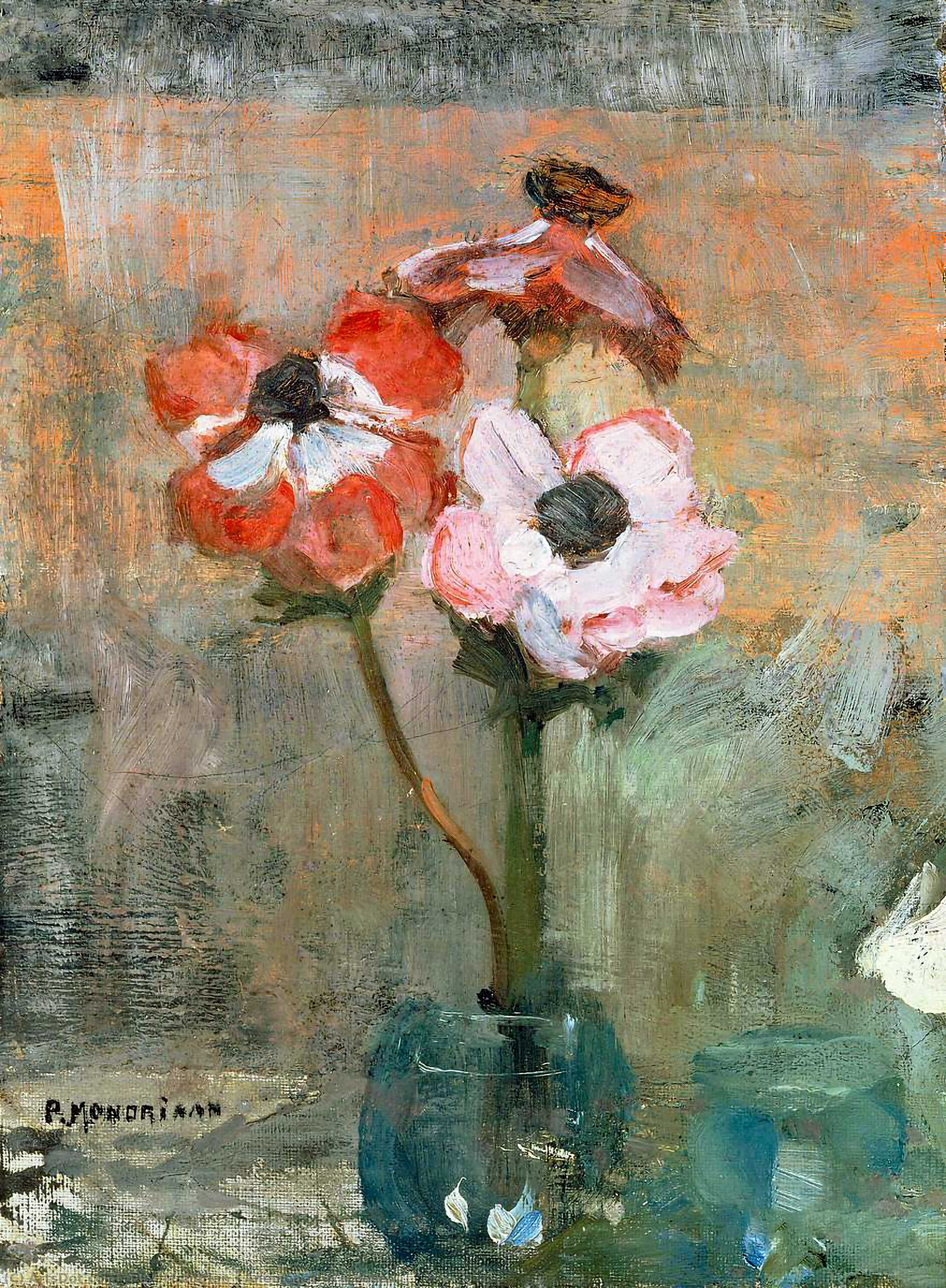
Discover Piet Mondrian’s ‘Anemones in a Vase,’ a seminal Neoplastic masterpiece! Explore geometric harmony, primary colors & the artist's revolutionary pursuit of universal beauty. Hand-painted reproduction available.
Discover Piet Mondrian (1872-1944), pioneer of abstract art & De Stijl. Explore Neoplasticism, geometric paintings, and his lasting impact on modern design.
A Study in Geometric Harmony: Piet Mondrian’s Anemones in a Vase
Piet Mondrian, a titan of modern art who irrevocably reshaped the visual landscape of the 20th century, embodies an unwavering pursuit of pure abstraction. His artistic journey—from depicting the natural world to distilling it into its fundamental elements—is brilliantly exemplified by *Anemones in a Vase*, a deceptively simple still life that encapsulates the core tenets of Neoplasticism. This movement, spearheaded by Theo van Doesburg in 1917, represented a radical departure from prevailing artistic conventions, prioritizing clarity and universality through reductive geometric forms and restrained color palettes. Mondrian’s unwavering commitment to this philosophy cemented his place as one of the foremost figures in shaping the aesthetic sensibilities of an era.
Neoplasticism: The Essence of Form and Color
At its heart, Neoplasticism—also known as De Stijl—was a fervent reaction against Impressionism and Expressionism. Artists involved sought to liberate art from representational illusion, focusing instead on constructing compositions using only three primary colors – red, yellow, and blue – and orthogonal lines (vertical and horizontal). This deliberate simplification wasn’t merely stylistic; it was intended to reflect a deeper philosophical conviction that the universe itself operates according to mathematical principles. Mondrian believed that by mirroring these underlying structures, art could transcend subjective experience and communicate universal truths.
“Anemones in a Vase”: A Delicate Balance of Color and Geometry
The painting itself presents a striking juxtaposition of organic beauty and geometric precision. Two anemones—their crimson petals delicately unfurled against the creamy white of their centers—are positioned within a vase rendered in a bold shade of azure blue. This careful arrangement underscores Mondrian’s early experimentation with Neoplasticism, demonstrating how he could integrate natural forms into his rigorously structured compositions. A cup sits discreetly at the lower right corner, adding depth and grounding the visual field. The muted tones of the tabletop serve as a counterpoint to the vibrancy of the flowers, creating an interplay that enhances their impact.
Decoding Mondrian’s Technique: Oil on Canvas
Executed in oil paint on canvas, *Anemones in a Vase* showcases Mondrian's mastery of technique. He employed meticulous brushstrokes—almost imperceptible in their subtlety—to achieve a smooth surface finish and to convey the illusion of texture without resorting to extraneous detail. The artist’s deliberate use of orthogonal lines – horizontal and vertical – dominates the composition, establishing a harmonious balance that reflects the movement’s core aesthetic principles. Furthermore, Mondrian's careful selection of color contributes significantly to the painting's emotive power—the assertive blue of the vase juxtaposed against the warm hues of the anemones evokes feelings of serenity and contemplation.
A Legacy Beyond Representation
*Anemones in a Vase*, though seemingly unassuming, represents a pivotal moment in Mondrian’s artistic evolution. It foreshadows his later explorations into increasingly abstract forms—squares and rectangles dominating his canvases—solidifying his reputation as one of the pioneers of minimalist art. More than just a depiction of flowers; it is an embodiment of Neoplasticist ideals – a testament to the transformative potential of reducing visual language to its purest expression. Its enduring appeal lies in its ability to communicate profound ideas about order, harmony, and the fundamental nature of reality.