A Prelude to Neoplasticism: Exploring Mondrian’s ‘Composition in Oval with Color Planes’
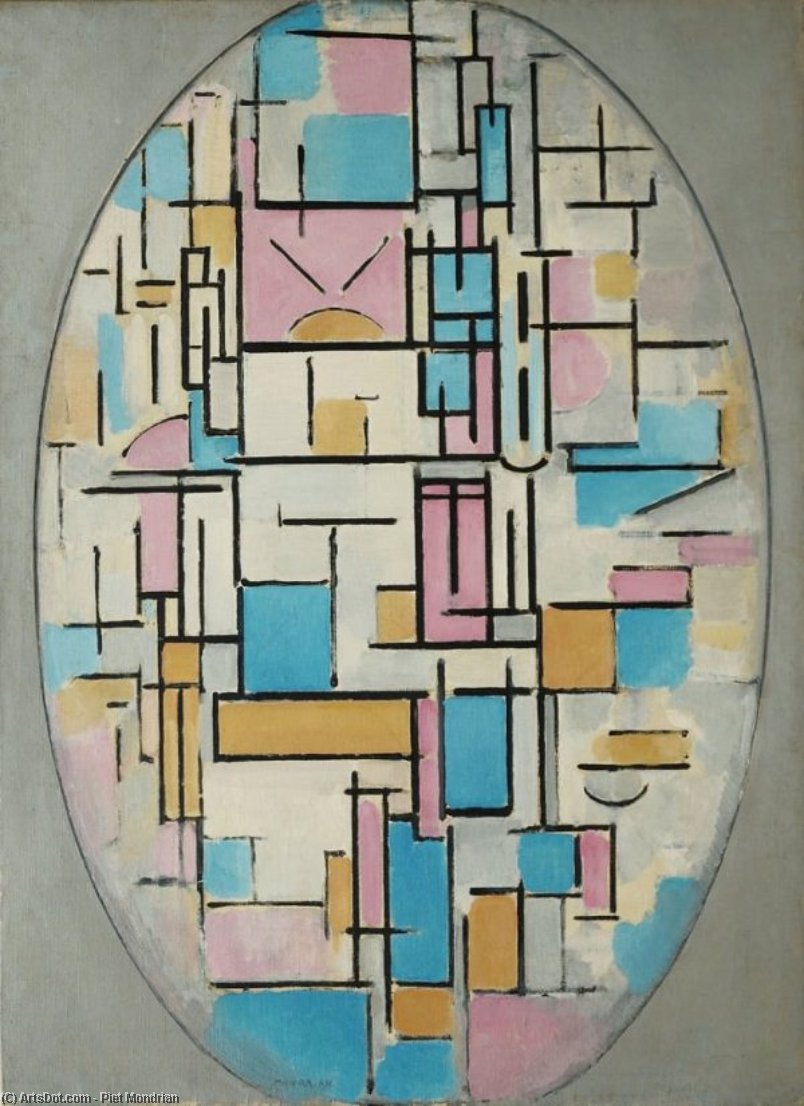
This captivating work by Piet Mondrian represents a pivotal moment in the artist's evolution towards his iconic style of geometric abstraction. Created during a period of intense experimentation, *Composition in Oval with Color Planes* offers a fascinating glimpse into the development of Neoplasticism – a movement that would profoundly impact 20th-century art and design. The painting isn’t yet the rigid gridwork Mondrian became famous for; instead, it's a dynamic exploration of color and form contained within an organic oval shape.
Deconstructing Form and Color
The composition is built around a central oval, internally divided into a series of intersecting planes of color. These aren’t blended or shaded traditionally; rather, Mondrian employs flat, distinct areas of hues – blues, yellows, pinks, and whites – creating a sense of spatial depth through juxtaposition. The use of rectangular and square shapes within the oval hints at the geometric precision to come, but retains a playful quality absent in his later works.
Notice how the colors aren’t applied randomly; they seem carefully considered for their relationships with one another, establishing a visual harmony despite the apparent fragmentation.
Historical Context: From Naturalism to Abstraction
Born in 1872, Piet Mondrian initially trained as a landscape painter within the Dutch Impressionist tradition. However, he became increasingly drawn to more abstract forms of expression. Influenced by Theosophy – a spiritual movement emphasizing underlying unity – and artists like Kazimir Malevich and his Suprematism, Mondrian sought to reduce painting to its essential elements:
pure form and color. This piece falls squarely within this transitional phase, bridging the gap between representational art and the radical abstraction that would define his mature style. It’s a testament to the artistic ferment of the early 20th century, a time when artists were actively dismantling traditional modes of representation.
Symbolism & The Search for Universal Harmony
While Mondrian aimed to move beyond subjective expression, his work wasn't devoid of meaning. He believed that abstract forms and primary colors could express universal harmonies and spiritual truths. The oval shape itself can be interpreted as a symbol of infinity or the cosmos, while the intersecting planes represent the dynamic interplay of opposing forces.
The deliberate limitation of color, even at this stage, suggests a desire to strip away the superficial and reveal an underlying order.
Emotional Impact & Interior Design Considerations
*Composition in Oval with Color Planes* evokes a sense of calm contemplation. The balanced composition and harmonious colors create a visually soothing effect. Unlike some abstract works that can feel jarring or chaotic, this painting possesses a quiet energy. In an interior design context, it would serve as a striking focal point without overwhelming the space. Its relatively subdued palette makes it versatile – complementing both modern and traditional settings.
- Ideal for living rooms, bedrooms, or studies.
- Pairs well with minimalist furniture and neutral color schemes.
- Its geometric forms echo architectural elements, creating a sense of cohesion.
This artwork is more than just an aesthetic object; it’s a window into the mind of one of art history's most influential figures – a precursor to a revolutionary artistic language that continues to resonate today.