A Subtle Prelude to Universal Harmony: Piet Mondrian’s 1919 Composition
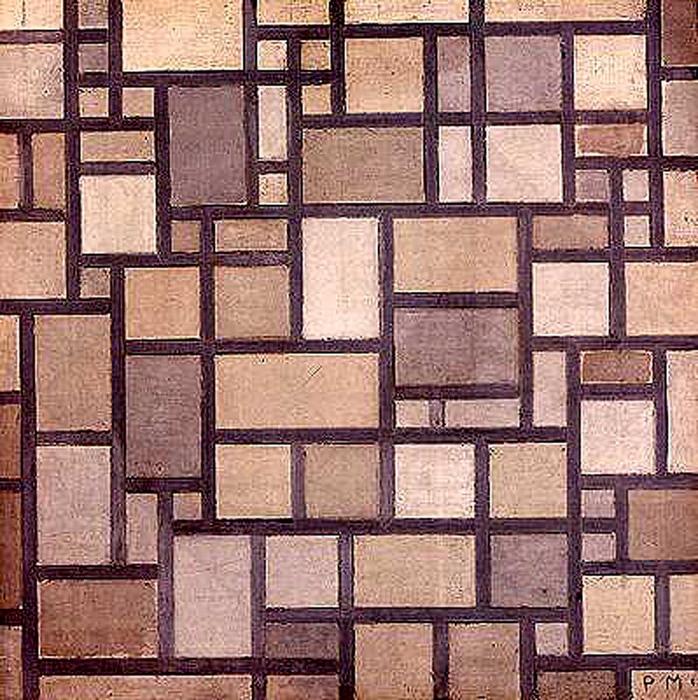
Piet Mondrian's *Composition: Light Color Planes with Grey Contours*, created in 1919, offers a fascinating glimpse into the evolution of one of modern art’s most recognizable styles – Neoplasticism. Measuring 49 x 49 cm and currently residing at the Kunstmuseum Basel, this work represents a pivotal moment in Mondrian's artistic journey, bridging his earlier explorations with the more iconic, boldly colored compositions that would define his later career.
De Stijl & The Quest for Pure Abstraction
This painting is deeply rooted in the principles of De Stijl (Neoplasticism), a Dutch movement founded by Theo van Doesburg. Driven by a utopian vision, De Stijl artists sought to express universal harmony through radical simplification. They believed that art should transcend individual expression and reflect fundamental truths about reality – truths best conveyed through pure abstraction, geometric forms, and a limited palette. This wasn’t merely an aesthetic choice; it was a philosophical one, aiming for a visual language applicable across disciplines, from painting to architecture.
Decoding the Composition: Form & Color
Unlike Mondrian's later works celebrated for their vibrant primary colors, *Composition: Light Color Planes with Grey Contours* presents a more restrained and nuanced aesthetic. The canvas is meticulously divided into a grid of rectangles and squares, delineated by crisp, dark grey lines. Instead of bold reds, yellows, and blues, the composition relies on subtle variations of white and grey, creating a delicate interplay of light and shadow. This limited palette isn’t a departure from Neoplasticism's core tenets but rather an exploration *within* those constraints – a study in tonal relationships and spatial dynamics. The careful arrangement of these planes evokes a sense of balance and order, yet the slight variations prevent it from feeling rigid or sterile.
From Cubism to Neoplasticism: Mondrian’s Artistic Evolution
To fully appreciate this work, understanding Mondrian's artistic trajectory is crucial. He began his career painting landscapes in a traditional style before being influenced by movements like Impressionism and Symbolism. His engagement with Analytic Cubism – particularly the work of Picasso – led him to deconstruct forms, but he ultimately rejected its representational elements. *Composition: Light Color Planes with Grey Contours* marks a decisive break from Cubism’s fragmented perspective and represents Mondrian's commitment to achieving “pure plastic art” as outlined in his influential 1917 essay, "The New Plastic in Painting." He sought not to depict objects but to create self-sufficient visual realities.
Symbolism & Emotional Resonance
While seemingly devoid of representational imagery, Mondrian’s work is imbued with symbolic meaning. The horizontal and vertical lines are believed to represent opposing forces – the static and the dynamic, masculine and feminine – brought into harmonious equilibrium. The limited color palette encourages contemplation rather than immediate emotional response. This isn't a painting designed to evoke strong feelings; it aims to create a sense of calm, clarity, and intellectual engagement.
It’s an invitation to experience art as a purely visual phenomenon, free from narrative or subjective interpretation.
Legacy & Influence
Mondrian's impact on 20th-century art and design is immeasurable. His Neoplastic principles profoundly influenced movements like Minimalism and Concrete Art, and his aesthetic continues to resonate in graphic design, architecture, and fashion today. *Composition: Light Color Planes with Grey Contours* stands as a testament to Mondrian’s visionary approach – a quiet yet powerful statement about the potential of abstraction to express universal values and create a more harmonious world.
- Style: Neoplasticism, Abstract Art
- Technique: Oil on Canvas
- Dimensions: 49 x 49 cm
- Location: Kunstmuseum Basel, Switzerland