A Cornerstone of Modern Abstraction
Created in 1930, this iconic artwork stands as a pivotal achievement within Piet Mondrian’s mature style and the broader trajectory of abstract art. It exemplifies the principles of Neoplasticism – a movement Mondrian co-founded under the banner of “De Stijl” (The Style) – aiming to distill painting down to its most fundamental elements: straight lines, right angles, primary colors, and black and white.
Decoding the Visual Language
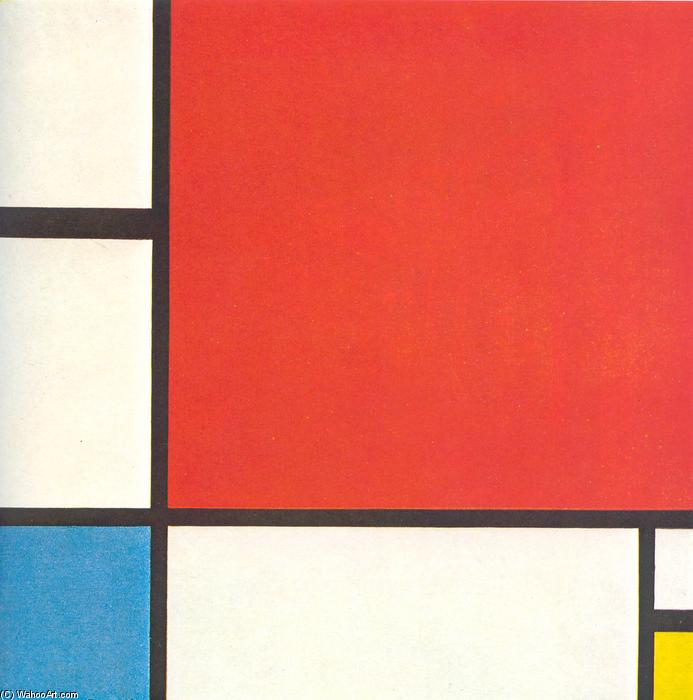
Rejecting representational imagery entirely, this composition presents a dynamic interplay of rectangular forms delineated by bold black lines. Blocks of pure red, blue, and yellow are strategically positioned against fields of white, creating a carefully balanced asymmetry. The absence of perspective or any illusionistic depth emphasizes the flatness of the canvas, focusing attention solely on the relationships between color, line, and shape. This deliberate simplification isn’t emptiness; it's a rigorous exploration of visual harmony.
Technique & Materials: Precision in Practice
Executed with oil paint on canvas, the artwork showcases Mondrian’s meticulous technique. The colors are applied in flat, even layers, devoid of visible brushstrokes or impasto. This smooth surface and precise application contribute to the work's overall sense of order and control. The stark contrast between the vibrant hues and the defining black lines is achieved through careful layering and a masterful understanding of color theory.
Historical Context: A Search for Universal Harmony
Emerging in the aftermath of World War I, Neoplasticism sought to express a utopian vision of universal harmony and spiritual order. Mondrian believed that by reducing art to its essential forms, he could transcend the chaos of the external world and reveal underlying truths. This artwork reflects this philosophical ambition, representing a conscious effort to create a visual language capable of expressing pure, abstract ideals.
Symbolism & Emotional Resonance
While devoid of explicit narrative content, the painting invites symbolic interpretation. The primary colors – red often associated with energy, blue with intellect, and yellow with joy – are not merely aesthetic choices but carry inherent psychological weight. The black lines can be seen as representing boundaries or structure, containing and defining the vibrant color fields within. Though abstract, the work evokes a sense of calm contemplation, intellectual clarity, and balanced tension.
Inspiring Interiors & Lasting Legacy
This composition continues to resonate deeply with contemporary audiences, influencing not only painting but also architecture, design, and fashion. Its clean lines and bold colors make it a striking focal point for modern interiors, adding a touch of sophisticated abstraction to any space. Owning a reproduction allows you to bring the enduring power and intellectual rigor of Mondrian’s vision into your home or office – a testament to the transformative potential of pure form and color.