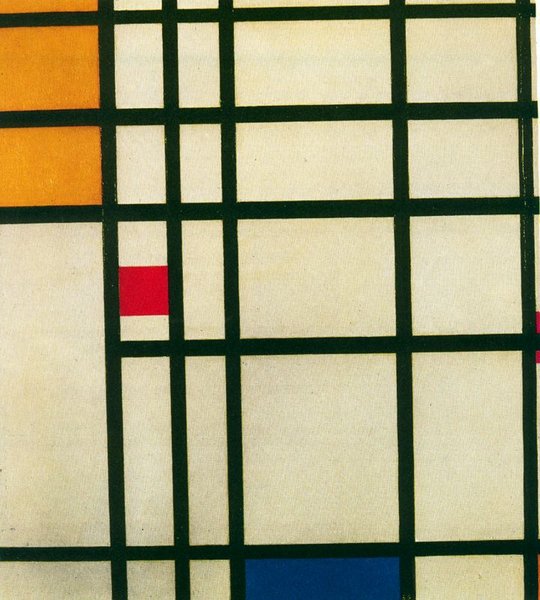
Composition with Red, Yellow and Blue: A Geometric Revelation
Piet Mondrian’s “Composition with Red, Yellow and Blue” stands as a monumental achievement in abstract art—a testament to the pursuit of pure form and universal harmony. Painted sometime between 1921 and 1930, this artwork embodies the core tenets of Neo-Plasticism, a movement spearheaded by Mondrian himself and inextricably linked to De Stijl, an influential Dutch artistic collective. It’s more than just pigment on canvas; it's a deliberate dismantling of representational illusion, striving instead for a visual language that transcends subjective experience.
- Subject Matter: The painting eschews recognizable imagery altogether. Instead, it presents a grid comprised of horizontal and vertical lines intersecting to form squares—primarily red, yellow, and blue rectangles. These colors are chosen not for their descriptive qualities but for their fundamental vibrational frequencies believed to correspond to elemental forces.
- Style & Technique: Mondrian’s meticulous approach is characterized by precise geometric construction. He employed a technique known as orthogonal projection, meticulously applying thin layers of oil paint to create crisp lines and sharply defined shapes. The flatness of the surface reinforces this conceptual ambition—rejecting any illusion of depth or perspective.
- Historical Context: Emerging from the aftermath of World War I, Neo-Plasticism arose as a reaction against Expressionist tendencies that prioritized emotional intensity over rational order. Influenced by Zen Buddhism and Russian Constructivism, it sought to liberate art from the constraints of tradition and embrace a purely intellectual aesthetic.
- Symbolism: The grid itself represents Mondrian’s belief in mathematical harmony—a visual embodiment of cosmic order. Each color symbolizes specific qualities: red for energy and passion, yellow for intellect and optimism, and blue for tranquility and spirituality. These colors are deliberately juxtaposed to create a dynamic equilibrium.
- Emotional Impact: Despite its apparent simplicity, “Composition with Red, Yellow and Blue” possesses a profound emotional resonance. Its austere beauty evokes feelings of calm contemplation and invites viewers to engage in an introspective dialogue about the nature of reality itself. It’s a piece that speaks to the human desire for clarity and balance amidst the complexities of existence.
Exploring De Stijl & Mondrian's Vision
The painting’s genesis lies within the broader context of De Stijl, founded in 1917 by Mondrian alongside Theo van Doesburg and Gerrit Rietveld. This collective championed a radical reformulation of artistic principles based on geometric abstraction and elemental color theory—a philosophy that profoundly impacted architecture, design, and visual culture. Mondrian envisioned De Stijl as a vehicle for achieving “universal harmony,” arguing that art should reflect the underlying structure of the cosmos.
A Legacy Enduring Through Reproduction
Today, “Composition with Red, Yellow and Blue” continues to inspire artists and designers alike. ArtsDot offers exceptional reproductions crafted by skilled artisans using archival pigments—allowing you to experience the artwork’s timeless beauty and intellectual depth in your own home or studio. Discover the transformative power of owning a piece of art history.
Discover More About Mondrian & His Influence
For further insight into Piet Mondrian's artistic journey and the enduring legacy of Neo-Plasticism, explore our curated articles database:
Piet Mondrian: Deconstructing Reality – A Study of Neo-Plasticism & Universal Harmony.