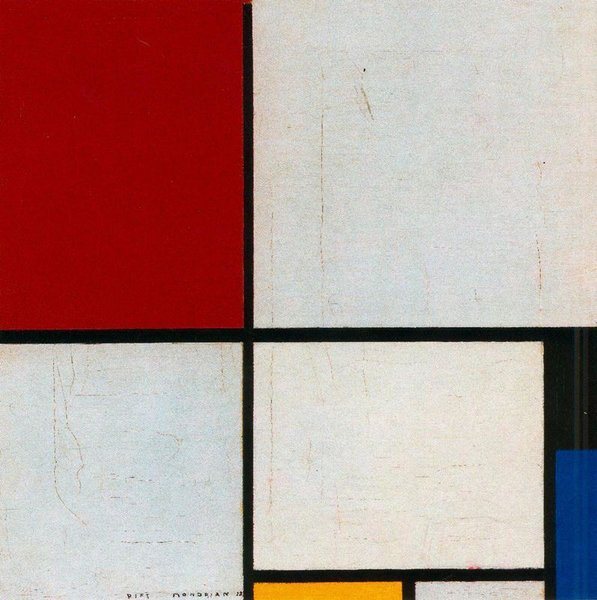
Explore Piet Mondrian's iconic *Composition with Red, Yellow and Blue* – a masterpiece of Neoplasticism. Discover the artist’s journey from landscapes to pure abstraction & its lasting impact on modern art & design.
Discover Piet Mondrian (1872-1944), pioneer of abstract art & De Stijl. Explore Neoplasticism, geometric paintings, and his lasting impact on modern design.
A Universe Within Lines: Deconstructing Mondrian’s Composition with Red, Yellow, and Blue
Piet Mondrian's *Composition with Red, Yellow, and Blue* isn’t merely a painting; it is a visual manifesto, a distillation of the artist’s lifelong pursuit of spiritual harmony through abstraction. Emerging from the vibrant artistic ferment of early 20th-century Europe, this work embodies the core principles of Neoplasticism – an aesthetic philosophy Mondrian co-founded with Theo van Doesburg and articulated in their journal *De Stijl*. To gaze upon its stark geometry is to encounter a radical departure from representational art, a deliberate rejection of the natural world in favor of universal forms. The painting’s power resides not in what it depicts, but in how it *is* – a carefully calibrated arrangement of black grid lines defining rectangles of primary colors and neutral tones. These aren't arbitrary choices; they are the building blocks of Mondrian’s visual language, intended to express underlying cosmic order.
From Dutch Landscapes to Pure Abstraction
Mondrian’s artistic journey was one of gradual but relentless simplification. He began his career painting traditional landscapes, influenced by the Hague School and Dutch Impressionism. Early works like *The Red Mill* reveal a skilled hand at rendering naturalistic detail, yet even then, hints of his future direction can be detected in his fascination with form and color. His move to Paris in 1912 proved pivotal, exposing him to the revolutionary ideas of Cubism. While initially embracing aspects of this new style, Mondrian soon began to push beyond its representational constraints, seeking a purer form of abstraction. He believed that by stripping away all traces of the objective world, he could access a deeper, more spiritual reality. This quest led him to develop Neoplasticism, where art wasn’t about imitating nature but about revealing its essential structure – a structure based on vertical and horizontal lines representing opposing forces in dynamic equilibrium. He sought not to depict the world as we see it, but rather to reveal its underlying principles of harmony and balance.
The Language of Lines and Color
The technique employed in *Composition with Red, Yellow, and Blue* is deceptively simple. Mondrian applied oil paint to canvas with precision, creating clean, sharp edges that define the geometric shapes. The black grid isn’t merely a structural element; it acts as a dynamic force, holding the composition together while simultaneously creating tension between the colored rectangles. The choice of primary colors – red, yellow, and blue – is also significant. These are considered fundamental hues, irreducible elements from which all other colors derive. By limiting his palette to these primaries along with white, black, and gray, Mondrian aimed to create a universal visual language, free from subjective interpretation. The asymmetrical arrangement of the rectangles further enhances the sense of dynamic balance, preventing the composition from becoming static or predictable. It’s a carefully orchestrated interplay of opposing forces – vertical versus horizontal, color versus neutrality, tension versus harmony.
A Lasting Legacy: Beyond the Canvas
The impact of Mondrian's Neoplasticism extends far beyond the realm of painting. His aesthetic principles have profoundly influenced graphic design, architecture, and fashion. The clean lines, geometric forms, and primary colors that define his work are instantly recognizable and continue to inspire contemporary artists and designers. *Composition with Red, Yellow, and Blue* is more than just a beautiful object; it’s an invitation to contemplate the fundamental principles of order, balance, and harmony – concepts that resonate deeply in our increasingly complex world. Owning a reproduction of this iconic work isn't simply acquiring a piece of art history; it's embracing a philosophy, inviting a sense of calm clarity into your space, and connecting with a legacy of artistic innovation that continues to shape our visual landscape.