A Symphony in Primary Colors: Exploring Piet Mondrian’s “Composition with Red, Yellow and Blue 3”
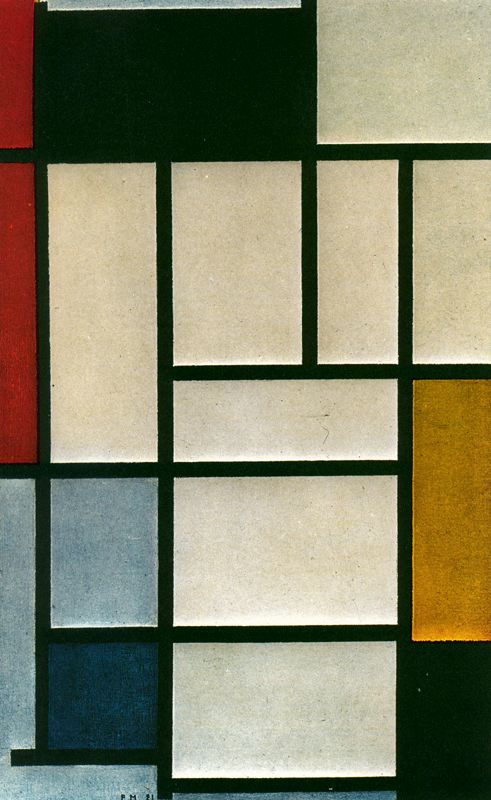
Piet Mondrian's "Composition with Red, Yellow and Blue 3," a deceptively simple yet profoundly resonant work, stands as a cornerstone of the De Stijl movement and a pivotal moment in the history of abstract art. This black-and-white photograph captures not merely a painting, but an architectural blueprint for pure form and color – a distillation of Western artistic tradition into its most elemental components. Created around 1930, during a period of intense experimentation and refinement within Mondrian’s evolving aesthetic, the piece embodies his lifelong quest to express universal harmony through geometric abstraction.
The photograph itself offers a glimpse into a canvas dominated by precisely delineated rectangles – blocks of red, yellow, and blue arranged against stark black and white backgrounds. These aren't merely decorative elements; they are fundamental building blocks, representing the core principles Mondrian sought to articulate: horizontal and vertical lines as the axes of stability, and primary colors as the keys to unlocking a deeper spiritual reality. Notice how the rectangles aren’t simply placed; they are carefully positioned to create a dynamic tension between order and movement, suggesting an underlying rhythm that belies the apparent stillness.
The Roots of Neoplasticism: From Landscape to Pure Abstraction
To truly appreciate “Composition with Red, Yellow and Blue 3,” it’s crucial to understand Mondrian's artistic journey. His early work, as evidenced by pieces like *The Red Mill*, was firmly rooted in the Dutch landscape tradition – a meticulous study of nature rendered with impressive technical skill. However, a persistent dissatisfaction with mere representation drove him toward simplification. He experimented with Pointillism and Fauvism, recognizing their potential for exploring color and form but ultimately finding them insufficient to express his deeper artistic vision. This period reveals a young artist grappling with the desire to transcend the limitations of depicting the visible world.
The development of Neoplasticism – “New Plastic Painting” – was a radical departure. Mondrian believed that by stripping away all extraneous detail and focusing solely on essential geometric forms and primary colors, he could create art that mirrored the underlying structure of reality itself. He sought to move beyond illusionistic representation and tap into a more fundamental, spiritual truth. This shift wasn’t merely stylistic; it represented a profound philosophical commitment to reducing art to its purest essence.
Decoding the Symbolism: Harmony and Tension
The seemingly austere composition of “Composition with Red, Yellow and Blue 3” is laden with symbolic meaning. The deliberate use of primary colors – red, blue, and yellow – was not arbitrary; Mondrian believed they represented fundamental forces within nature and human experience. Black and white, conversely, symbolized the spiritual realm, providing a grounding counterpoint to the vibrant hues. The precise lines and rectangles create a sense of order and stability, while their carefully considered arrangement generates an underlying tension—a dynamic equilibrium that reflects the constant interplay between opposing forces.
Furthermore, Mondrian’s insistence on horizontal and vertical lines represents the fundamental axes of existence – masculine and feminine principles, or perhaps more broadly, reason and emotion. The deliberate asymmetry within the composition contributes to this sense of dynamism, suggesting a continuous process of becoming rather than static equilibrium. It's a visual meditation on balance, harmony, and the inherent tension that drives all creation.
A Legacy in Color and Form: Reproductions for Modern Spaces
Today, “Composition with Red, Yellow and Blue 3” continues to exert a powerful influence on artists, designers, and interior decorators alike. Its clean lines, bold colors, and reductive aesthetic offer a timeless elegance that transcends stylistic trends. ArtsDot offers meticulously crafted hand-painted reproductions of this iconic masterpiece, allowing you to bring its profound beauty into your own space. Whether adorning a minimalist living room or adding a touch of intellectual sophistication to a contemporary office, a reproduction of Mondrian’s “Composition with Red, Yellow and Blue 3” is more than just a decoration—it's an invitation to contemplate the fundamental principles of art and design.
Explore our collection today and discover the perfect way to experience the enduring power of this seminal work. Learn more about “Composition with Red, Blue & Yellow” here.