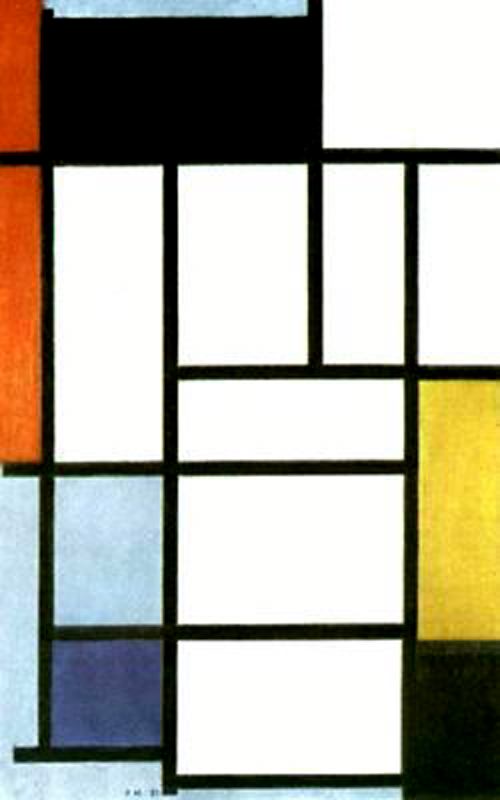
Composition with Red, Blue and Yellow – A Testament to Geometric Harmony
Piet Mondrian’s “Composition with Red, Yellow and Blue,” created between 1937 and 1942 during his pivotal period of artistic exploration, stands as arguably the most recognizable emblem of Neoplasticism—a movement he founded alongside Theo van Doesburg. More than just a painting; it's a distillation of philosophical ideals into visual form, reflecting Mondrian’s unwavering belief in the universality of geometric abstraction and its capacity to express fundamental truths about existence.
- Historical Context: The genesis of Neoplasticism lies within the intellectual ferment of the early 20th century. Influenced by thinkers like Rudolf Steiner and Henri Bergson, Mondrian sought to liberate art from representational illusion, arguing that it should strive for a purely objective depiction of reality—a realm devoid of subjective emotion or sensory experience. This radical stance positioned him at the forefront of avant-garde artistic discourse.
- Style & Technique: Mondrian’s meticulous approach is evident in every aspect of this artwork. He employed oil paints on canvas with unwavering precision, applying them within meticulously defined rectangular areas—the lozenge shapes characteristic of De Stijl. The resulting surface possesses remarkable flatness, rejecting any suggestion of textural depth or illusionistic perspective. This deliberate simplification underscores Mondrian’s commitment to reducing art to its purest elemental components: straight lines and primary colors (red, yellow, blue).
The composition itself is governed by a strict grid structure—black orthogonal lines dividing the canvas into precisely delineated rectangles filled with vibrant hues. These rectangles are not merely decorative; they represent Mondrian’s conceptual framework for perceiving the cosmos. The deliberate absence of shading or blending reinforces this sense of clarity and intellectual rigor.
- Color Palette: Mondrian's masterful use of color is paramount to conveying his artistic vision. He eschewed traditional chromatic mixing, opting instead for unmodulated blocks of red, yellow, and blue—the foundational colors of the visible spectrum. This uncompromising palette symbolizes harmony and balance, mirroring Mondrian’s belief in an underlying order governing all phenomena.
- Symbolism & Emotional Impact: Beyond its formal beauty, “Composition with Red, Blue and Yellow” carries profound symbolic weight. The black lines represent stability and structure—the framework upon which the colored rectangles are superimposed. Together, they evoke feelings of serenity, rationality, and spiritual contemplation – reflecting Mondrian’s aspiration to transcend earthly concerns and access a higher realm of consciousness.
This artwork continues to resonate with audiences today because it embodies timeless principles of artistic expression. Its geometric simplicity speaks to an enduring fascination with order and clarity, while its bold colors inspire awe and wonder. Reproductions crafted by ArtsDot offer exceptional quality and detail, allowing viewers to experience the essence of Mondrian’s masterpiece in their own homes.