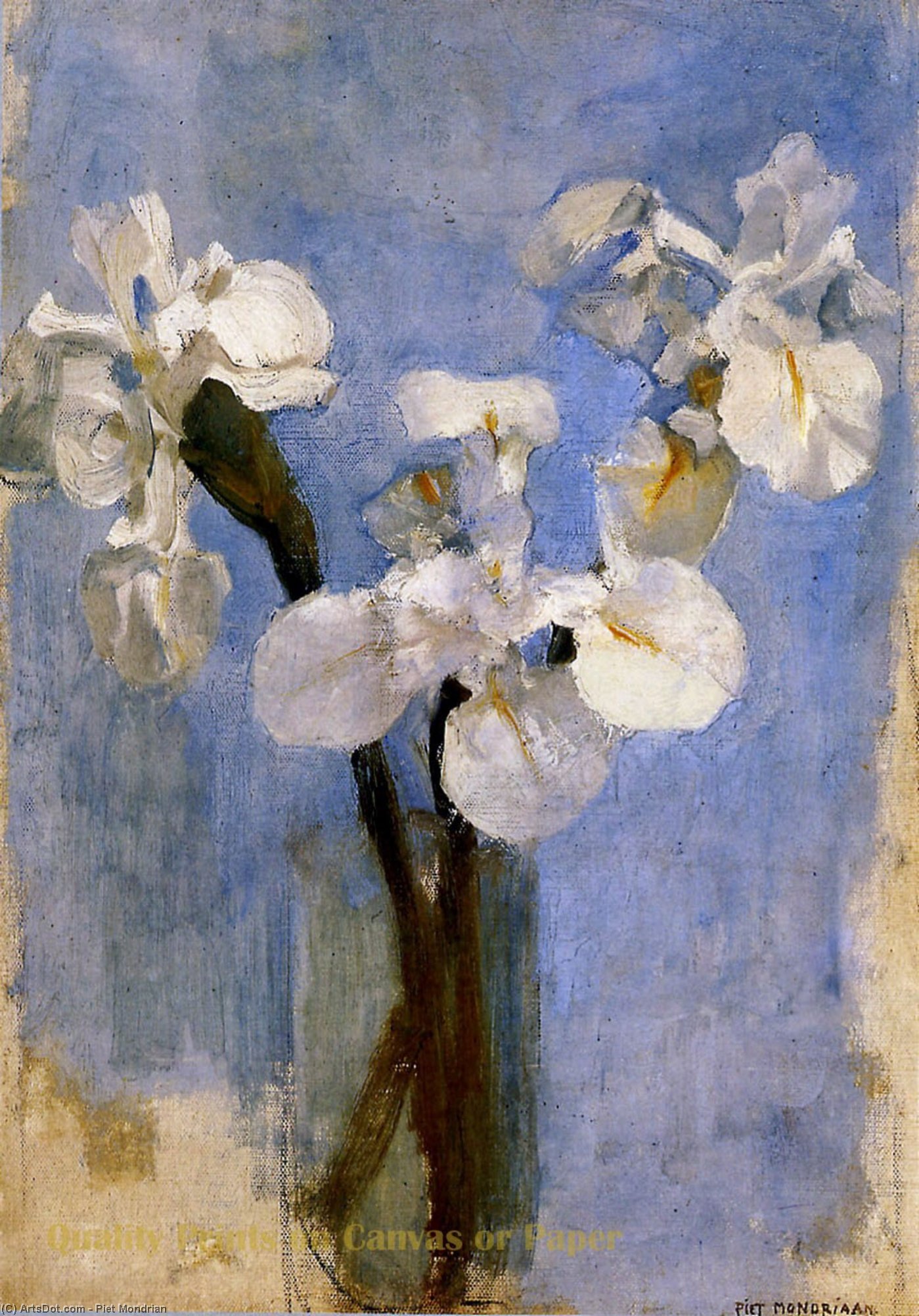
A Symphony of Color and Geometric Precision: Exploring Piet Mondrian’s ‘Flowers Sun’
Piet Mondrian’s “Flowers Sun,” painted in 1909, stands as a pivotal work demonstrating the nascent stages of his groundbreaking Neoplasticist style – a movement that would redefine modern art. Initially exploring landscapes imbued with Impressionistic brushstrokes reminiscent of the Hague School and Impressionism itself—pieces like *The Red Mill*—Mondrian’s early artistic endeavors reveal a meticulous student absorbing nature's nuances, yet simultaneously harboring an ambition to transcend mere visual representation.
- Style: Impressionistic – Initially influenced by Impressionist techniques, Mondrian swiftly moved away from representational art toward abstraction.
- Technique: Oil Paint Impasto – Thickly applied paint creates a tactile surface and emphasizes textural qualities, capturing the essence of light and color.
- Composition: Still Life – The artwork depicts a vase containing white irises, presenting a familiar subject matter within an innovative stylistic framework.
However, it was during his formative years that Mondrian began to wrestle with the fundamental question of how art could communicate beyond the surface appearance of reality. He wasn’t satisfied with simply mirroring what he saw; he sought a deeper truth—a distillation of form and color into its purest essence. This quest drove him toward experimentation with Pointillism and Fauvism, styles that offered contrasting approaches to color and composition.
“Flowers Sun” exemplifies Mondrian’s evolving vision. The hazy blue background serves as an atmospheric perspective, subtly suggesting an outdoor setting—a deliberate choice reflecting the broader influence of Japanese landscape painting on European artists at the time. Lines are predominantly short and broken, contributing to a dynamic visual rhythm that contrasts with the stillness of the flowers themselves. These fragmented lines embody Mondrian’s belief in geometric abstraction as a pathway to universal harmony.
Symbolically, irises—often associated with wisdom, faith, and hope—are rendered in stark primary colors – white, orange, and green – aligning perfectly with Neoplasticist principles. The artist's intention wasn't merely to depict flowers; it was to express an underlying spiritual concept through visual language. Mondrian’s masterful manipulation of color and texture elevates “Flowers Sun” beyond a simple botanical observation into a profound meditation on artistic form and its capacity for conveying emotion.
Further Exploration: Contextualizing Mondrian's Artistic Journey
Mondrian’s exploration of abstraction began with a deliberate rejection of traditional painting conventions. Influenced by thinkers like Rudolf Steiner, he embraced the concept of “spiritual geometry,” believing that mathematical ratios could unlock the secrets of cosmic order. This philosophical underpinning profoundly shaped his artistic practice.
The Legacy of Neoplasticism
“Flowers Sun” represents an early manifestation of Mondrian’s revolutionary Neoplasticist style—a movement he founded alongside Theo van Doesburg in 1920. Neoplasticism sought to reduce painting to its fundamental elements: horizontal and vertical lines, combined with primary colors (red, yellow, blue) – a radical departure from Impressionistic color palettes.
Reproductions & Inspiration
A high-quality reproduction of “Flowers Sun” can bring Mondrian’s vision into your home or studio. ArtsDot offers exceptional prints on premium canvas and paper, capturing the vibrancy and textural richness of this iconic artwork. Explore our collection today!