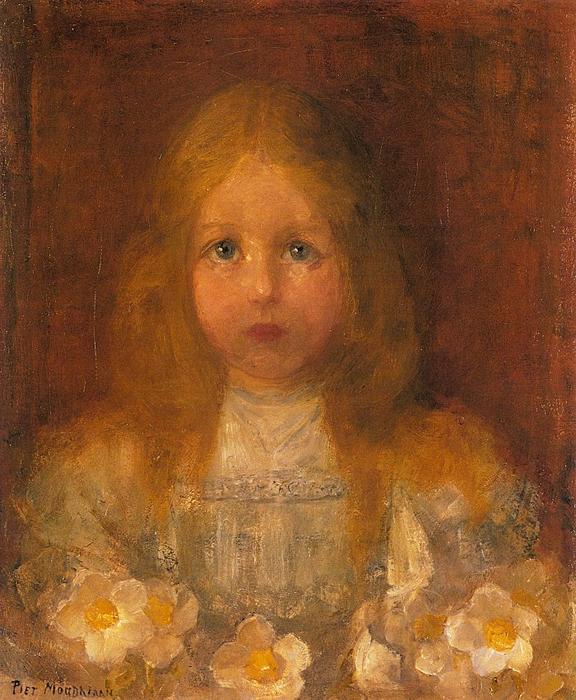
A Portrait of Serenity: Exploring Piet Mondrian’s ‘Little Girl’
- Subject Matter The painting depicts a young girl, rendered with meticulous detail against the stark backdrop of Mondrian's signature neoplasticism style. Her gaze is direct and contemplative, inviting viewers into her inner world—a quiet moment captured in vibrant geometric abstraction.
- Style: Neoplasticism Piet Mondrian’s ‘Little Girl’ exemplifies the core tenets of neoplasticism, a revolutionary artistic movement born from Dutch De Stijl. Rejecting representational art altogether, Mondrian sought to express universal harmony through pure geometric forms—primarily horizontal and vertical lines intersecting at right angles—and primary colors: red, yellow, and blue.
- Technique Executed with precise brushstrokes, the painting utilizes tempera on canvas. This medium lends itself beautifully to Mondrian’s reductive aesthetic, allowing for crisp edges and unwavering color saturation. The artist's careful consideration of composition ensures that every element contributes to the overall balance and visual impact.
- Historical Context Created in approximately 1937-1940, ‘Little Girl’ emerged during a period of intense artistic experimentation and intellectual debate surrounding abstraction. Mondrian was deeply influenced by Zen Buddhism and sought to achieve spiritual enlightenment through art—a desire reflected in the painting's austere simplicity and harmonious arrangement.
- Symbolism Beyond its formal qualities, ‘Little Girl’ carries subtle symbolic weight. The flowers positioned on either side of the girl represent fertility and renewal, juxtaposed against the rigid geometric framework. This deliberate contrast underscores Mondrian’s belief that beauty resides in balance—a harmonious coexistence between opposing forces.
The Influence of Zen Buddhism
Mondrian's fascination with Zen philosophy profoundly shaped his artistic vision. He believed that true art should transcend the sensory world and connect directly to the underlying spiritual essence of existence. This conviction fueled his relentless pursuit of simplification, mirroring the Buddhist concept of emptiness—the absence of inherent duality—and guiding him toward a visual language devoid of illusion.
Color Palette: Harmony Through Primaries
The painting’s color palette is deliberately restrained, utilizing only red, yellow, and blue – Mondrian's chosen primary colors. These hues are applied in blocks of solid pigment, creating a visually striking contrast against the neutral canvas surface. The careful selection of colors reflects Mondrian’s conviction that they could convey profound emotional resonance without resorting to representational imagery.
Composition and Balance
Mondrian's compositional strategy prioritizes balance and symmetry. The girl is positioned centrally within the frame, flanked by two flowers—one on each side—creating a harmonious equilibrium that embodies De Stijl’s aesthetic ideals. This deliberate arrangement reinforces the painting’s meditative quality and invites contemplation of its underlying geometric principles.