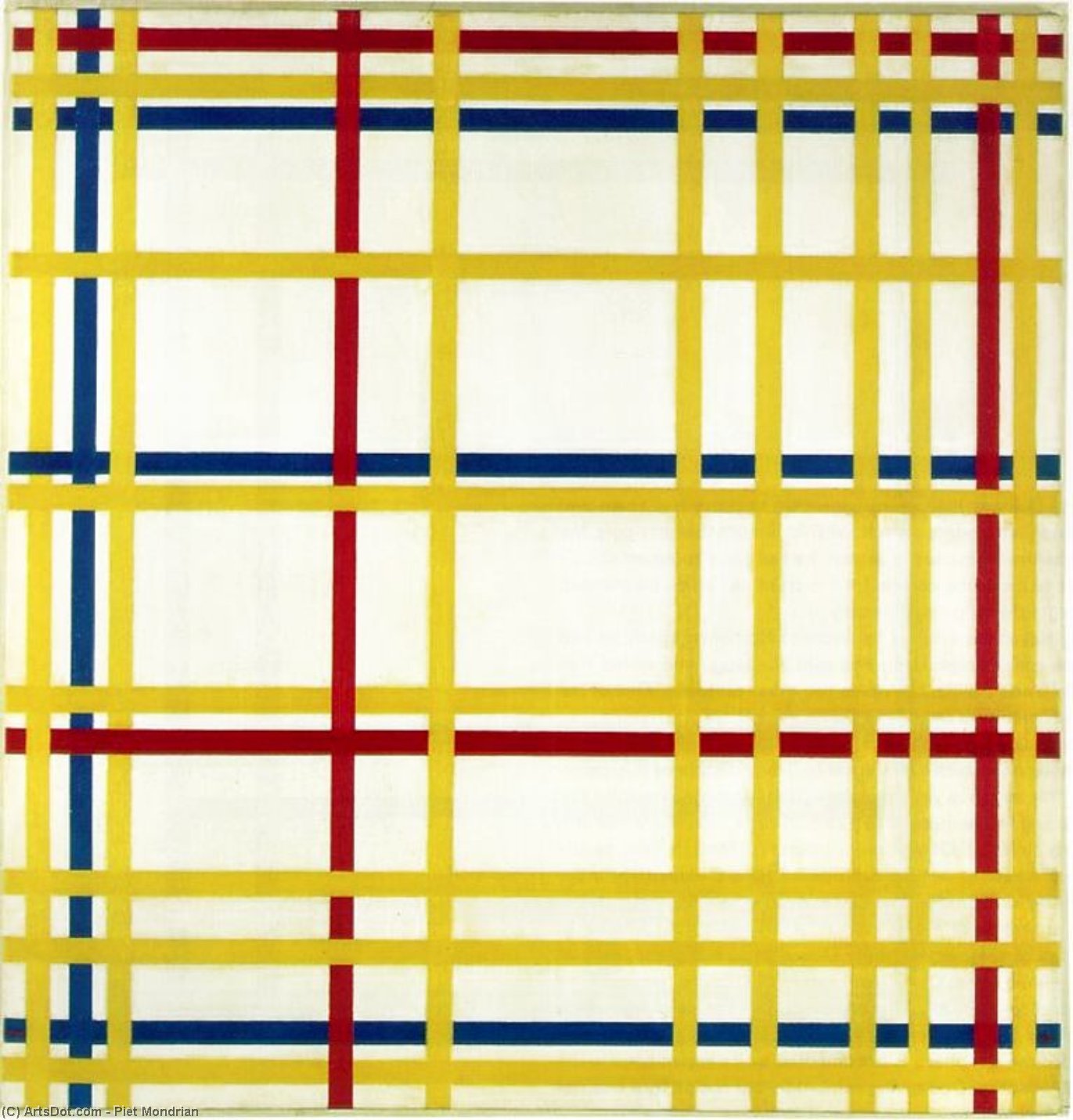
A Symphony of Order: Exploring Piet Mondrian’s *New York City I*
Piet Mondrian's *New York City I*, completed in 1942, is far more than a geometric abstraction; it’s a visual distillation of a philosophy and a poignant reflection of the artist’s evolving relationship with urban life. Measuring 119 x 114 cm and executed in oil on canvas, this work stands as a pivotal piece within Mondrian's Neoplasticist period, embodying his lifelong pursuit of universal harmony through pure abstraction. Interestingly, recent discoveries revealed that the original artwork was displayed upside down for decades at Kunstsammlung Nordrhein-Westfalen – a testament to the subtle complexities even within such seemingly rigid compositions!
The Genesis of Neoplasticism and Mondrian’s Vision
To understand *New York City I*, one must grasp the principles of Neoplasticism (De Stijl). Founded in 1917 by Theo van Doesburg, this Dutch movement sought to reduce art to its most fundamental elements: straight lines, primary colors (red, yellow, blue), and neutral tones (black, white, gray). Mondrian believed that these basic components represented the underlying structure of reality and could express a universal spiritual order. He wasn’t merely *depicting* New York City; he was attempting to capture its dynamic energy and complex rhythms through an abstract visual language. His arrival in New York after fleeing Europe during WWII profoundly impacted his work, moving him away from strict geometric precision towards a more expressive use of line and color – as seen in the varying thicknesses and placements within this piece.
Deconstructing the Composition: Lines, Colors, and Space
The painting is characterized by its grid-like structure—a network of black vertical and horizontal lines that define a series of rectangles. Within these rectangles, Mondrian strategically places blocks of primary colors – vibrant red, cheerful yellow, and calming blue – alongside areas of white.
This isn’t randomness; it's carefully calculated balance. The varying sizes of the colored rectangles create a sense of visual tension and movement, preventing the composition from feeling static. The use of black lines isn’t simply structural; they act as dynamic forces, defining space and creating relationships between the colors.
Notice how the density of lines varies – this is particularly significant given the recent revelation about its original orientation.
Historical Context: War, Migration, and Artistic Evolution
*New York City I* was created during a tumultuous period in history—World War II. Mondrian’s relocation to New York represented both a personal refuge and an artistic turning point. The city's grid-like street plan, its vibrant energy, and the constant flow of movement deeply influenced his work. The painting can be seen as a response to this new environment – a translation of urban chaos into a harmonious abstract order. It’s also important to remember that Mondrian was part of a larger wave of European artists who sought refuge in America during the war, contributing significantly to the development of Abstract Expressionism and other post-war art movements.
Symbolism and Emotional Resonance
While Neoplasticism aimed for objectivity, *New York City I* isn’t devoid of emotional impact. The primary colors evoke feelings of energy, optimism, and vitality. The black lines represent structure and control, while the white spaces suggest openness and possibility.
The painting embodies a sense of hope amidst chaos—a belief in the power of order to overcome adversity. It’s a testament to Mondrian's conviction that art could transcend the limitations of the physical world and connect with something deeper and more universal.
Legacy and Influence
Mondrian’s influence on 20th-century art is immeasurable. His work paved the way for Minimalism, Color Field painting, and countless other abstract styles. His ideas continue to inspire artists, designers, and architects today. *New York City I* remains a powerful symbol of modernism—a timeless masterpiece that invites contemplation and celebrates the beauty of pure form and color.