A Silent Dialogue Between Geometry and Landscape
Piet Mondrian’s *not identified*, created sometime around 1920, stands as a cornerstone of Neo-Plasticism—a movement born from Mondrian's relentless pursuit of pure abstraction. This monochrome masterpiece isn’t merely a depiction of a rural scene; it’s an embodiment of philosophical ideals concerning the relationship between humanity and nature.
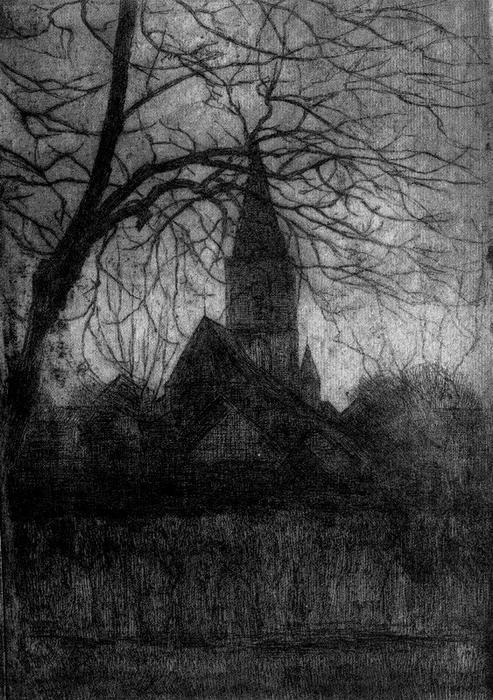
- Subject Matter: The artwork presents a tranquil landscape dominated by a church steeple, rendered entirely in shades of gray. Sparse trees punctuate the horizon line, creating a dynamic counterpoint to the verticality of the spire.
- Style & Technique: Mondrian’s approach aligns with Impressionism's spirit but departs from its meticulous observation of detail. Instead, he employs loose brushstrokes—likely charcoal or graphite—to achieve a textured surface that conveys an atmosphere of stillness and contemplation. The artist deliberately eschewed color, prioritizing geometric forms to express universal harmony.
- Composition: The pyramidal structure of the steeple commands attention, anchoring the image while simultaneously emphasizing the horizontal expanse of the meadow below. This deliberate asymmetry contributes to the artwork’s visual tension and invites viewers to consider the interplay between opposing forces.
- Color Palette & Texture: Absence of color is paramount—grayscale tones are utilized to sculpt form and depth. The textured surface achieved through charcoal lends a palpable physicality to what appears initially as a purely conceptual piece, hinting at the artist’s tactile engagement with his medium.
Beyond its formal qualities, *not identified* resonates with profound symbolic significance. The stark gray hues evoke winter—a season often associated with introspection and spiritual renewal—while the geometric abstraction represents Mondrian's belief in a transcendent order underlying reality. The church steeple symbolizes faith and stability, juxtaposed against the organic chaos of the trees, suggesting a harmonious reconciliation between opposing forces.
Consider this artwork for interior design projects seeking to evoke serenity and sophistication. Its minimalist aesthetic complements contemporary spaces beautifully, offering a timeless connection to artistic principles rooted in geometric precision and emotional resonance. Reproductions crafted with archival quality materials ensure that its understated beauty persists across generations.