A Genesis of Pure Abstraction
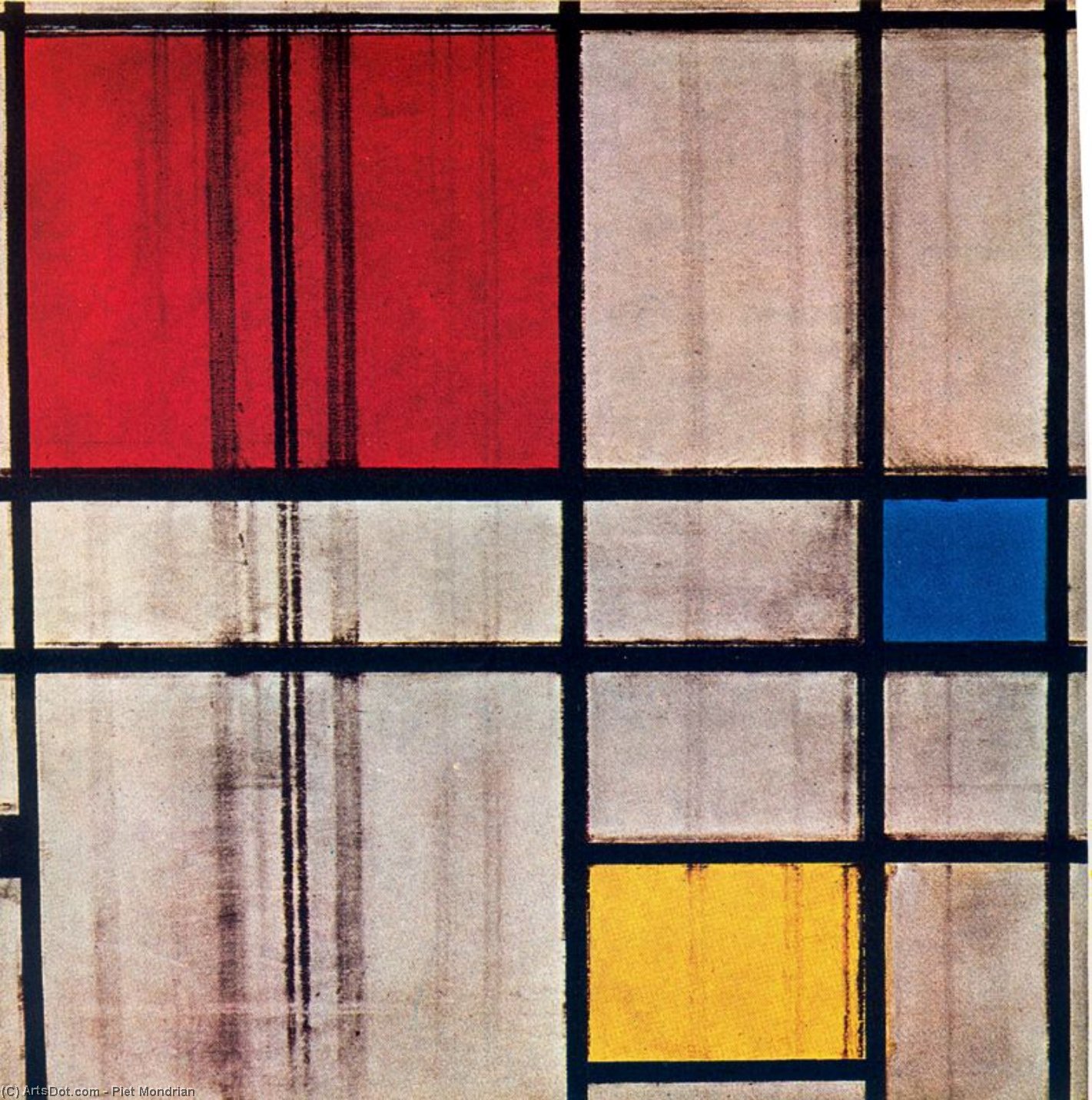
Piet Mondrian’s *Unfinished Composition with red yellow and blue* is not merely a painting; it's a visual manifesto, a distillation of an artistic philosophy that would irrevocably alter the course of 20th-century art. The work, deceptively simple in its execution, represents a pivotal moment in Mondrian’s relentless pursuit of abstraction – a journey away from the representational world and towards what he believed was a more fundamental, spiritual truth. The canvas is divided into a grid, a carefully orchestrated arrangement of colored rectangles—red, yellow, blue, and white—set against a stark black network of vertical and horizontal lines. It’s an image that feels both rigorously controlled and surprisingly dynamic, a testament to the tension between order and vitality at the heart of Mondrian's Neoplasticism.
The Path to Neo-Plasticism
To understand this work, one must consider Mondrian’s artistic evolution. Born Pieter Cornelis Mondriaan in 1872, he initially trained as a teacher while simultaneously nurturing his passion for art. His early works were steeped in the traditions of Dutch landscape painting, echoing the Hague School and Impressionism. However, a move to Paris in 1912 proved transformative. Immersed in the avant-garde scene, Mondrian encountered Cubism, which sparked a deconstruction of form that would define his future trajectory. He began to dismantle traditional perspectives, reducing objects to their essential geometric components. This process wasn’t merely stylistic; it was driven by a profound belief that art could transcend the limitations of the visible world and express universal truths.
The years following his return to the Netherlands in 1914 saw the development of *De Stijl* (The Style), a movement Mondrian co-founded with Theo van Doesburg. This group advocated for pure abstraction, believing that art should be stripped down to its most fundamental elements – lines, shapes, and primary colors. This wasn’t simply an aesthetic choice; it was rooted in a utopian vision of harmony and order, a belief that abstract forms could reflect the underlying structure of reality and contribute to a more balanced society. *Unfinished Composition with red yellow and blue* embodies this philosophy perfectly. The incomplete nature of the work hints at Mondrian's ongoing exploration, his constant refinement of these core principles.
Symbolism in Simplicity
While seemingly devoid of representational content, Mondrian’s compositions are rich in symbolic meaning. The horizontal and vertical lines aren’t arbitrary; they represent the fundamental oppositions that govern existence – masculine and feminine, static and dynamic, spiritual and material. The primary colors—red, yellow, and blue—are not merely aesthetic choices but rather the purest expressions of color, unmixed and irreducible. White represents space and potentiality, while black provides definition and structure. The careful balance between these elements creates a sense of equilibrium, reflecting Mondrian’s belief in the underlying harmony of the universe.
This painting isn't about *what* is depicted; it’s about *how* it is depicted. It invites contemplation not on a specific subject but on the very essence of form and color. The emotional impact is subtle yet profound—a sense of calm, clarity, and intellectual stimulation. The work resonates with a timeless quality, transcending its historical context to speak to universal human concerns about order, balance, and the search for meaning.