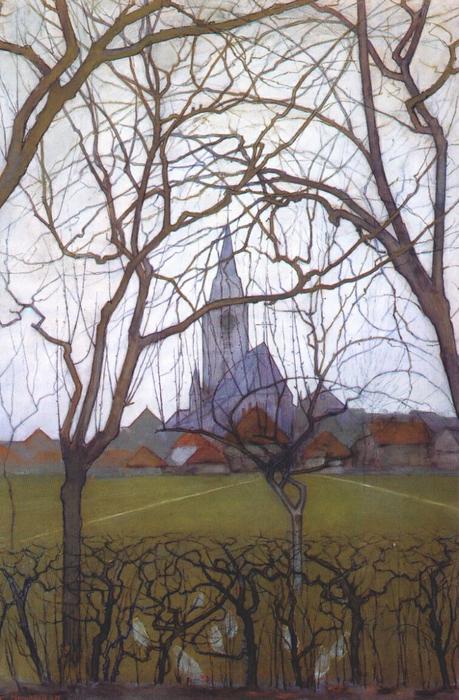
A Prelude to Abstraction: The Quiet Soul of Village Church
In the quietude of 1898, long before the world came to recognize Piet Mondrian as the architect of geometric abstraction, there existed a young artist deeply immersed in the atmospheric textures of the Dutch landscape. His charcoal drawing, Village Church, serves as an arresting window into this formative era. It is far more than a mere depiction of a rural settlement; it is a profound meditation on structure and stillness. The scene captures a wintry moment where the skeletal fingers of bare tree branches reach across the foreground, creating a natural, organic archway that draws the viewer’s gaze toward the central spire. This composition does not merely present a view; it invites an intimate encounter with the solitude of a landscape caught in the breath between seasons.
The technical mastery displayed in this work reveals a burgeoning fascination with the interplay of light and shadow. Utilizing the dry, tactile medium of charcoal, Mondrian employs intricate hatching and cross-hatching to breathe life into the wintry chill. There is a palpable sense of texture here—the rough, rugged bark of the foreground trees contrasts beautifully with the smoother, more ethereal rendering of the distant church and sky. While the palette remains restrained within a grayscale spectrum, subtle hints of earth tones suggest the dampness of the soil and the muted life of a dormant field. This mastery of tonal variation demonstrates Mondrian’s roots in the Hague School, yet even here, one can sense his burgeoning desire to strip away the superfluous in favor of essential form.
The Architecture of Emotion and Form
Beyond its representational surface, Village Church vibrates with a symbolic tension between the organic and the constructed. The irregular, flowing lines of the natural world—the twisting branches and undulating terrain—are anchored by the rigid, vertical geometry of the church steeple. This juxtaposition of the wild and the architectural foreshadows the revolutionary aesthetic philosophy that would later define Mondrian’s legacy. To the discerning collector or interior designer, this piece offers a sophisticated balance; it possesses the serene, melanchative beauty of a classical landscape while hinting at the structural precision of modernism.
For those seeking to infuse a space with a sense of tranquility and intellectual depth, this artwork provides an unparalleled emotional anchor. It evokes a mood of introspection and peace, making it a perfect centerpiece for a study, a minimalist gallery, or a refined living area where understated elegance is paramount. As a high-quality reproduction, it allows the subtle nuances of Mondrian’s early charcoal strokes to be appreciated in any setting, bringing a piece of art history's most significant evolutionary leap into the contemporary home. It is an invitation to pause, to look through the branches, and to find beauty in the structural essence of the world.