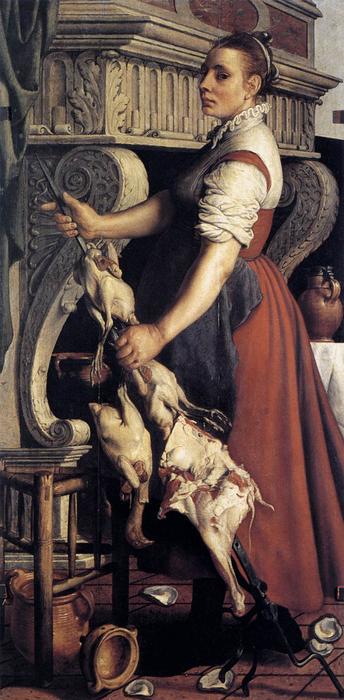
Explore Pieter Aertsen's masterpiece 'The Cook,' a stunning Northern Renaissance genre painting depicting a woman preparing chicken in an Antwerp kitchen, rich with symbolism and detail.
Pieter Aertsen (1508-1575) was a Dutch Mannerist painter renowned for pioneering monumental genre scenes blending still life & biblical themes. Influential in Flemish Baroque and Dutch Golden Age painting, he preceded Bruegel the Elder with realistic
Discover Palazzo Bianco in Genoa, Italy! Explore masterpieces by Rubens, Caravaggio & Genoese artists within stunning 16th-century architecture. A UNESCO World Heritage site offering a rich artistic journey through European art.
A Window Into Domestic Life: Pieter Aertsen’s “The Cook”
Pieter Aertsen’s “The Cook,” completed in 1559, stands as an extraordinary testament to the Northern Mannerist preoccupation with capturing the minutiae of everyday existence. More than just a depiction of a woman preparing food—though that is undeniably its core subject—the painting operates on multiple levels, inviting contemplation about themes of fertility, domestic harmony, and the subtle interplay between observation and narrative.
Aertsen’s stylistic signature is immediately recognizable: he eschews the idealized beauty favored by earlier Renaissance artists in favor of a grounded realism that nonetheless retains an artistic sensibility. The painting exemplifies the meticulous technique characteristic of Flemish art during this period—a hallmark of which was painstaking layering of glazes to achieve luminous color and textural depth. Notice how Aertsen skillfully renders the folds of the woman’s dress, capturing the subtle sheen of fabric illuminated by the warm glow emanating from the fireplace.
The historical context surrounding “The Cook” is crucial to understanding its significance. Antwerp in 1559 was a crucible of artistic experimentation, fueled by burgeoning commercial prosperity and influenced by humanist ideals. Artists like Aertsen were responding to a shift away from solely religious iconography toward subjects that reflected the realities of human experience—a trend that would ultimately propel the Dutch Golden Age into prominence.
- Symbolism: The chicken itself is laden with symbolic meaning, representing fertility and abundance – a common motif in Northern Renaissance still lifes. Its placement beside the hearth underscores the importance of domestic warmth and nurturing.
- Composition: Aertsen’s masterful composition draws the viewer's eye inward, guiding attention toward the central figure while simultaneously establishing a balanced visual rhythm. The fireplace serves as a focal point, anchoring the scene and creating a sense of intimacy.
- Color Palette: The artist employs a restrained color palette dominated by earthy tones—ochres, reds, and browns—which contribute to the painting’s overall atmosphere of quiet contemplation.
Beyond its technical brilliance, “The Cook” possesses an undeniable emotional resonance. It captures a moment of serene domesticity, conveying a sense of comfort and contentment that transcends time. The woman's gaze is direct yet gentle, inviting the viewer to share in her quiet activity—a gesture that speaks volumes about Aertsen’s ability to imbue his subjects with psychological complexity.
“The Cook” continues to inspire artists and designers alike, serving as a reminder of the enduring power of genre painting to illuminate the human condition. Its meticulous detail and evocative atmosphere offer invaluable insight into the artistic sensibilities of the Northern Renaissance—a legacy that persists in its timeless beauty and profound symbolic depth.