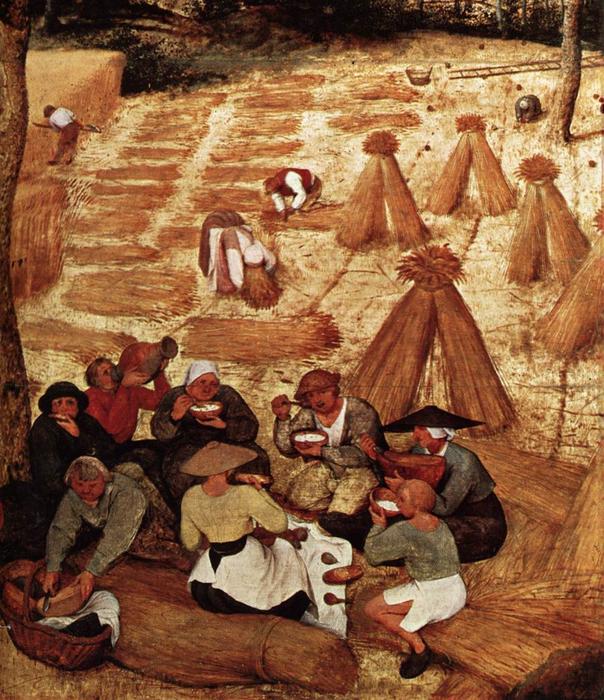
A Slice of 16th-Century Life: Bruegel’s ‘The Corn Harvest’ (detail)
Pieter Bruegel the Elder's *The Corn Harvest (detail)* offers a captivating glimpse into the rhythms and realities of rural life in 1565. This fragment, taken from the larger composition housed at the Metropolitan Museum of Art, isn’t merely a depiction of agricultural labor; it’s a vibrant tableau brimming with human activity, symbolic meaning, and artistic mastery. It invites us to step back in time and witness a moment of communal effort and seasonal abundance.
The Scene: Labor, Leisure, and the Cycle of Life
This detail focuses on the bustling heart of the harvest. We see at least fourteen figures engaged in various tasks – reaping, gathering, resting, and even indulging in food and drink amidst their work. Bruegel doesn’t idealize peasant life; he presents it with a remarkable degree of realism. The composition is densely populated, conveying a sense of energetic activity. The juxtaposition of labor and leisure—some diligently working while others pause to eat—highlights the cyclical nature of agricultural existence and the importance of respite within demanding work. Piles of harvested corn dot the field, testament to their collective efforts.
Artistic Technique: Realism and Detail
Bruegel’s skill as an oil painter is evident in every brushstroke. The use of oil on panel allows for a rich texture and luminosity that brings the scene to life. He meticulously renders details – the folds in clothing, the individual features of the figures, the textures of the grain and haystacks. While not employing strict linear perspective (characteristic of later Renaissance styles), Bruegel creates depth through layering and subtle shading. The earthy color palette—dominated by browns, ochres, and greens—is punctuated by brighter accents in garments, adding visual interest and drawing the eye to key areas within the composition. Impasto is skillfully used to create tactile textures, particularly on the harvested crops.
Historical Context: A Time of Change
Created during a period of significant social and religious upheaval in the Netherlands, *The Corn Harvest* reflects both the stability of rural life and the anxieties of the time. Bruegel’s series of paintings depicting the months of the year—of which this is a part (representing August)—were commissioned by a wealthy patron. However, beyond fulfilling a commission, Bruegel's work often contained subtle social commentary. The focus on peasant life was somewhat unusual for the period and can be interpreted as an acknowledgement of the importance of the working class.
Symbolism and Interpretation
Beyond its realistic depiction, *The Corn Harvest* is rich in symbolism. The abundance of food represents prosperity and gratitude for a successful harvest. The communal aspect of the scene emphasizes the importance of cooperation and social harmony. Some scholars suggest that Bruegel’s inclusion of figures indulging in food and drink may also carry cautionary undertones about gluttony or excess.
Ultimately, the painting invites multiple interpretations, making it a compelling subject for contemplation.
Emotional Impact & Legacy
*The Corn Harvest (detail)* evokes a sense of warmth, vitality, and connection to the land. It’s a celebration of human effort and the rewards of labor. Bruegel's work continues to resonate with audiences today because it speaks to universal themes – the importance of community, the cyclical nature of life, and our relationship with the natural world. His influence on subsequent generations of artists, particularly those of the Dutch Golden Age, is undeniable.
- Artist: Pieter Bruegel The Elder
- Title: The Corn Harvest (detail)
- Date: 1565
- Medium: Oil on Panel
- Location: Metropolitan Museum of Art, New York City
For those seeking to bring a touch of Renaissance artistry into their homes or collections, a high-quality reproduction of *The Corn Harvest (detail)* offers a timeless and evocative addition. Its rich detail and compelling narrative will undoubtedly spark conversation and inspire appreciation for the enduring legacy of Pieter Bruegel the Elder.