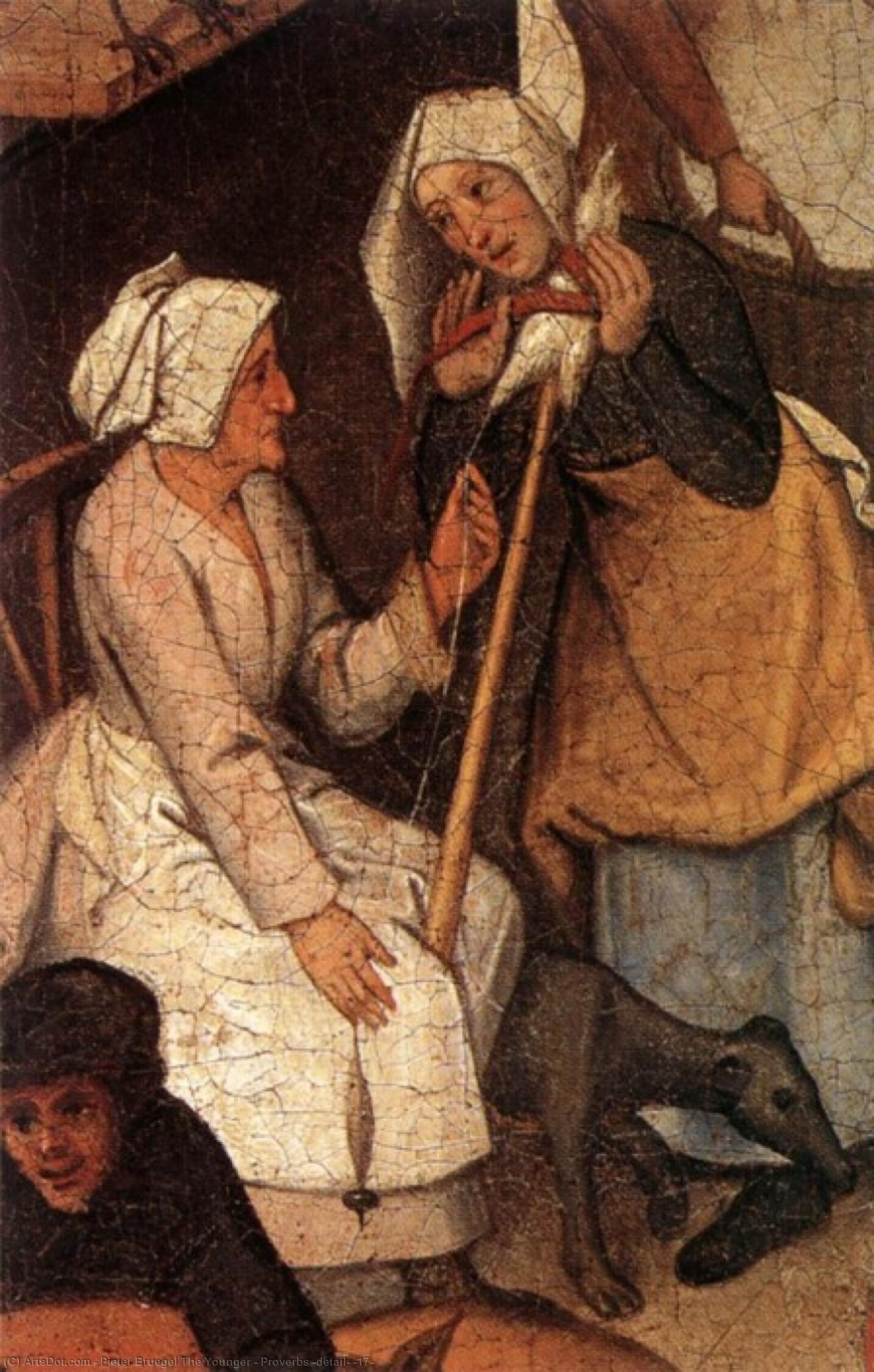
A Window into Flemish Wisdom: The Intricacy of Proverbs
In this captivating detail from the masterpiece Proverbs, we are invited to step into a meticulously crafted world that breathes with the vitality of 16th-century Flanders. Pieter Bruegel the Younger, working within the rich tradition of his father’s legacy, presents a scene that is far more than a mere collection of figures; it is a complex tapestry of human behavior and social observation. The composition draws the eye through a rhythmic arrangement of daily life, where every brushstroke serves to ground the viewer in a tangible, earthy reality. As we gaze upon this fragment of a larger narrative, we encounter a profound sense of movement—the sweeping of a broom, the turning of a page, and the quiet intensity of shared glances—all rendered with the characteristic precision that defines the Northern Renaissance.
The artistry on display is a testament to the Flemish mastery of detail and texture. Through a sophisticated use of light and shadow, the artist breathes life into the simple garments of the women in the foreground, contrasting their humble, utilitarian attire with the more structured, formal clothing of the men in the background. This interplay of textures—the coarse fabric of a peasant's dress against the smooth surface of an open book or the woven reeds of a basket—creates a sensory experience that transcends the two-dimensional plane. The technique is not merely about imitation but about capturing the essence of existence, where the mundane tasks of cleaning and sorting are elevated to the level of high art through careful observation and a painterly devotion to realism.
Symbolism and the Human Condition
Beyond its surface beauty, this work serves as a profound meditation on the human condition. The title itself, Proverbs, hints at a deeper layer of allegorical meaning, where each figure and action may represent a specific moral lesson or a proverbial truth. The woman seated with her book suggests the pursuit of knowledge or perhaps the folly of misplaced study, while the figures engaged in labor remind us of the inescapable cycles of toil and maintenance that define the lives of the working class. There is a poignant tension between the domestic sphere of the women and the more public, conversational space occupied by the men, reflecting the social hierarchies and gendered roles of the era.
For the discerning collector or interior designer, this piece offers an unparalleled opportunity to introduce a sense of historical depth and intellectual curiosity into a contemporary space. The artwork does not merely decorate a wall; it commands attention, acting as a conversation piece that invites contemplation. Whether placed in a grand library or a sophisticated modern living area, a high-quality reproduction of this detail brings with it the weight of history and the enduring charm of the Flemish masters. It is an investment in storytelling, offering a timeless aesthetic that bridges the gap between the golden age of Netherlandish art and the refined tastes of the modern era.