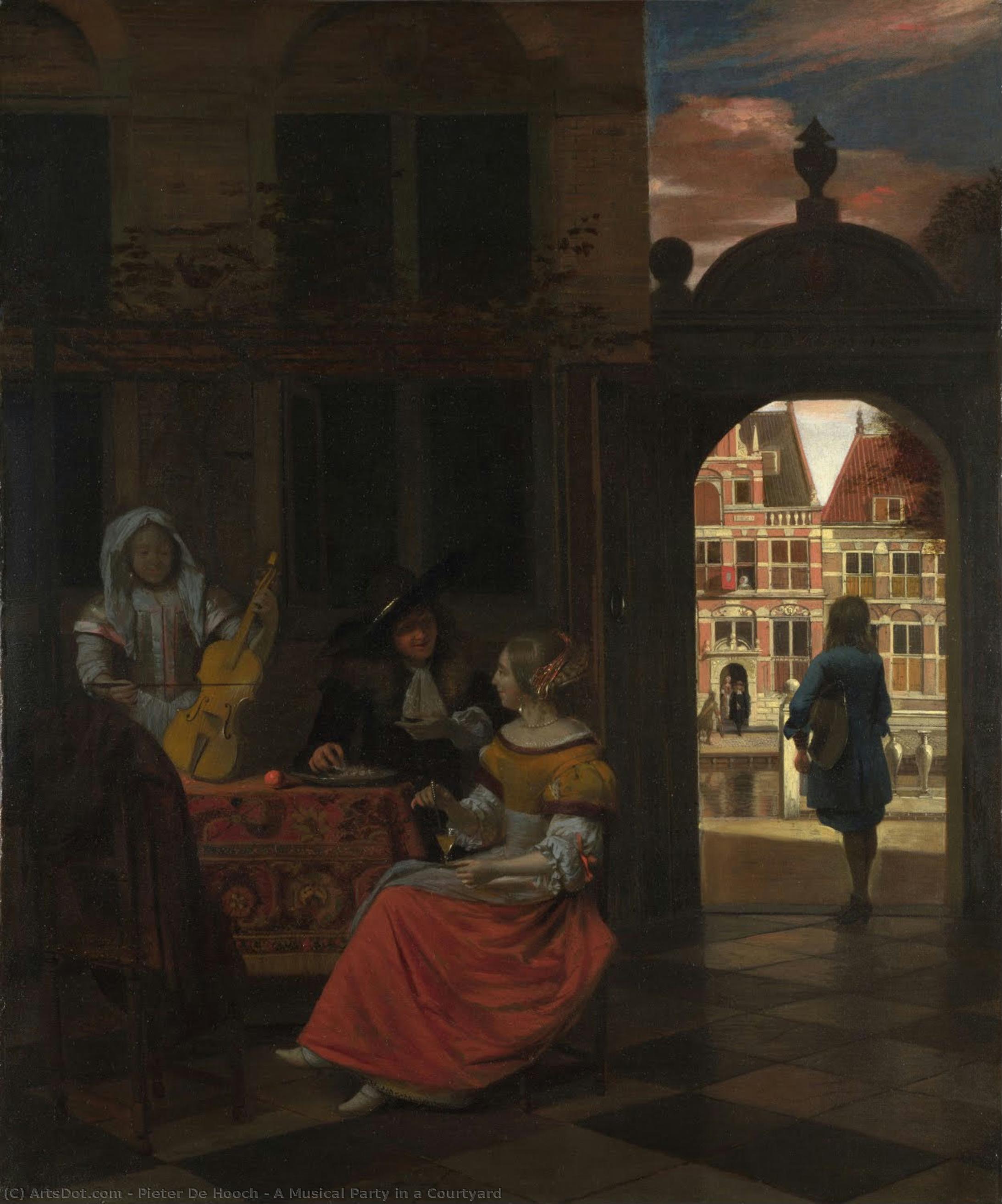
Experience Pieter de Hooch's masterful depiction of a lively musical party in a Dutch courtyard, circa 1677, showcasing the artist’s signature style and capturing the essence of the Golden Age. Discover this exquisite hand-painted reproduction and bring a touch of Amsterdam's charm into your home.
A Window into Amsterdam's Golden Age: Pieter de Hooch’s "A Musical Party in a Courtyard"
Pieter de Hooch’s “A Musical Party in a Courtyard,” painted in 1677, offers a remarkably intimate glimpse into the daily life of 17th-century Amsterdam. This captivating scene, rendered in meticulous detail and bathed in soft light, transcends mere representation; it's a poignant meditation on social interaction, leisure, and the burgeoning prosperity of the Dutch Republic. The painting’s subject – a group gathered for music within a private courtyard – was a common motif during this era, reflecting the growing importance of domesticity and refined entertainment amongst the city’s wealthy merchant class. De Hooch masterfully captures not just the visual elements but also the subtle nuances of human behavior, creating an atmosphere brimming with quiet conversation and gentle amusement.
A Masterclass in Dutch Genre Painting
- Style & Technique: “A Musical Party” exemplifies De Hooch’s signature style within the broader genre of Dutch Golden Age painting. His approach, heavily influenced by Nicolaes Berchem, prioritized a naturalistic depiction of everyday life, utilizing a restrained palette dominated by muted browns, creams, and subtle blues to create a sense of atmospheric depth. The artist's masterful use of light – particularly the diffused glow filtering through the doorway – is central to the painting’s charm, illuminating key figures and subtly shaping the viewer’s gaze.
- Composition: De Hooch employs a carefully constructed composition, drawing the eye through a series of interconnected elements. The open doorway acts as a visual portal, inviting the viewer into the scene while simultaneously creating a sense of distance and observation. The placement of figures – seated, standing, playing instruments – contributes to the painting’s dynamic flow.
Historical Context & Hendrick de Keyser's Influence
The painting’s creation coincides with a period of significant social and economic change in Amsterdam. The city was experiencing an unprecedented boom, fueled by trade and maritime expansion. This prosperity fostered a growing middle class eager to embrace the arts and cultivate refined tastes. Notably, the inclusion of the tablet bearing the date 1620 and referencing Hendrick de Keyser – a prominent Delft painter – subtly anchors the scene within the artistic landscape of the time. De Hooch’s work is considered a direct continuation of De Keyser's style, demonstrating his deep understanding of Delft’s artistic traditions and his ability to synthesize them with his own innovative approach.
Symbolism & Emotional Resonance
Beyond its technical brilliance, “A Musical Party” resonates with a profound sense of human connection. The figures are not grand heroes or historical personages; they are ordinary individuals engaged in a simple pleasure – the enjoyment of music and companionship. The woman seated on the bench, clutching her handbag, evokes a feeling of quiet contemplation, while the musician lost in his performance embodies the spirit of artistic expression. The painting’s overall mood is one of tranquility and warmth, inviting viewers to share in this intimate moment of social grace. It's a testament to De Hooch's ability to capture not just what he saw, but also the very essence of human experience.