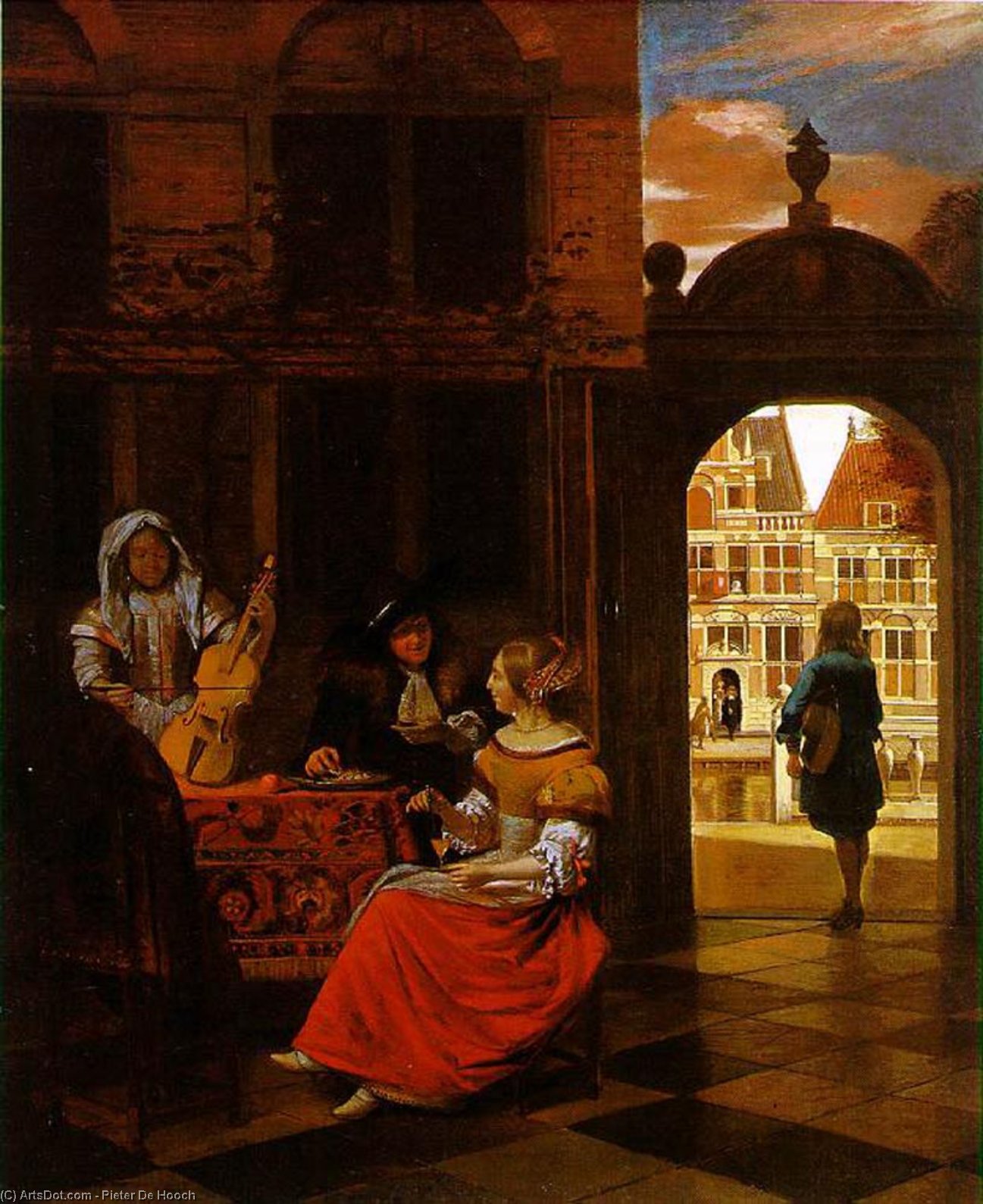
Experience Pieter de Hooch’s ‘Musical Party in a Courtyard,’ a serene Dutch Golden Age masterpiece capturing an intimate Rotterdam gathering with masterful light and detail. Discover this captivating window into 17th-century domestic life and own a piece of art history.
Pieter de Hooch (1629-1694) was a Dutch Golden Age painter known for his luminous depictions of domestic life, architectural interiors & tranquil courtyards. Explore his realistic style and influence on Impressionism.
Explore European art from the 13th-19th centuries at London's National Gallery! Discover masterpieces by Van Gogh, Rembrandt & more – free entry!
A Window into Dutch Domestic Life: Pieter de Hooch’s Musical Party in a Courtyard
Pieter de Hooch's “Musical Party in a Courtyard,” painted in 1677, stands as a quintessential example of the Dutch Golden Age’s fascination with capturing fleeting moments of everyday life. More than just a depiction of an afternoon gathering, this serene tableau offers a profound glimpse into the social and psychological landscape of seventeenth-century Rotterdam – a city brimming with burgeoning commerce and intellectual curiosity. The painting resides within ArtsDot’s extensive collection, providing art enthusiasts worldwide with access to exceptional reproductions that faithfully preserve the artist's masterful vision.
The Scene: Quiet Elegance Amidst Urban Activity
The composition itself is deceptively simple yet remarkably effective. De Hooch skillfully employs a shallow depth of field, concentrating attention on a courtyard bathed in diffused sunlight – a technique characteristic of his oeuvre and mirroring the prevailing artistic sensibilities of the time. Five figures occupy the space; a gentleman seated at a dining table engages in conversation with another man, while a woman leans against a chair, seemingly absorbed in contemplation. A violinist performs near the center, creating an audible counterpoint to the visual stillness. The inclusion of a bench and a clock subtly reinforces the notion of time passing – a recurring motif in De Hooch’s work, reflecting his preoccupation with capturing transient experiences.
Style and Technique: Vermeer's Influence and Atmospheric Impressionism
De Hooch’s style owes considerable debt to Johannes Vermeer, whose meticulous attention to detail and masterful use of light had revolutionized painting practice. However, unlike Vermeer’s idealized interiors, De Hooch prioritizes realism, striving to portray the subtle nuances of human behavior and the atmospheric conditions of a typical Rotterdam courtyard. He achieves this through painstaking brushwork – layering thin glazes of color to create luminous surfaces that convey an astonishing sense of depth and texture. The artist's masterful manipulation of chiaroscuro—the interplay between light and shadow—further enhances the painting’s dramatic impact, guiding the viewer’s gaze across the scene and imbuing it with a palpable emotional resonance.
Historical Context: Reflecting Enlightenment Values
“Musical Party in a Courtyard” emerged during the Dutch Republic's Golden Age – a period marked by unprecedented economic prosperity and intellectual ferment. The burgeoning middle class sought to express its aspirations through art, favoring scenes of domestic tranquility that conveyed values such as refinement, piety, and social harmony. De Hooch’s depiction aligns perfectly with these ideals, presenting an idealized vision of bourgeois life—a celebration of companionship and artistic appreciation. It speaks to a broader cultural preoccupation with observing and documenting the natural world and human experience, anticipating developments in Impressionism decades later.
Symbolic Resonance: Light, Music, and Domestic Tranquility
Beyond its visual beauty, “Musical Party in a Courtyard” carries symbolic weight. The courtyard itself represents a microcosm of urban life—a space where social interactions unfold amidst the backdrop of daily routines. Light – particularly diffused sunlight – symbolizes enlightenment and spiritual grace, mirroring the philosophical currents of the Enlightenment era. Music serves as an emblem of intellectual stimulation and emotional expression, highlighting the importance of artistic pursuits in shaping human understanding. Ultimately, De Hooch’s painting encapsulates a profound desire for serenity and contentment—a timeless message that continues to resonate with audiences today.