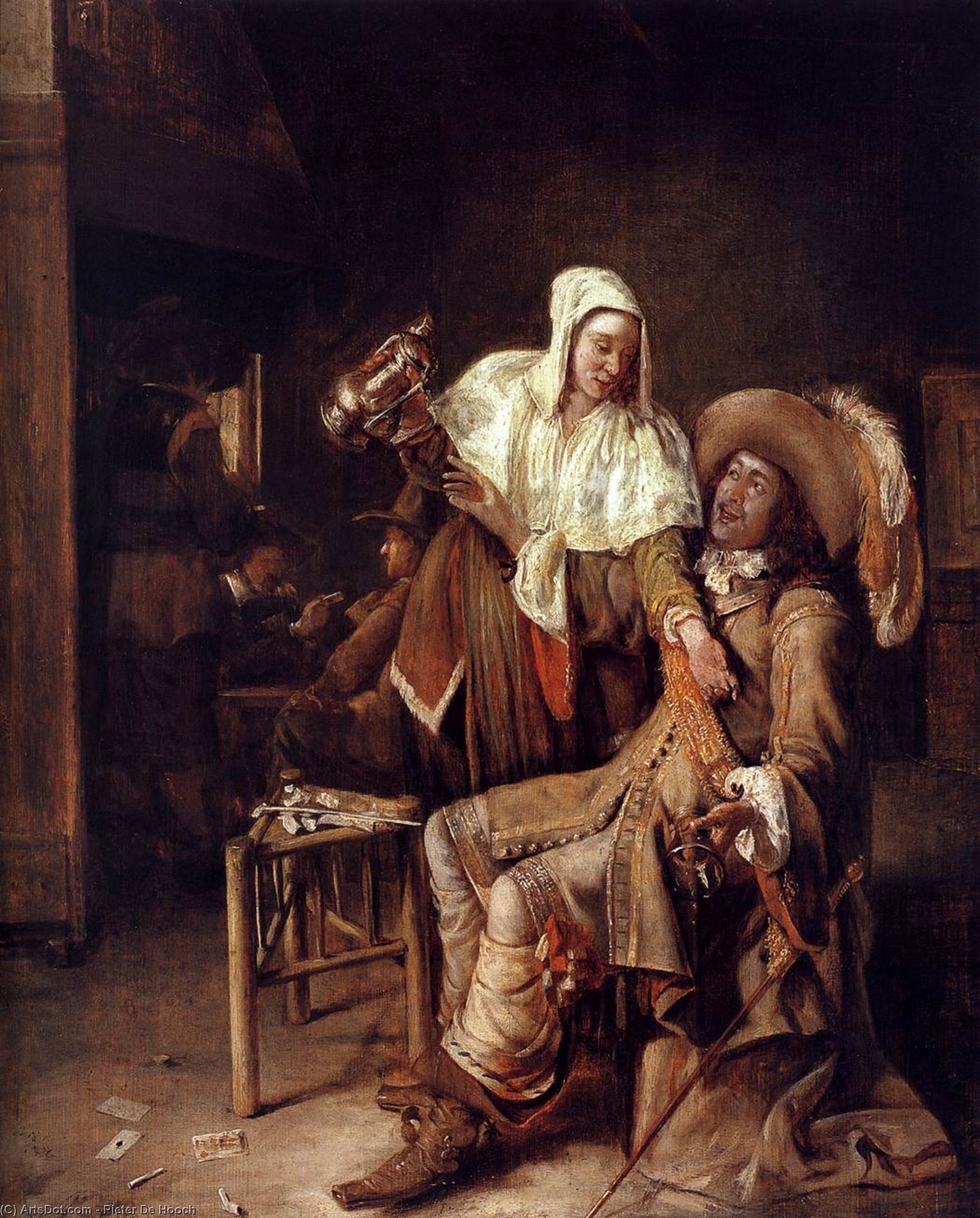
Pieter de Hooch’s "The Empty Glass," a captivating 1653 Dutch Golden Age genre painting, showcases intimate domestic life with diffused light and subtle psychological depth. Admire this masterful portrait of two figures and discover the beauty of everyday moments – own a piece of art history.
The Empty Glass by Pieter de Hooch
Pieter de Hooch’s “The Empty Glass,” painted in 1653, stands as a quintessential example of Dutch Golden Age genre painting—a captivating snapshot of domestic life imbued with subtle psychological depth. Located within the Museum Boijmans Van Beuningen in Rotterdam and meticulously documented by Cornelis Hofstede de Groot, this artwork offers a glimpse into the burgeoning middle class’s fascination with portraying everyday scenes with remarkable realism.
The painting depicts two figures—a man seated at a dining table and a woman standing beside him—engaged in conversation. A wine glass rests upon one of the chairs, accompanied by another cup on the tabletop, creating an atmosphere of relaxed conviviality. De Hooch’s masterful use of light – particularly diffused illumination filtering through a doorway – establishes a sense of intimacy and invites contemplation.
Stylistically, “The Empty Glass” aligns closely with the broader oeuvre of Hendrik Sorgh and Jan Steen, reflecting Haarlem’s artistic dominance during the period. De Hooch's palette leans heavily on browns and yellows, mirroring the earthy tones prevalent in interiors of the time. His technique is characterized by meticulous attention to detail—the folds of fabric, the textures of surfaces—demonstrating a commitment to capturing the nuances of human experience.
Beyond its aesthetic qualities, “The Empty Glass” carries symbolic resonance. The empty glass itself serves as a potent metaphor for potential, anticipation, and perhaps even unspoken desires. Scholars have noted parallels with Hafez’s poetry, where emptiness represents receptiveness and openness to divine grace—a theme that resonates powerfully within the painting's contemplative mood.
Furthermore, “The Empty Glass” exemplifies the humanist spirit of the era, prioritizing observation and portraying individuals as complex beings navigating social interactions. It remains a treasured piece within the Boijmans collection, continuing to inspire admiration for its artistic merit and its ability to convey profound emotional truths.